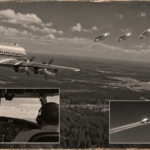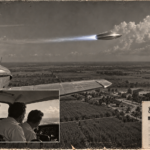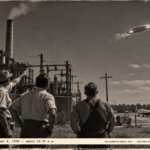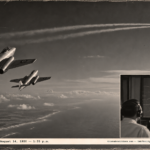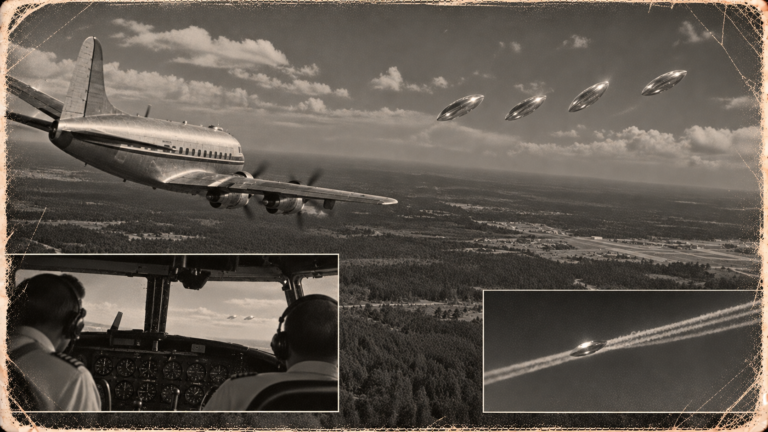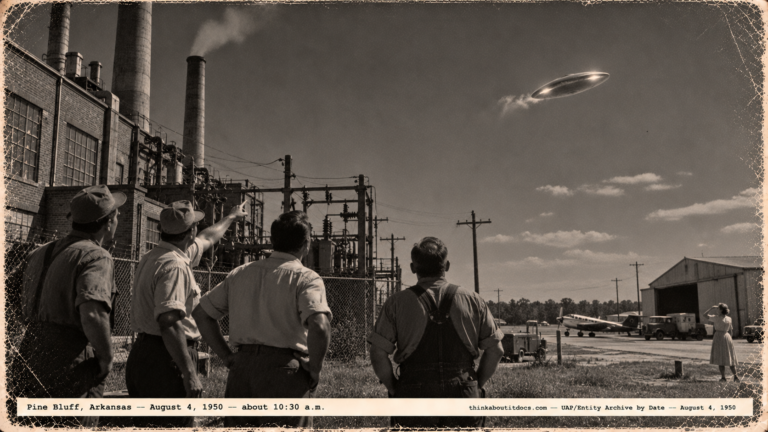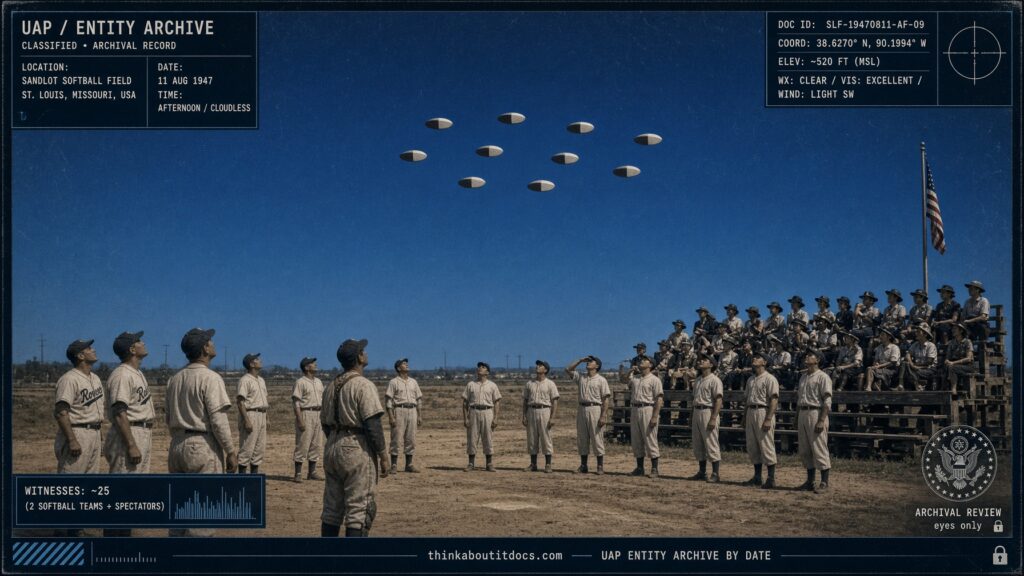
August 11, 1947 — St. Louis, Missouri. A softball game paused as roughly 25 witnesses, many aviation-trained, watched nine discs flip in unison at an estimated 25,000 feet and 1,000 mph.
THINK ABOUTIT UFO SIGHTINGS REPORT
1947: The St. Louis Softball Game — Nine Discs, Twenty-Five Witnesses
A softball game on the outskirts of St. Louis stopped mid-play when nine dark specks in the sky resolved into discs, flipping in perfect unison every two seconds as they crossed a cloudless afternoon sky at an estimated 1,000 miles an hour. Two full teams and a crowd of spectators watched together — and roughly half of those witnesses had aviation training. This is one of the largest, most professionally qualified witness groups of the entire 1947 wave.
Date: August 11, 1947
Sighting Time: Afternoon
Day/Night: Day, clear cloudless sky
Location: Outskirts of St. Louis, Missouri
Urban or Rural: Suburban/outskirts
No. of Entity(s): Not Applicable
Entity Type: Not Applicable
Entity Description: Not Applicable
Hynek Classification: DD — Daylight Disc. Multiple structured objects observed in clear daylight conditions at high altitude, with no landing or entity involved.
Duration: Not precisely specified; sustained enough for detailed group observation of the flipping motion pattern
No. of Object(s): 9
Description of the Object(s): Disc-shaped objects, dark on one side and light-colored on the other, flipping in unison approximately every two seconds — a motion that alternately displayed the dark and light faces to observers on the ground, appearing to the primary witness as roughly grape-sized held at arm’s length.
Shape of Object(s): Disc-shaped
Size of Object(s): Not directly estimated; apparent size roughly grape-sized at arm’s length from an estimated altitude of 25,000 feet
Color of Object(s): Dark on one side, light-colored on the other
Distance to Object(s): Estimated altitude approximately 25,000 feet
Height & Speed: Approximately 25,000 feet altitude, an estimated 1,000 mph
Number of Witnesses: Approximately 25 — two full softball teams (one composed entirely of aircraft ground instructors, the other of pilot and aircraft mechanic students) plus spectators
Special Features/Characteristics: The objects’ synchronized flipping motion, alternating dark and light faces every two seconds across all nine objects simultaneously, is a specific and unusual detail distinct from simple formation flying, suggesting either coordinated behavior or a shared physical characteristic (such as tumbling reflective discs) producing the same visual effect across the whole group; the witness pool’s aviation composition is exceptional — a primary witness who was a veteran commercial pilot and licensed A&E mechanic, one entire team of aircraft ground instructors, and the opposing team made up of pilot and aircraft mechanic students, meaning a substantial share of the roughly 25 observers had direct professional training in aircraft recognition and aerial observation.
Case Status: Unexplained
Source: Loren E. Gross, UFOs: A History — 1947
Related Cases: 1947: August UFO|UAP & Entity Sightings Archive
Detailed Report
On the afternoon of August 11, 1947, a softball game was underway on the outskirts of St. Louis, Missouri, between two teams with an unusually aviation-heavy roster: one team consisted entirely of aircraft ground instructors, and the other of pilot and aircraft mechanic students. Among the players and spectators was a veteran commercial pilot who had gone on to become an aircraft and engine (A&E) mechanic with aviation inspection authorization — a witness with substantial professional grounding in identifying conventional aircraft.
This witness first noticed dark specks growing in the sky, moving in a vertical V formation, with one object leading and the others stepped above and below it in trail. As the objects drew closer, they resolved into nine discs, approaching at an estimated altitude of 25,000 feet and a speed of roughly 1,000 mph, against a completely cloudless, cobalt-blue sky. The discs were dark on one side and light-colored on the other, and — most distinctively — flipped in unison every two seconds, a synchronized motion visible across all nine objects simultaneously. At arm’s length, the primary witness compared their apparent size to a grape.
Both softball teams and roughly 25 spectators stopped to watch the display. The witness pool’s composition is the case’s defining strength: a meaningful proportion of the roughly 25 people present had direct professional training in aircraft identification and aerial observation, either as working ground instructors or as students actively training for pilot or mechanic certification. This wasn’t a crowd of casual observers encountering something unfamiliar — it was, in significant part, an audience specifically trained to recognize conventional aircraft, watching something that didn’t match any of it.
RESEARCHER’S NOTES
A Crowd That Knew What It Was Looking At
- On why the witness composition matters more here than almost anywhere else in the archive: Most large-witness-count UFO cases involve crowds with no particular aviation background, which leaves open the standard skeptical question of whether untrained observers correctly judged altitude, speed, or the ordinariness of what they saw. This case removes much of that uncertainty by structural accident rather than investigative design — the two teams happened to be composed of aviation ground instructors on one side and pilot/mechanic students on the other, meaning a genuinely unusual proportion of the assembled crowd had professional-level training in exactly the skill set relevant to assessing this sighting.
- On the synchronized flipping detail: Nine objects flipping in unison, on a consistent two-second interval, is a specific enough behavioral detail that it resists easy dismissal as a loose or vague recollection. Whether this reflects coordinated flight behavior, a shared aerodynamic characteristic among tumbling reflective objects moving through the same air currents, or something else entirely, it is a consistent, repeated, cross-witness observation rather than an isolated impression from a single viewer.
- On the limits of the sourcing: The case is preserved through Loren Gross’s UFOs: A History — 1947, a respected compilation within the field, but this archive has not located an independent contemporaneous newspaper account or a named list of the roughly 25 witnesses beyond the primary pilot-mechanic. Confirming the case through a period St. Louis newspaper, if one exists, would meaningfully strengthen the documentary record beyond Gross’s compilation alone.
A ballgame paused, two teams of aviation-trained observers looked up together, and nine discs flipped in perfect unison across a clear St. Louis sky at speeds and altitudes no 1947 aircraft could match. It’s rare for this archive to find a crowd this large that was also this qualified to know exactly what it was seeing wasn’t ordinary. The game, presumably, continued once the objects were gone. The question they left behind did not.