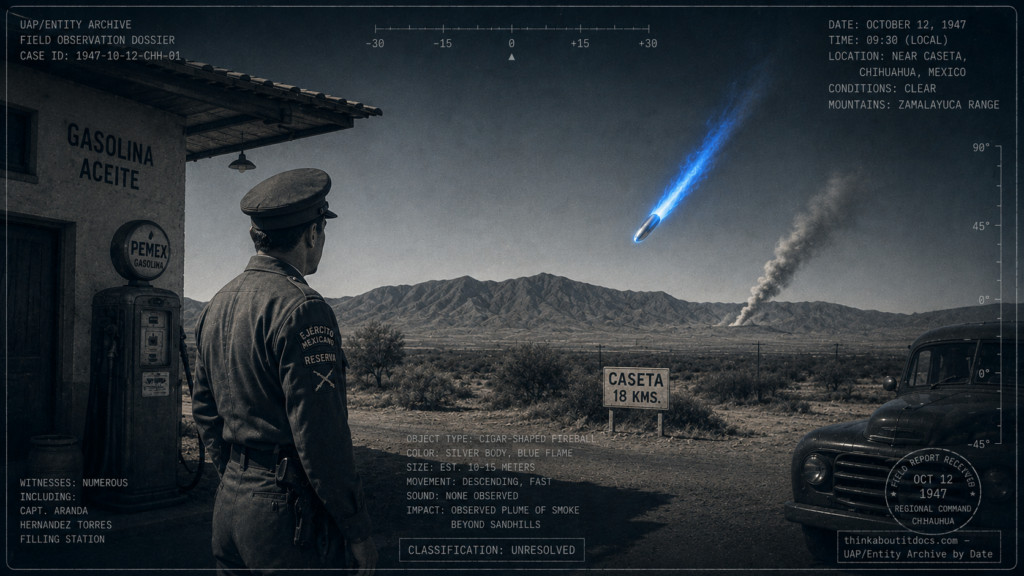
October 12, 1947 — Guadalupe, Chihuahua, Mexico. A blue-and-silver fireball, resembling an errant V-2 rocket, plunged toward the Zamalayuca Mountains in a billow of smoke — but no wreckage was ever recovered.
THINK ABOUTIT UFO SIGHTINGS REPORT
1947: The Guadalupe, Mexico Fireball
A blue-and-silver fireball tore across the Chihuahua sky like an errant V-2 rocket, watched by numerous witnesses including a Mexican Army reserve officer, before plunging toward the Zamalayuca Mountains in a billow of smoke and a loud explosion. Search teams went looking for a meteorite. They found nothing at all.
Date: October 12, 1947
Sighting Time: 09:30 CST
Day/Night: Day
Location: Guadalupe, Chihuahua, Mexico, with the object’s apparent impact point near the Zamalayuca Mountains
Urban or Rural: Rural — northern Mexican desert terrain
No. of Entity(s): Not Applicable
Entity Type: Not Applicable
Entity Description: Not Applicable
Hynek Classification: NL — Nocturnal Light equivalent for daytime (a fireball/falling object observed at distance with an apparent ground impact); no landing, physical trace, or entity confirmed.
Duration: Not precisely specified; visible across a substantial arc of sky given the described flight path and eventual disappearance over the sandhills
No. of Object(s): 1
Description of the Object(s): Cigar-shaped, blue-and-silver in color, trailing blue flame, resembling in flight profile an errant V-2 rocket rather than a natural meteor.
Shape of Object(s): Cigar-shaped
Size of Object(s): Not specified
Color of Object(s): Blue and silver, with a trailing blue flame
Distance to Object(s): Not specified; observed across a wide area including from the Hernandez Torres filling station near Caseta
Height & Speed: Descending flight path resembling an errant rocket rather than level flight; specific altitude and speed not numerically recorded
Number of Witnesses: Numerous, unnamed except for Mexican Army reserve Capt. Aranda, who watched from the Hernandez Torres filling station near Caseta
Special Features/Characteristics: The object’s flight path — heading east to west and plunging toward the Zamalayuca Mountains with a billow of smoke and a loud explosion — matched what witnesses described as resembling an errant V-2 rocket rather than a natural meteor entry; despite the described impact and explosion, no meteorites or other physical remains were recovered in the searches that followed, a notable absence given the apparent violence of the described impact; the case is documented with unusual thoroughness by ufologist Loren E. Gross, appearing across three separate publications rather than a single passing mention.
Case Status: Unexplained
Source: Brad Sparks; Loren E. Gross, UFOs: A History, Jul-Dec 1947, p. 38; UFOs: A History — 1947, pp. 69-71; Supplement, Aug-Dec 1947, pp. 44-45
Related Cases: 1947: October UFO|UAP & Entity Sightings Archive
Detailed Report
At 9:30 in the morning on October 12, 1947, numerous witnesses in and around Guadalupe, Chihuahua, in northern Mexico, watched an unusual object cross the sky. Described as cigar-shaped, colored blue and silver, and trailing blue flame, it traveled from east to west before beginning a descent that witnesses compared to an errant V-2 rocket rather than a natural meteor — a comparison notable given how recently V-2 technology had entered public awareness through its wartime use and the postwar rocket-testing programs both the United States and, per contemporary rumor, the Soviet Union were believed to be conducting.
Mexican Army reserve Captain Aranda observed the object from the Hernandez Torres filling station near Caseta, watching it disappear over the sandhills near Colonia Reforma. The object’s apparent flight path suggested it was heading toward impact in the Zamalayuca Mountains, and witnesses reported a billow of smoke and a loud explosion consistent with a ground impact at that location.
Despite the apparent violence of the impact — smoke, a loud explosion, a described crash trajectory — subsequent searches of the area found no meteorites or other physical remains whatsoever. This absence is a significant detail: a genuine meteor impact violent enough to produce a visible explosion and smoke would typically be expected to leave some recoverable fragment or impact crater, and the complete absence of any physical trace complicates a simple meteor explanation without providing a clear alternative.
The case is unusually well documented for its era and location, appearing across three separate publications by ufologist Loren E. Gross — UFOs: A History (Jul-Dec 1947), a further UFOs: A History volume specifically covering 1947, and a dedicated supplement covering August-December 1947 — indicating sustained research interest in the case rather than a single passing citation.
RESEARCHER’S NOTES
An Explosion Without Wreckage
- On why the missing debris matters: A cigar-shaped object trailing flame, descending toward an apparent impact with a visible smoke plume and audible explosion, is a description that fits several conventional explanations reasonably well on its face — a large meteor (bolide), a piece of falling space debris, or, given the era’s genuine anxiety about postwar rocket testing, an actual errant test rocket of terrestrial origin. What complicates all three explanations equally is the same detail: no physical trace was ever recovered despite a search specifically undertaken to find one. Bolides that produce visible ground-level effects (smoke, sound) at the described intensity typically leave recoverable fragments; an actual rocket test gone wrong would typically leave substantial debris. The absence cuts against every mundane explanation almost equally.
- On the named military witness: Capt. Aranda’s status as a Mexican Army reserve officer, observing from a specific, named location (the Hernandez Torres filling station near Caseta), gives this account a level of specific, checkable detail uncommon among the numerous other unnamed witnesses referenced in the case. His military background also provides some baseline credibility regarding his ability to distinguish an unusual aerial event from routine air traffic or ordinary atmospheric phenomena.
- On the sourcing depth: Loren Gross’s decision to document this case across three separate publications, rather than a single brief mention, suggests he considered it a case worth returning to and cross-referencing carefully — a pattern consistent with cases that have some documentary substance behind them, as opposed to thinly sourced rumors that tend to appear once and then vanish from the literature.
A rocket-like fireball, a mountain range, an explosion loud enough for numerous witnesses across a wide area to hear and see — and then nothing. No crater confirmed in detail, no metal, no stone, nothing a search party could carry back as proof of what had fallen from the sky over northern Mexico that October morning. Whatever it was, it left behind only the accounts of the people who watched it go.