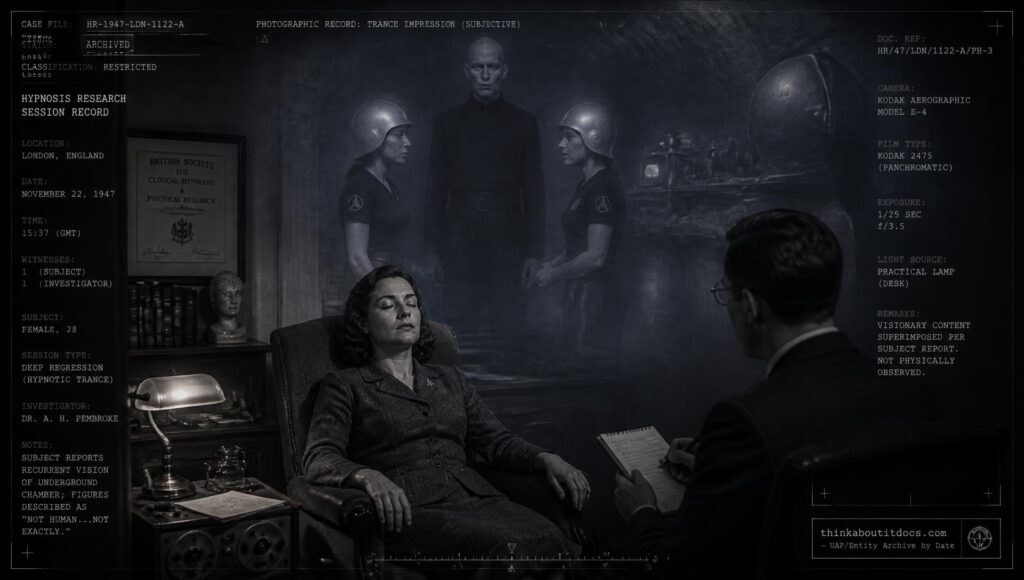
November 22, 1947 — London, England. A hypnosis subject described an underground encounter with silver-helmeted beings and a branded mark on her leg — abduction motifs that predate the genre's popular recognition by over a decade.
THINK ABOUTIT UFO|UAP ENTITY ENCOUNTER REPORT
1947: The London Hypnosis Case
A Mark That Predates Its Own Genre
Fourteen years before Betty and Barney Hill made “alien abduction” a phrase the world would recognize, a woman in a London hypnosis session described being seized by silver-helmeted beings in an underground chamber, searched for a mark they couldn’t find, and branded with a symbol using a gun-like device. When she came out of the trance, researchers said the mark was still there. This case doesn’t fit neatly anywhere in the timeline ufology usually tells about itself — and that’s exactly why it deserves careful, honest documentation rather than either dismissal or overstatement.
Date: November 22, 1947
Sighting Time: Afternoon
Day/Night: Day (session conducted indoors)
Location: London, England — the physical site of a hypnosis experiment; the events described occurred within the witness’s trance experience, at a location she could not identify in ordinary geographic terms
Urban or Rural: Urban (session location); the trance-described location was underground/subterranean
No. of Entity(s): 3 described directly — two women and one man — with additional unspecified “operators” whose machinery sounds were heard but who were not directly seen
Entity Type: Humanoid
Entity Description: Two women, wearing silvery helmets and black shirts; one man, tall, nearly bald, who spoke to and threatened the witness and administered the branding. None of the beings spoke English, yet the witness reported understanding them regardless — an unexplained comprehension the account does not attribute to any specific mechanism (telepathy is implied but not explicitly named in the surviving summary).
Hynek Classification: CE-IV (Close Encounter of the Fourth Kind) — an abduction/onboard-or-enclosed-space account involving direct physical interaction with entities and a reported physical after-effect (the branding mark). This classification is applied to the content of the trance account itself; this report does not thereby assert the account describes a literal physical event.
Duration: Not specified within the trance narrative itself; the hypnosis session’s real-world duration is not recorded in the available source
No. of Object(s): Not Applicable — no craft was described; the narrative involves travel to a “place with a cloudy atmosphere” and then through a doorway into an underground location, with no vehicle or craft mentioned
Description of the Object(s): Not Applicable
Number of Witnesses: 1 (the trance subject); the hypnotist/investigator (N.S.W. Chibbett) was present and documented the session but did not himself experience the described events
Special Features/Characteristics: The witness reported traveling at great speed to a location with a cloudy atmosphere before passing through a doorway into an underground setting containing machinery and the sounds of unseen operators; she was seized and overpowered by the two women and brought before the man; a search of her shoulder for an existing “mark” is described, implying either a prior expectation on the beings’ part or a returning-contact narrative element; failing to find the mark, the man used a gun-like device to burn the characters “H6AQ” onto her leg; he reportedly laughed while causing her pain and then issued a threat; the beings communicated with her despite not speaking English; the branding mark was reported to remain visible on her leg after she emerged from the trance, which — if accurately reported — would constitute an extraordinary physical corroboration of a hypnotically-recovered narrative, though this archive has not located independent verification (a photograph, a medical examination, or third-party confirmation) of the mark’s existence beyond the investigator’s own account.
Case Status: Insufficient Data
Source: N.S.W. Chibbett, Flying Saucer Review, Special Issue No. 3
Related Cases: 1947: November UFO|UAP & Entity Sightings Archive
Detailed Report
On November 22, 1947, a hypnosis experiment conducted in London produced an account that, examined against the later history of UFO abduction literature, reads as strikingly ahead of its time. Under hypnosis, the subject reported entering a trance-like state and experiencing a sensation of traveling at great speed toward a place with a cloudy atmosphere. From there, she described passing through a doorway into an underground location, filled with machinery and the audible sounds of unseen operators at work.
Within this setting, two women — described as wearing silvery helmets and black shirts — seized and overpowered her, bringing her before a tall, nearly bald man. She reported blacking out at some point during this sequence, then regaining awareness to find her shoulder had been exposed while the beings searched it for a mark. When they failed to find whatever they were looking for, the man produced a gun-like device and used it to burn a set of characters — “H6AQ” — onto her leg, laughing as the process caused her pain, before issuing a threat and, presumably, releasing her back to ordinary consciousness. Throughout the encounter, none of the beings spoke English, yet the witness reported that she nonetheless understood their communications.
The account’s most striking claim is its conclusion: according to investigator N.S.W. Chibbett, writing in Flying Saucer Review’s third special issue, the branded characters were still visible on the witness’s leg when she emerged from the trance. If accurately reported and independently verifiable, a physical mark corresponding directly to a hypnotically-recovered narrative detail would represent an unusually strong form of corroborating evidence — bridging the gap between subjective trance testimony and objective physical reality. This archive has not been able to locate any further documentation of the mark itself (photographic evidence, medical examination records, or third-party witness confirmation) beyond Chibbett’s own published account.
RESEARCHER’S NOTES
A Case That Shouldn’t Exist Yet, But Does
- On why this case’s date is its most significant feature: The specific combination of elements in this account — underground abduction by humanoid beings, telepathic-style communication despite a language barrier, a physical search of the body, and a branding/marking event with a claimed lasting physical trace — did not become recognized as a coherent genre pattern in ufological literature until Betty and Barney Hill’s case entered public awareness in the early-to-mid 1960s, and would not be fully codified as “the abduction narrative” for decades after that. Finding this full cluster of motifs already present in a documented 1947 case, fourteen-plus years before the genre’s popularly recognized starting point, is genuinely unusual and worth taking seriously as a historical data point, independent of any judgment about what actually happened to the witness.
- On why hypnotic origin requires particular caution here, as elsewhere: As with this archive’s treatment of the 1946 Flagstaff, Arizona case, a hypnotically-recovered account carries the same well-documented risk of confabulation that affects all hypnosis-derived testimony, regardless of when it was recorded. This archive does not have access to the hypnotist’s specific methodology, the exact questions posed during the session, or any pre-hypnosis baseline account from the witness, all of which would be necessary to assess how much of the narrative reflects a spontaneous experience versus material shaped by the hypnotic process itself.
- On the claimed physical mark, and why it’s treated with particular skepticism despite its evidentiary potential: A verified physical mark corresponding to a hypnotic narrative detail would be a genuinely significant piece of evidence — but “verified” is doing essential work in that sentence, and this archive has found no verification beyond the investigating researcher’s own written account. Skin marks, scratches, or minor blemishes that predate a hypnosis session are commonly and unconsciously incorporated into trance narratives as confirming detail; without contemporaneous photography or a documented pre-existing absence of any mark, the claim cannot be assessed independently.
- On the sourcing itself: N.S.W. Chibbett’s account appears in a special issue of Flying Saucer Review, a recognized specialist publication within British ufology, lending it more institutional standing than an anonymous or undated claim would carry. That said, this archive has not located independent corroboration of the case from any second researcher or publication, and the case appears to rest on a single investigator’s single published write-up.
Whatever actually happened in that London hypnosis session in November 1947, the account it produced reads like it belongs to a much later chapter of ufological history — one that, as far as the historical record shows, hadn’t been written yet. That’s either a remarkable coincidence, an early and unusually specific instance of a genuinely recurring phenomenon, or a demonstration that the human imagination was fully capable of generating “abduction” imagery years before popular culture gave it a shared vocabulary. This archive documents the case honestly, without pretending to know which.