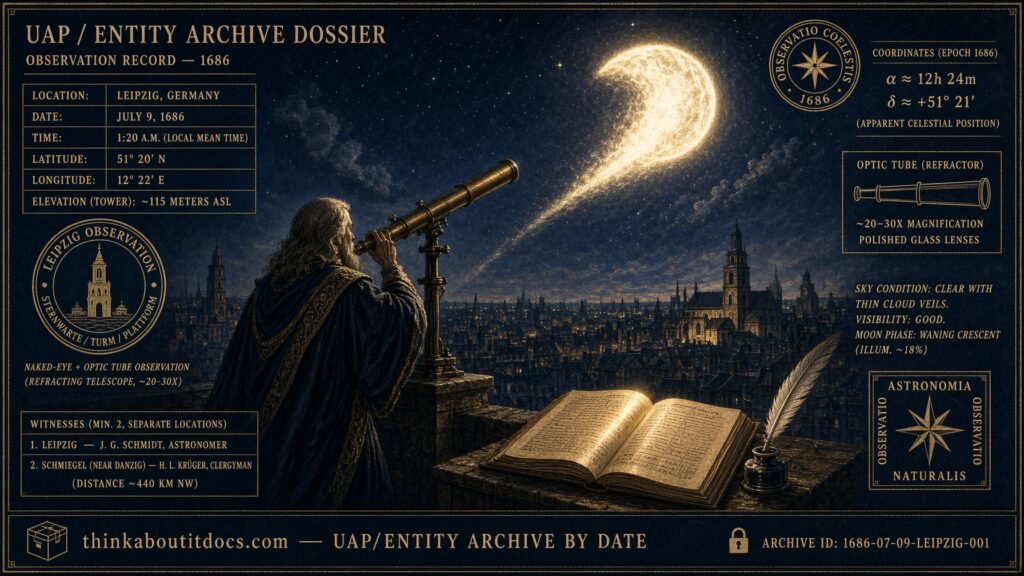
Bright enough to read by — Gottfried Kirch's object over Leipzig, July 1686
THINK ABOUTIT UFO|UAP SIGHTINGS REPORT
1686: The Gottfried Kirch Object | Leipzig, Germany
A working astronomer, “perfectly well instructed in astronomical matters,” watches an object half the apparent size of the moon hang motionless above Leipzig for a full fifteen minutes, bright enough to read by — then measures its position precisely enough that a second, independent observer sixteen German miles away, comparing notes afterward, allowed later analysts to calculate its altitude at over thirty English miles.
Date: July 9, 1686
Sighting Time: 1:20 a.m.
Day/Night: Night
Location: Leipzig, Germany, with a corroborating observation from Schmiegel, near Danzig (Gdańsk)
Urban or Rural: Urban — observed from within the city by a professional astronomer
No. of Entity(‘s): Not Applicable
Entity Type: Not Applicable
Entity Description: Not Applicable
Hynek Classification: NL (Nocturnal Light)
Duration: Approximately fifteen minutes (“a semi-quadrant of an hour”) of near-stationary visibility
No. of Object(s): One
Description of the Object(s): A brilliant fireball-like object with a trailing tail, remaining largely fixed in position for an extended period before darting obliquely and leaving behind two smaller nodes or globules, visible only through an optical instrument
Shape of Object(s): Fireball with a tail; later resolving into two smaller globules
Size of Object(s): Apparent diameter equal to half the diameter of the moon
Color of Object(s): Bright enough to read by; specific color not otherwise recorded
Distance to Object(s): Calculated at not less than sixteen German miles from Leipzig in a direct line, based on cross-referencing with the Schmiegel observation
Height & Speed: Calculated altitude of at least thirty English miles (roughly 6.5 German miles perpendicular); largely stationary in apparent position for most of the fifteen-minute observation before a final oblique dart
Number of Witnesses: At least two independent observers at separate locations — Gottfried Kirch at Leipzig and an unnamed observer at Schmiegel, near Danzig
Special Features/Characteristics: The object’s brightness was sufficient for the witness to read by it directly; cross-location triangulation between the two observation points allowed a documented altitude calculation of over thirty English miles — an extraordinary height for the period’s understanding of atmospheric phenomena; the object left behind two smaller “globules or nodes” visible only through an optic tube (telescope)
Case Status: Insufficient Data
Source: Gottfried Kirch, Ephemerides (appendix to the ephemeris for the year 1688); quoted by Rev. Edward Polehampton in The Gallery of Nature and Art, or a Tour through Creation and Science (1815)
Summary/Description: About 1:20 a.m., a brilliant object half the apparent diameter of the moon was observed hovering for a full fifteen minutes. The observer, “the late Mr. Gottfried Kirch, for many years a diligent observer of the heavens, perfectly well instructed in astronomical matters,” recorded it as “a fire ball with a tail,” positioned in the constellation Aquarius. “At first, the light was so great that we could see to read by it; after which, it gradually vanished in its place.” The phenomenon was observed simultaneously at Schmiegel, a town roughly eleven German miles south of Danzig, at an altitude of about 6 degrees above the southern horizon there — allowing calculation that the object was no less than sixteen German miles from Leipzig in a direct line and at least 6.5 German miles (over thirty English miles) in perpendicular altitude. Kirch noted the object was not entirely fixed for its full duration; his own accompanying figure shows it “darted obliquely to the right-hand,” leaving behind two smaller globules or nodes visible only through a telescope.
Related Cases: 1676: Geminiano Montanari’s vast body, reported to Edmond Halley
Detailed Report
Gottfried Kirch (1639–1710) was a genuine, historically significant German astronomer, later appointed the first Royal Astronomer of the Berlin Academy of Sciences and credited with discovering the Great Comet of 1680 — the first comet discovered by telescope. His observational credentials were substantial and independently verifiable, and his description of this July 1686 object was recorded in his own published astronomical ephemeris, the standard professional publication format for recording celestial observations of the period, rather than in a popular pamphlet or secondhand chronicle.
What distinguishes this account from a simple bright-meteor report is the cross-location corroboration Kirch himself documents: a second, independent observation from Schmiegel, near Danzig, allowed a calculated distance and altitude for the object using basic triangulation — a genuinely scientific approach to an anomalous aerial observation, undertaken by a professional astronomer using the standard tools of his discipline. The resulting altitude estimate, over thirty English miles, would place the object well into the upper atmosphere by later scientific understanding — a height difficult to reconcile with the object’s described fifteen-minute near-stationary visibility and extreme brightness, since ordinary meteors are visible for mere seconds and are not stationary. Kirch’s own note that the object was not perfectly fixed, but “darted obliquely” before leaving two secondary nodes visible only telescopically, adds a further behavioral complexity not well explained by a single natural meteoric or cometary phenomenon.
RESEARCHER’S NOTES
The Kirch Object — Leipzig 1686 and a Professional Astronomer’s Triangulated Altitude
- Source chain assessment: Gottfried Kirch is among the most credentialed and independently verifiable observers in this entire archive — a professional, historically documented astronomer who later became the first Royal Astronomer of the Berlin Academy of Sciences, recording this observation in his own published scientific ephemeris rather than in a popular account.
- Physical evidence / evidentiary weight: The account includes a genuine cross-location triangulation calculation — an independent second observation from Schmiegel used to estimate the object’s distance and altitude — a level of methodological rigor rare even among this archive’s better-documented astronomical entries.
- Classification issues / corrections: The combination of extreme brightness, an extended fifteen-minute near-stationary duration, and a calculated altitude of over thirty miles is difficult to reconcile with a standard meteor or fireball, which are typically visible for only seconds; this discrepancy is the primary reason the case is classified Insufficient Data rather than Explained.
- Pattern context / comparative cases: This sighting belongs to a broader cluster of credentialed astronomical observations in the late 17th-century archive, alongside Cassini’s Venus satellite observations and Geminiano Montanari’s calculated 9,600 mph object reported to Edmond Halley — together forming an unusually scientifically documented layer of the pre-modern UAP record.
The Kirch object stands among the most methodologically rigorous entries in the entire pre-modern archive — not a passing impression but a triangulated, altitude-calculated observation by a working professional astronomer whose credentials are independently verifiable, describing behavior that does not comfortably fit the standard astronomical phenomena of his own discipline.
“At first, the light was so great that we could see to read by it; after which, it gradually vanished in its place.”