Two weeks of unkillable visitors — Cape Ann, Massachusetts, 1692
THINK ABOUTIT ENTITY ENCOUNTER REPORT
1692: The Cape Ann Strangers | Ebenezer Babson’s Encounters, Massachusetts
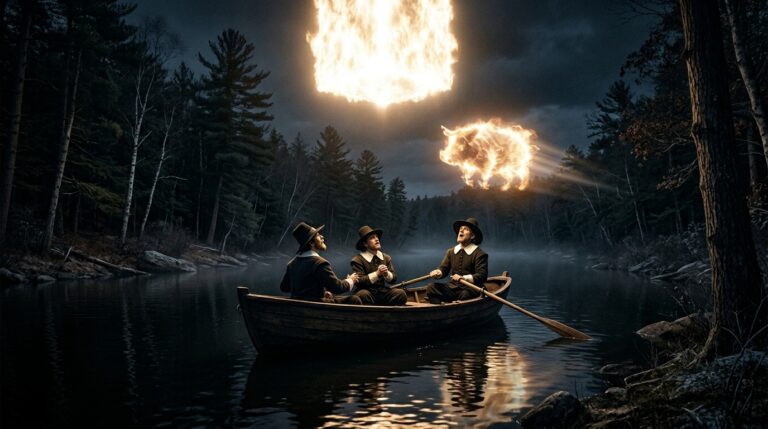
Over two weeks, Ebenezer Babson and the garrison at Cape Ann repeatedly encountered a group of unidentified strangers who survived point-blank gunfire without apparent injury, vanished from spots they were seen falling in, and were once watched — eleven strong — performing what onlookers described as strange incantations, before disappearing entirely and never being seen again.
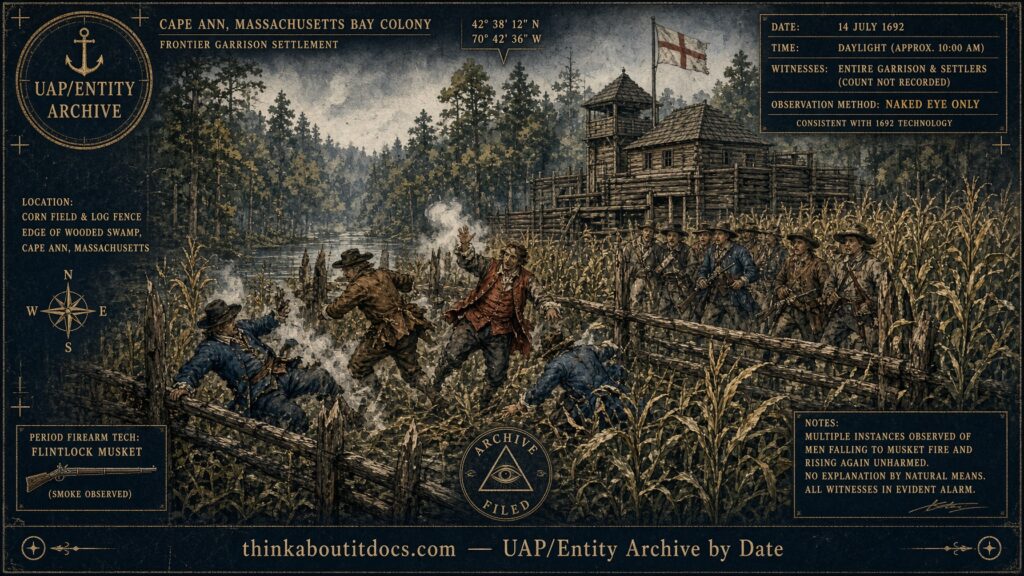
Date: Summer 1692 (a sustained sequence of encounters over one to two weeks, culminating July 14)
Sighting Time: Multiple encounters, both night and day, over the encounter period
Day/Night: Both — the initial encounter was at night, later mass sightings occurred in daylight
Location: Cape Ann, Massachusetts
Urban or Rural: Rural colonial frontier settlement
No. of Entity(‘s): Varied across encounters — initially two, later up to eleven observed together
Entity Type: Humanoid “strangers,” suspected by contemporaries to be French-Canadian scouts allied with hostile Native forces, though this attribution was never confirmed
Entity Description: Described as men in the general human form; notable for surviving direct gunfire without apparent physical injury and for their capacity to vanish from locations they had just been seen falling in
Hynek Classification: Not Applicable — no craft described; classified as a sustained CE-II/CE-III-type entity encounter sequence outside the standard Hynek scale
Duration: Approximately one to two weeks of recurring encounters
No. of Object(s): Not Applicable
Description of the Object(s): Not Applicable
Shape of Object(s): Not Applicable
Size of Object(s): Not Applicable
Color of Object(s): Not Applicable
Distance to Object(s): Close range, including direct pursuit and gunshot-range engagement
Height & Speed: Not recorded — the strangers moved on foot and by concealment (behind logs, into swampland)
Number of Witnesses: Multiple — Ebenezer Babson individually, his family, an entire garrison of soldiers, and scouts Richard Dolliver among others
Special Features/Characteristics: Three men shot by Babson’s pursuit party fell to the ground and then rose again with no apparent signs of injury; one man shot by Babson directly dropped, but when the group rushed to the spot, no one was there; the strangers were also accused of beating on barns and throwing stones during the encounter period, and were observed by two garrison scouts performing what looked like ritual incantations shortly before the sightings ceased entirely
Case Status: Unexplained
Source: Jerome Clark, Unexplained!
Summary/Description: Ebenezer Babson was returning home late one night when he saw two men step out of his house and dash into a cornfield. Checking on his family, he found them unaware of any intruders. Armed, he went outside and spotted the two men bolting up from behind a log; as they escaped toward a swamp, one was overheard telling the other, “The man of the house is now come; else we might have taken the house.” The family retreated to a nearby garrison, and over the following one to two weeks Babson and others had repeated encounters with the strangers, suspected by the garrison to be French-Canadian scouts allied with hostile Native forces. On July 14, the entire garrison watched half a dozen of the strangers; a pursuit party led by Babson got within gunshot range, and three men who were shot fell to the ground before rising again with no apparent injury. One who turned to fire back narrowly missed Babson, the bullet lodging in a tree from which the shooter later retrieved it. Shortly after, the garrison group trapped one stranger; Babson shot him and the man dropped, but when the party rushed to the spot, no one was there. Days later, two garrison scouts observed eleven of the strange men performing what looked like ritual incantations; scout Richard Dolliver fired on them, scattering the group. The strangers were also blamed for beating on barns and throwing stones during this period. In one of the final sightings, Babson ambushed three strangers from behind a bush, but his gun misfired; the strangers gave him a disdainful glance and walked on. They were never seen again after that.
Related Cases: Not Applicable
Detailed Report
The Cape Ann encounters are preserved through Jerome Clark’s modern compilation Unexplained!, a secondary source, though the events themselves are well established within regional New England colonial folklore and occurred during a documented period of genuine military and settler anxiety regarding French-Canadian and allied Native raiding parties along the Massachusetts frontier — 1692 fell within the period of King William’s War (1689–1697), when such fears were grounded in real, ongoing conflict rather than pure invention.
What distinguishes this account from a straightforward wartime scouting-party narrative is the specific, repeated detail of apparent physical invulnerability and disappearance: multiple men shot at close range, some directly by name (Babson’s own account of one man dropping under fire and then being found absent when the party reached the spot), consistently survived or vanished rather than being captured, killed, or leaving bodies or blood trails behind — outcomes that would be expected from an engagement with conventional human combatants under 17th-century firearms. The contemporary garrison’s own explanation (French-Canadian scouts) was a reasonable period hypothesis given the wartime context, but the account as preserved does not describe any conventional resolution — no bodies recovered, no captures made, no scouts ever identified or apprehended despite a sustained one-to-two-week engagement involving an entire garrison.
RESEARCHER’S NOTES
The Cape Ann Strangers — Massachusetts 1692 and Two Weeks of Unkillable Visitors
- Source chain assessment: The account reaches modern readers through Jerome Clark’s compilation, a secondary source; the underlying colonial New England folklore tradition is well established regionally, but no single contemporary 1692-era primary document has been cited or independently verified in the surviving summary.
- Geographic or historical context: The encounters occurred during King William’s War (1689–1697), a period of genuine, active conflict between English colonists and French-Canadian/allied Native forces in New England — a context that both explains the garrison’s mundane hypothesis and complicates any simple dismissal of the account as pure invention, since real wartime tension was the backdrop against which these specific, repeated, and physically anomalous encounters were recorded.
- Classification issues / corrections: The contemporary “French-Canadian scout” explanation does not account for the repeated invulnerability-to-gunfire and disappearance-after-being-shot details, which are the account’s most analytically significant and least explicable elements; this archive presents both the mundane period hypothesis and the unresolved physical anomalies without adjudicating between them.
- Pattern context / comparative cases: The eleven-figure group performing “peculiar incantations” shortly before the encounters ceased permanently is a distinctive narrative element without a close parallel elsewhere in this archive’s 17th-century North American record, and stands out for its ritual framing within an otherwise military/wartime encounter narrative.
The Cape Ann strangers of 1692 present one of colonial New England’s most sustained and strangest entity-encounter sequences — a two-week engagement involving an entire garrison, repeated direct gunfire, and consistent physical anomaly, ending as abruptly and unresolvedly as it began, with no bodies, no captures, and no strangers ever seen again.
“The man of the house is now come; else we might have taken the house.”