"Much slower than a meteor" — Edmond Halley's Oxford object, March 1719
THINK ABOUTIT UFO|UAP SIGHTINGS REPORT
Edmond Halley’s 1719 Oxford Sighting | Submitted to the Royal Society
A bright, whitish-blue object crosses England from the west in a straight line, moving so slowly that the Vice-President of the Royal Society himself times it crossing twenty degrees of sky in under half a minute — far too slow for any meteor. The man who formally wrote it up for the Philosophical Transactions was Sir Edmond Halley, already the most credentialed astronomer in Britain, submitting an anomalous aerial phenomenon to the same institutional journal where he published his cometary orbit calculations.
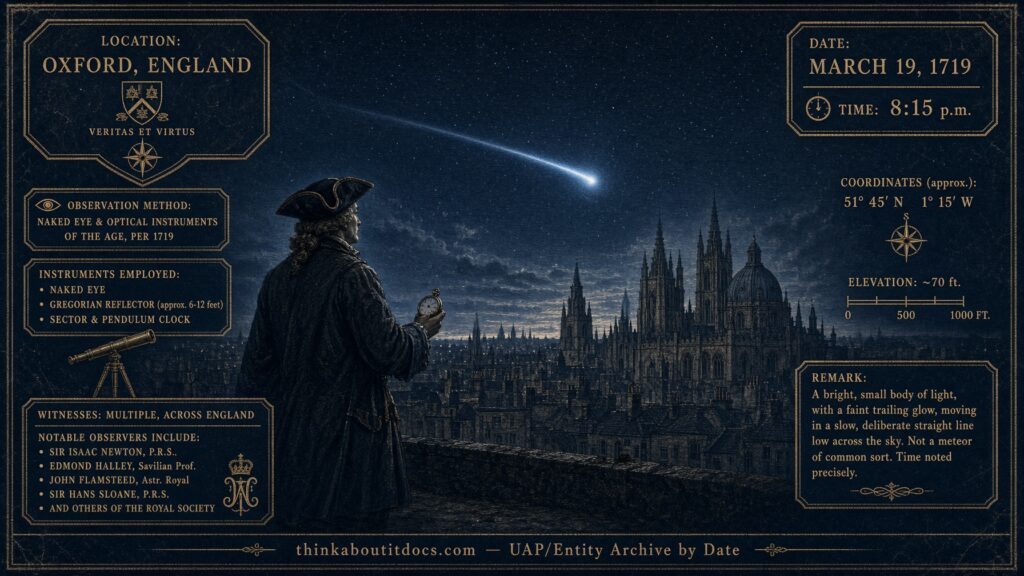
Date: March 19, 1719
Sighting Time: 8:15 p.m.
Day/Night: Night
Location: Oxford, England, with corroborating sightings reported from multiple locations across England
Urban or Rural: Urban — observed simultaneously across multiple English cities and towns
No. of Entity(‘s): Not Applicable
Entity Type: Not Applicable
Entity Description: Not Applicable
Hynek Classification: NL (Nocturnal Light)
Duration: At least half a minute for the twenty-degree transit measured by Sir Hans Sloane; total visible duration across all reports not separately aggregated
No. of Object(s): One
Description of the Object(s): A very bright, whitish and blue-tinged object moving from the west in a straight line, at a speed substantially slower than a typical meteor
Shape of Object(s): Not specifically described beyond a bright point/body of light
Size of Object(s): Not recorded in specific measurement
Color of Object(s): Whitish and blue
Distance to Object(s): Not recorded
Height & Speed: Traveled over 20 degrees of arc in less than half a minute per Sir Hans Sloane’s direct timing — described by Halley as “much slower than a meteor”
Number of Witnesses: Multiple witnesses across England, explicitly including Sir Hans Sloane, Vice-President of the Royal Society and physicist
Special Features/Characteristics: Formally documented in a peer-reviewed institutional scientific journal by one of the most credentialed astronomers in British history; independently corroborated by a second Royal Society officer; classified by Halley as a meteor in the paper’s title despite his own account noting its anomalously slow speed
Case Status: Insufficient Data
Source: Sir Edmund Halley, “An Account of the Extraordinary Meteor Seen All Over England,” Philosophical Transactions of the Royal Society of London 30 (1720): 978–990
Summary/Description: At 8:15 p.m. on March 19, 1719, a very bright, whitish and blue-tinged object was observed moving from the west in a straight line across the sky, at a speed substantially slower than a typical meteor. The object was seen by multiple witnesses across England, including Sir Hans Sloane, Vice-President of the Royal Society and physicist, who personally timed the object traveling over 20 degrees of arc in less than half a minute. Sir Edmond Halley, second Astronomer Royal and the astronomer for whom Halley’s Comet is named, formally documented the event in a paper submitted to the Royal Society’s Philosophical Transactions, titling it an account of an “extraordinary meteor” despite noting its curiously slow speed compared to ordinary meteoric phenomena.
Related Cases: Not Applicable
Detailed Report
Edmond Halley (1656–1742) is among the most historically significant and independently verifiable figures in the entire history of astronomy — second Astronomer Royal of Britain, the scientist who correctly predicted the periodic return of the comet that bears his name, and a close associate of Isaac Newton whose encouragement and funding helped bring the Principia Mathematica to publication. His formal submission of this sighting to the Philosophical Transactions of the Royal Society, the flagship scientific journal of the era, places this account on a fundamentally different evidentiary footing than the vast majority of entries in this archive — it was peer-reviewed and published by the same institutional process that validated the period’s most significant scientific discoveries.
The paper’s own title — “An Account of the Extraordinary Meteor Seen All Over England” — frames the object within the period’s standard astronomical vocabulary, but Halley’s own account, corroborated by Sir Hans Sloane’s precise timing, describes behavior that does not comfortably fit that category: a twenty-degree transit in under half a minute is an angular speed dramatically slower than any conventional meteor, which typically traverses the sky in a matter of one or two seconds at most. The word “meteor” in 18th-century scientific usage was considerably broader than its modern meaning, covering a wide range of atmospheric luminous phenomena, but Halley’s own explicit noting of the anomalous slowness suggests he recognized the object did not fit neatly within even that broader period category.
RESEARCHER’S NOTES
Halley’s Oxford Object — England 1719 and the Royal Society’s Own Anomaly
- Source chain assessment: This is among the most rigorously credentialed sources in the entire pre-modern archive — a peer-reviewed paper by Edmond Halley, submitted to and published in the Royal Society’s own flagship journal, corroborated by a second named Royal Society officer (Sir Hans Sloane) who personally timed the object.
- Classification issues / corrections: Halley’s own paper titles the object a “meteor,” the standard period category for atmospheric luminous phenomena, but his and Sloane’s own timing data describe an angular speed dramatically inconsistent with typical meteoric transit, a discrepancy Halley himself implicitly notes without resolving — this archive presents the object under his own contemporary label while flagging that label’s internal tension with his data.
- Pattern context / comparative cases: This sighting belongs to a small cluster of Royal Society-adjacent astronomical observations in the early 18th-century archive, including Halley’s own earlier 1676 and 1716 personal sightings and James Short’s later Venus-satellite observation, together forming a credentialed institutional layer distinct from the period’s folkloric and secondhand accounts.
- Geographic or historical context: The sighting’s wide multi-location visibility across England and its formal documentation by two senior Royal Society figures reflect the period’s growing institutional infrastructure for collecting and cross-verifying witness reports of unusual phenomena — a marked evolution from the single-chronicler accounts that dominate earlier centuries of this archive.
Halley’s Oxford object stands as one of the archive’s clearest illustrations that institutional scientific rigor does not, by itself, resolve an anomalous aerial sighting — the era’s most credentialed astronomer, working with the era’s most credentialed scientific institution, documented an object whose own measured behavior sat awkwardly within the explanatory category he assigned it.
Sir Hans Sloane saw it travel over 20 degrees “in less than half a minute” — although listed as a meteor, the slow speed is most curious.