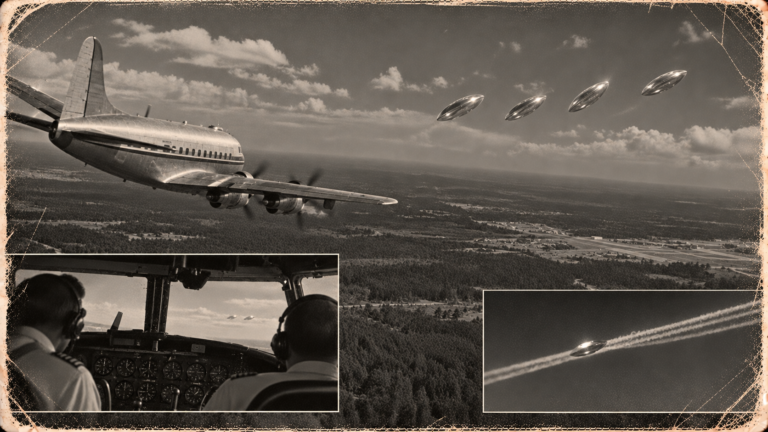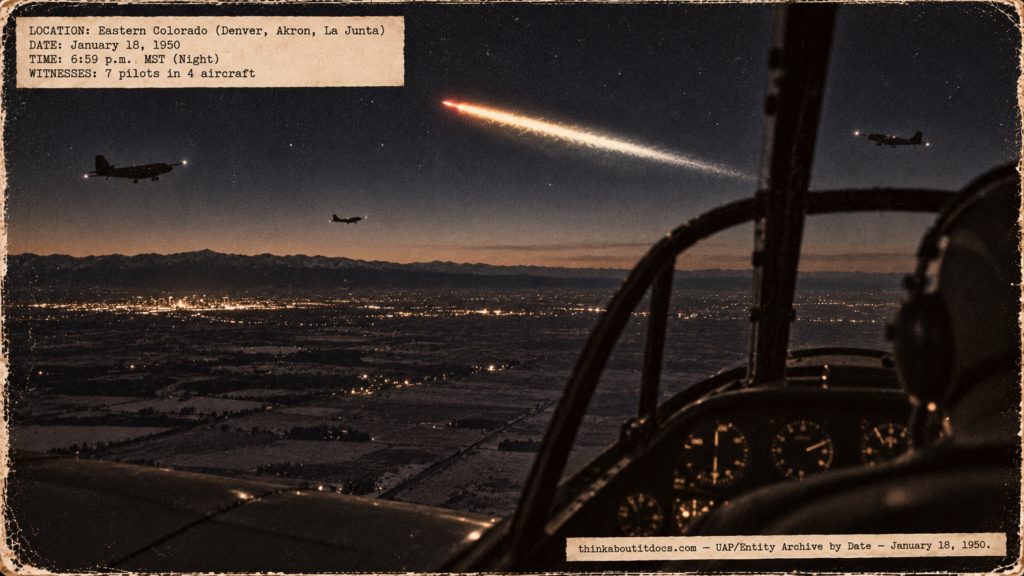
Seven Air Force pilots in four aircraft over eastern Colorado saw a fast-moving flame on the evening of January 18, 1950.
THINK ABOUTIT UFO|UAP SIGHTINGS REPORT
1950: Denver, Colorado Pilots’ Flame Sighting
At 6:59 p.m. on January 18, 1950, a student-officer pilot flying a T-6 fifteen miles southeast of Denver watched a long streak of flame cross the sky at high speed: cylindrical, rounded at the front, tapering toward the rear, white with more red at the head. It lasted about five seconds. Then the other reports began to come in. Within minutes it emerged that seven pilots in four aircraft, scattered across eastern Colorado from near Denver to near La Junta and Akron, had seen a similar fast flame moving southwest.
The Air Force’s Office of Special Investigations at Lowry Air Force Base interviewed every pilot, plotted their positions and headings on aeronautical charts, checked radar and experimental-aircraft records, and found nothing to explain it. Their overlay suggested the flame’s course would carry it over the area near Holloman AFB in New Mexico. Project Blue Book’s record card is less mysterious: it lists the Denver, Colorado pilots’ flame sighting as a meteor. This report preserves both the eight-pilot investigation and the verdict.
Date: January 18, 1950
Sighting Time: 6:59 p.m. MST (1859 hours per the Blue Book card and Lt. Webb); the pilots’ individual times run from 1858 to 1905
Day/Night: Night (evening, well after sunset)
Location: Eastern Colorado: about 15 miles southeast of Denver (Webb and Drysdale, T-6); halfway between Denver and Akron (Ehlinger and Legg, T-6); about 35 miles northeast of Akron (Kreitz and Avery, C-47); about ten minutes out of La Junta (Daniel and Romberg, C-47)
Urban or Rural: Rural (airborne over the plains of eastern Colorado)
No. of Entity’s: Not Applicable
Entity Type: Not Applicable
Entity Description: Not Applicable
Hynek Classification: NL (Nocturnal Light)
Duration: About 5 seconds (Webb), 5 to 8 seconds (Ehlinger), 15 to 20 seconds (Daniel, Romberg, Kreitz), about 20 seconds (Legg)
No. of Object(s): 1
Description of the Object(s): A fast-moving flame or light, cylindrical, rounded at the front and tapering to the rear, that crossed the sky on a generally southwest course and faded from view. Webb could see no running lights, silhouette or other features.
Shape/Size/Color of Object(s): Cylindrical, rounded in front, tapered to the rear; length estimated at 100 feet (Webb), 50 feet (Ehlinger) or 50 yards (Legg); white-reddish with more red at the front (Webb), light blue with a tinge of orange (Daniel, Romberg), light blue to white like an oxygen torch (Kreitz), bright orange to white (Ehlinger, Legg)
Distance to Object(s): 5 to 10 miles (Ehlinger, Legg); about 35 miles (Kreitz); Webb, Daniel and Romberg could not estimate it
Height & Speed: Altitude estimates: about 5,000 feet above Webb’s T-6, which was at 8,500 feet; 1,500 feet above the T-6 (Drysdale); about 12,000 feet (Ehlinger, Legg); 25,000 to 30,000 feet (Kreitz). Speed: high, faster than jet flight (Kreitz and the Blue Book card). Headings estimated at 200 degrees (Webb, Daniel, Romberg), about 210 degrees (Ehlinger, Legg) and 240 degrees (Kreitz)
Number of Witnesses: 7 who saw it, from 8 pilots in four aircraft: 1st Lt. Arthur P. Webb and 1st Lt. Douglas R. Drysdale; Capt. H. F. Daniel and 1st Lt. Robert P. Romberg; Capt. John W. Kreitz (Maj. Lyndall J. Avery did not see it); Capt. John L. Ehlinger and 1st Lt. Clinton C. Legg
Special Features/Characteristics: Four aircraft at separate locations; positions and headings plotted on aeronautical charts; Lowry-area radar not operating from 1800 to 2030; no record of experimental aircraft in the area; plotted course extended toward the Holloman AFB area; slight electrical disturbance noted along the horizon; clear weather, unlimited visibility
Case Status: Explained. Project Blue Book’s record card gives the conclusion “Astro (METEOR).” The OSI investigators, working before that evaluation, reported the object as unidentified.
Source: AFOSI 14th District Report of Investigation (file 24-48), 24 January 1950, from interviews of 19 to 24 January; Project Blue Book (Project 10073) record card; NICAP 1950 UFO Chronology (Project 1947; Dan Wilson)
Summary/Description: Seven of eight USAF pilots flying four aircraft over eastern Colorado on the evening of January 18, 1950 saw a fast, cylindrical flame or light, reddish-white to light blue, moving southwest for 5 to 20 seconds. OSI at Lowry AFB plotted their positions and headings, found the Lowry-area radar was off and no experimental aircraft were on record, and noted that the course extended toward Holloman AFB. Blue Book’s card concludes it was a meteor.
Related Cases: Corona, New Mexico, fireball (January 7, 1950); Holloman AFB lights (January 6, 12 and 13, 1950); Howard, Kansas, C-47 sighting (January 6, 1950); Blackstone, Virginia, C-45 encounter (January 24, 1950)
Detailed Report
The Call to Lowry
The investigation began on January 19, 1950, when 1st Lt. Arthur P. Webb, of the 3415th Student Officers’ Squadron, telephoned to report that while flying near Denver the previous evening he had seen a flame move across the sky at high speed. Special agents of the 14th OSI District at Lowry AFB, Special Agent Frederick K. Ungerer and the report’s writer, interviewed Webb and then traced the other pilots who had been aloft that evening.
Four Aircraft, Seven Observers
- T-6, Webb and Drysdale: about 15 miles southeast of Denver, heading 190 degrees at 8,500 feet, on interphone with no unusual radio noise. Webb saw a long cylindrical streak of flame, rounded at the front and tapering to the rear, white-reddish with more red in front, moving on a heading of about 200 degrees at high speed without changing altitude or course. He put its length at 100 feet, its height about 5,000 feet above him, and its time in view at about five seconds, and noted 1859 hours. Drysdale gave the time as 1905, said it looked like a shooting star on a flat trajectory, and put it 1,500 feet higher than the T-6. Both said they had never seen a comparable sight.
- C-47, Daniel and Romberg: heading 110 degrees at 10,000 feet, about ten minutes out of La Junta. Capt. H. F. Daniel saw the flame appear at his left and cross their path very fast, and nudged 1st Lt. Robert P. Romberg, who saw it too. They watched it fade at their right, judged its heading at 200 degrees, and described it as light blue with a tinge of orange and quite long, slightly higher than their aircraft. It was sighted at 1905 and stayed in view 15 to 20 seconds.
- C-47, Kreitz and Avery: heading 60 degrees at 9,000 feet, about 35 miles northeast of Akron, at 1900. Capt. John W. Kreitz saw what looked like a meteor but larger and slower, keeping level flight, light blue to white like an oxygen torch. He put it at 25,000 to 30,000 feet, about 35 miles away, moving faster than a jet, on a heading of 240 degrees, visible about 15 seconds. Maj. Lyndall J. Avery did not see it.
- T-6, Ehlinger and Legg: heading 60 degrees at about 10,000 feet, halfway between Denver and Akron, at 1858. Capt. John L. Ehlinger and 1st Lt. Clinton C. Legg saw a bright orange-to-white flame five to ten miles away, at about 12,000 feet, traveling at high speed on a course of about 210 degrees. Legg watched about 20 seconds and Ehlinger 5 to 8. Ehlinger put its length at 50 feet and Legg at 50 yards. It faded from view.
The Plot and the Checks
The agents plotted the four aircraft and the flame’s position and heading for each pilot on an overlay of the Trinidad, Denver and Cheyenne sectional charts. An extension of the flame’s plotted course suggested it would pass over the area near Holloman Air Force Base in New Mexico. A check with the Denver Bomb Plot, a detachment of the 3903d Radar Bomb Scoring Squadron, found its radar was not operating between 1800 and 2030 hours. Lowry Base Operations, the Training and Operations section of the 3415th Technical Training Wing and the Flight Service Section found no record of notice of experimental aircraft in the area. Weather was clear with unlimited visibility, and some slight electrical disturbance was noted along the horizon. No one on the ground reported the flame.
The Verdict
The Project 10073 record card lists the source as eight USAF pilots, the time as 1859 MST, the color as reddish-white, the shape as round and tapered in the rear, the size as 100 feet long, the speed as faster than a jet, the estimated altitude as 15,000 feet, the course as southwest and the time observed as five seconds. The handwritten conclusion is “Astro (METEOR).”
RESEARCHER’S NOTES
Eight Pilots, Four Aircraft, One Flame, and a One-Word Verdict
- One Event, Two Listings: NICAP’s chronology lists two Denver entries on January 18, one at 6:19 p.m. for T-6 pilots and one at 6:59 p.m. for Lt. Webb and six other pilots. Both trace to this one OSI report. The Blue Book card’s time of 1859 MST matches the second, and the first looks like a transcription slip for the same hour.
- Estimates That Cannot Be Reconciled: Altitude estimates run from 1,500 feet above Webb’s T-6 to 25,000 to 30,000 feet, distance from 5 to 35 miles and length from 50 feet to 50 yards. The pilots agree on the flame’s brightness, its rapid motion and its rough direction, and they do not agree on how far away it was.
- A Consistent Track: The headings the pilots gave, 200, 210 and 240 degrees, all point southwest, and the four aircraft were flying different headings from widely separated positions. The OSI plot extended the track toward the Holloman area.
- Why Blue Book Called It a Meteor: The pilots themselves reached for meteor comparisons: Kreitz said it looked like a meteor, though larger and slower, and Drysdale said it looked like a shooting star on a flat trajectory. Aircraft well over a hundred miles apart all seeing a similar flame within a few minutes fits a high-altitude object, which is consistent with the Blue Book conclusion, though the file does not give the reasoning behind the card.
- The Experimental Aircraft Question: The OSI checked for experimental aircraft and found no record of notice of any. The Lowry-area radar was not operating, so the file contains no radar data either way. The slight electrical disturbance along the horizon is noted without comment.
- Record Quality: Names, ranks, squadrons, headings and altitudes for all eight pilots survive, which is unusual for a 1950 report. The times spread from 1858 to 1905, and no sketch or photograph is in the file.
The Denver flame is one of the best-documented multi-pilot sightings of January 1950: four aircraft, eight pilots, seven observers, a chart overlay and a set of negative checks. It is filed here as Explained on the strength of the Blue Book card’s meteor conclusion, and the wide gaps in the pilots’ distance and altitude estimates are part of why a meteor is a reasonable reading. The investigation is still worth reading for what it shows: the Air Force’s own agents treated it as an unidentified flame, took eight statements, and plotted a course that pointed at New Mexico.
“…similar flame or light…”
From the AFOSI Report of Investigation on the January 18, 1950 sighting over eastern Colorado, which found all observers described it in similar terms.