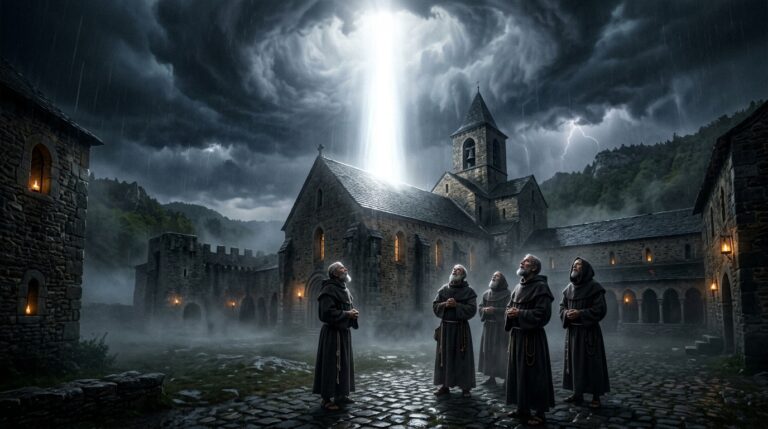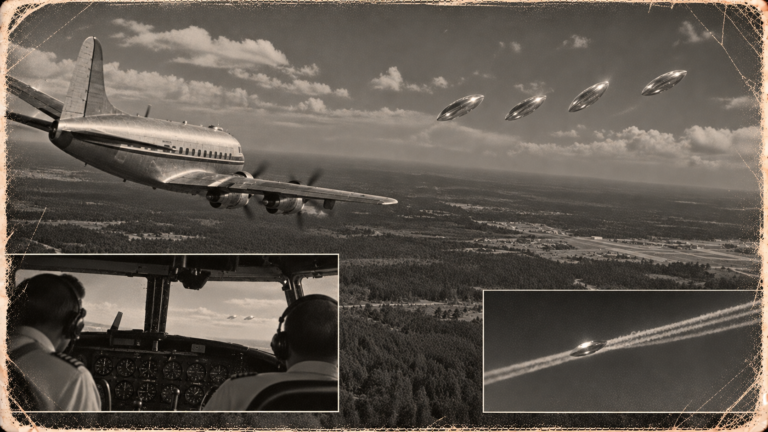
Barre-des-Cévennes, Lozère, France, early 1956: two gendarmes were paralyzed at 50 yards, watched a luminous probe circuit the Castelás hilltop, and saw four silhouettes walk the craft's perimeter. M. Barboule's watch never worked again.
THINK ABOUTIT UFO|UAP & ENTITY ENCOUNTER REPORT
1956: Barre-des-Cévennes, France — The Gendarmes Who Couldn’t Draw Their Weapons
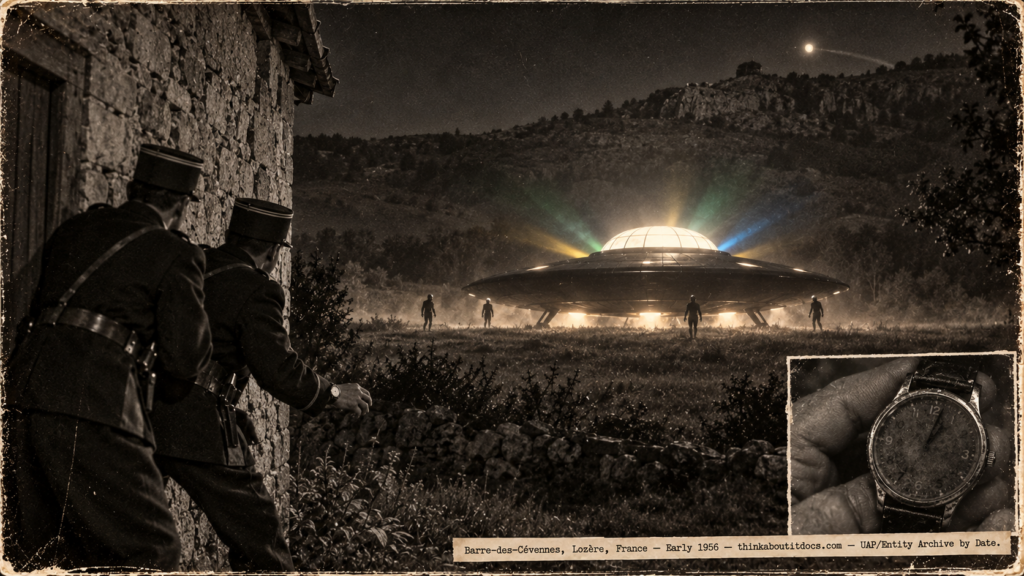
In early 1956, around 1:00 a.m., two French gendarmes named M. Simon and M. Barboule were returning from duty and pushing their bicycles up a hill near Barre-des-Cévennes in the Lozère when a noise that rapidly grew into a deafening racket stopped them in their tracks. Fifty yards away and a few feet above the ground, a round black disc approximately 35 feet in diameter and 4 feet thick was hovering. Beneath it, a row of pipe-like openings emitted short reddish flames, as though white-hot. A powerful hot wind radiated from the object and physically shoved both men against the wall of a nearby barn.
The disc landed in a flat field. The flame vents cooled and darkened. Then, after about a minute, an opaque ivory-white dome lit up on top of the craft and from its base multi-colored rays — yellow, green and blue — burst outward in all directions. A luminous ball-like object emerged from those rays, detached itself, and made two slow circuits of the hilltop called Castelás before returning to the disc and disappearing. While it was gone, both gendarmes observed approximately four human-like silhouettes walking in slow circuits around the perimeter of the landed craft, as if conducting an inspection. When the ball returned, the figures vanished. The dome went dark, the hot wind resumed, the deafening noise returned, and the disc rose vertically and was gone. Throughout the entire encounter both men had been unable to move — M. Simon placed his hand on his revolver but could not draw it. M. Barboule’s watch never ran properly again.
Date: Beginning of 1956 (specific date not recorded; approximately 1:00 a.m.)
Sighting Time: 1:00 a.m.
Day/Night: Night
Location: Barre-des-Cévennes, Lozère, France — near the hilltop peak known as Castelás (also spelled Castelai or Castelas), in the Cévennes uplands
Urban or Rural: Rural — a hillside road with a barn, flat agricultural field, and rocky upland peak nearby
No. of Entity(‘s): Approximately 4 (silhouettes only — human-like, not closely observed)
Entity Type: Humanoid — silhouettes only; apparent normal human stature and proportions
Entity Description: Approximately four human-like silhouettes observed walking slowly around the perimeter of the landed disc, described as if conducting an inspection. Not observed in detail — described only as silhouettes against the craft’s illumination. They disappeared when the luminous probe ball returned to the disc.
Hynek Classification: CE-II (Close Encounter II) — object observed at close range with physical effects on witnesses (paralysis, inability to draw weapon) and on equipment (permanent watch damage); CE-III element (humanoid silhouettes observed) present but not clearly resolved
Duration: Not precisely timed; both men were paralyzed during the event. The full sequence — approach, landing, dome illumination, probe circuit, occupant activity, departure — spanned multiple minutes.
No. of Object(s): 1 main disc; 1 secondary luminous probe ball (deployed from and returned to the main craft)
Description of the Object(s): Main craft: round black disc approximately 35 feet in diameter (about 10–11 metres) and 4 feet thick. Beneath the disc, a row of pipe-like or flue-like openings that appeared red-hot, emitting short reddish flames. Above, after landing, an opaque ivory-white dome that lit up brightly. From the dome’s base, multi-colored rays (yellow, green, blue) radiating in all directions. Secondary object: a luminous ball-like probe that emerged from the dome’s light field, circled a nearby hilltop peak twice, and returned to the craft.
Shape/Size/Color of Object(s): Main disc: black/dark; approximately 35 ft diameter × 4 ft thick; underside with red-hot vent tubes; top with ivory-white dome and multi-colored ray emissions. Probe: luminous ball (color not specified beyond “luminous”).
Distance to Object(s): Approximately 50 yards (approximately 45 metres) — the disc first appeared at this distance. It then landed in the flat field approximately 50 yards from the witnesses’ position at the barn.
Height & Speed: Initially hovering a few yards above the ground at 50 yards range. Landed in the field. Departed vertically at the conclusion of the event. Speed of departure not described beyond “rose vertically and disappeared.”
Number of Witnesses: 2 — M. Simon (gendarme) and M. Barboule (gendarme), both on duty, returning from a tour of duty by bicycle
Special Features/Characteristics: (1) Hot wind strong enough to physically push both men against a barn wall, emanating from the craft’s underside vents. (2) Paralysis of both witnesses throughout the encounter — M. Simon placed his hand on his revolver holster but could not draw the weapon. (3) Multi-colored ray display from the dome base. (4) A secondary luminous probe that made two autonomous circuits of a nearby hilltop. (5) Approximately four human-like silhouettes observed walking around the craft’s exterior during the probe’s absence. (6) Permanent mechanical damage to M. Barboule’s watch — it never ran properly after the encounter.
Case Status: Unexplained. Investigated by J. Tyrode and published in Lumières Dans La Nuit (LDLN), No. 116 — France’s most rigorous civilian UFO research journal. No official French government investigation is documented in available sources.
Source: J. Tyrode, Lumières Dans La Nuit (LDLN), No. 116. LDLN was founded by Raymond Veillith in 1958 and is the oldest and most methodologically rigorous French-language civilian UFO research journal. The case was documented retrospectively — the event preceded LDLN’s founding by approximately two years.
Summary/Description: Two on-duty gendarmes near Barre-des-Cévennes observed a 35-ft black disc land in a field 50 yards away, deploy a luminous probe that circled a hilltop peak twice, and show four silhouettes walking its exterior. Both men were paralyzed throughout; one could not draw his weapon. The other’s watch was permanently damaged. CE-II with CE-III elements. LDLN No. 116, investigated by J. Tyrode.
Related Cases: 1956: Unknown Date UFO|UAP & Entity Sightings Archive; 1956: Choisy-le-Roi, France (February 1956, CE-III); 1956: Harsby, Sweden — Brita Räninger CE-III (June 12, 1956)
Detailed Report
Barre-des-Cévennes is a small commune in the Lozère department of southern France, in the high uplands of the Cévennes range — a rugged landscape of limestone plateaus, deep river gorges and isolated farms. In early 1956, around 1:00 a.m., Gendarmes M. Simon and M. Barboule were completing a tour of duty and making their way home along a hill road, pushing their bicycles up the incline. They were near a barn when they heard a sound building rapidly into what they described as a deafening racket.
Fifty yards ahead and a few yards above the ground, a round black mass had appeared. It was approximately 35 feet in diameter and 4 feet thick — a disc, clearly defined against the night sky. Along its underside ran a row of openings resembling flue-pipe mouths or vents, which appeared red-hot and were emitting short reddish flames. From the disc radiated a strong hot wind that physically pushed both men backward against the barn wall behind them.
The object descended and landed in the flat field approximately 50 yards from their position. The red vent openings cooled and darkened, as if the propulsion had been cut. Both men noticed that they were unable to move — a paralysis that would continue throughout the encounter. M. Simon, a trained police officer, placed his hand on his revolver holster. He could not remove the weapon.
After approximately a minute of stillness, an opaque ivory-white dome lit up on the top of the disc. From the base of this dome, dazzling multi-colored rays — yellow, green and blue — emerged and spread outward in all directions, illuminating the surrounding countryside. Then a luminous ball-like object emerged from the source of the rays, detached itself from the craft, and began moving independently. It drifted to the nearby hilltop peak called Castelás and made two slow, unhurried circuits of the summit before returning to the disc and disappearing back into the dome’s light field.
During this interval — while the luminous probe was making its survey of Castelás — both gendarmes observed approximately four silhouettes at the perimeter of the landed disc. The figures appeared human in stature and proportion; they were walking slowly around the craft in circuits, as if conducting an external inspection. They were observed only as silhouettes against the craft’s illumination. When the probe returned, the figures disappeared — whether into the craft or simply no longer visible is not specified in the account.
With the probe’s return, the dome light and the multi-colored rays extinguished. The hot wind resumed and the deafening noise returned. The disc rose vertically from the field and disappeared into the sky. Both men found they could move again. They continued home.
M. Barboule’s watch never ran properly after that night.
The case was subsequently investigated by researcher J. Tyrode and published in Lumières Dans La Nuit, No. 116. LDLN was founded in 1958 by Raymond Veillith — making the publication date approximately two years after the event — but investigation of cases predating the journal’s founding was standard practice. LDLN’s methodology, longevity (it ran until 2007) and editorial standards made it the most rigorous venue in French-language UFO research.
RESEARCHER’S NOTES
Five Distinct Physical Effects and What They Suggest
- The hot wind and heat effect: The strong hot wind from the craft’s underside vents — powerful enough to push two adult men against a barn wall — indicates a real energetic phenomenon producing directed airflow and thermal output. This is consistent with a propulsion exhaust, a plasma effect or intense electromagnetic heating of the surrounding air. It is not consistent with a hallucination, a misidentified conventional aircraft or a weather phenomenon.
- Paralysis: Simultaneous immobility in both witnesses — and the specific detail of M. Simon’s hand on his holster being unable to complete the draw — is one of the most frequently reported physical effects in close-encounter cases of the 1950s. The mechanism is unknown. Hypotheses in the research literature include strong electromagnetic fields disrupting neuromuscular function, direct physiological suppression, or extreme psychological shock producing a freeze response. The simultaneous onset in two people and the persistence throughout the encounter (until the craft departed) is the element that distinguishes this from a simple panic freeze.
- The watch: Permanent mechanical damage to M. Barboule’s watch is the most physically concrete aftermath of the encounter. Mechanical watches of the 1950s used mainspring movements; they could be permanently damaged by strong magnetic fields (which can magnetize the steel components, causing them to stick or run erratically) or by intense heat (which can affect the spring metal and lubricating oil). The watch damage is consistent with either the electromagnetic or thermal effects already described. It is also the only piece of physical evidence in the case — a damaged object that could, in principle, have been examined by a watchmaker and documented at the time.
- The probe: The luminous ball that emerged, made two circuits of a hilltop and returned is an autonomous secondary object apparently deployed from and retrieved by the main craft. This behavior — sending out a smaller scout or sensor while the main craft remains landed — appears in a small number of other 1950s CE-II cases. The circuits of the Castelás peak specifically suggest either a terrain-mapping function or a systematic survey of the surrounding landscape from an elevated vantage point.
- The silhouettes: The observation of approximately four human-like figures walking around the craft’s exterior during the probe’s absence technically qualifies this case for CE-III classification, but the silhouette-only nature of the observation limits confidence. The figures were not described in any physical detail; only their movement pattern — slow circuits of the craft, as if inspecting it — was noted. They disappeared simultaneously with the probe’s return, suggesting either re-entry into the craft or that whatever activity they were performing concluded at that moment.
- The mid-1950s French wave context: The Barre-des-Cévennes encounter falls within one of the most documented UFO waves in European history — the French sighting wave of 1954–1956, which produced hundreds of CE cases with physical effects and multiple witnesses. Choisy-le-Roi (February 1956), Orly Airport (February 1956) and the Le Houlme car-stop case (September 1956) are contemporaries in the same national record. The gendarme witness category appears repeatedly in this wave: on-duty police officers in rural France made some of the period’s most credible and detailed reports, likely because their professional training both sharpened observation and made them reluctant to report experiences that could affect their careers.
The Barre-des-Cévennes case stands on two named law enforcement witnesses, five distinct physical effects (heat, wind, paralysis, electromagnetic watch damage, luminous probe), occupant silhouettes and first-generation French investigative documentation in LDLN. The watch that never worked again is the one element that, if the physical object still exists or was examined at the time, could serve as direct physical corroboration. The investigation by Tyrode in LDLN No. 116 remains the primary source. The full French-language text of that article would complete the record.
M. Simon put his hand on his revolver holster, but could not remove it. M. Barboule’s watch never ran properly again.
Gendarmes M. Simon and M. Barboule, Barre-des-Cévennes, Lozère, France, early 1956 — J. Tyrode, Lumières Dans La Nuit (LDLN), No. 116