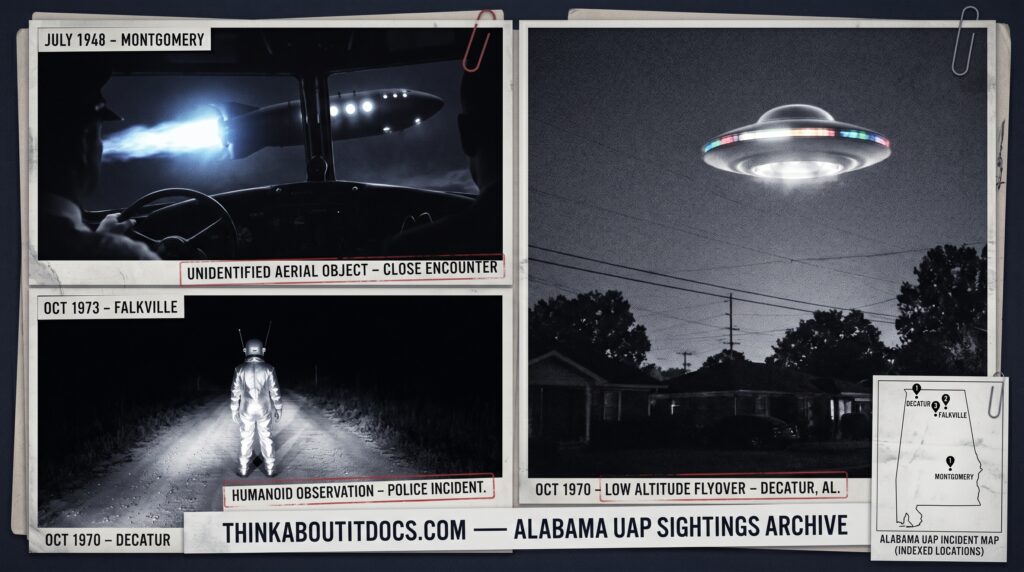
Alabama UAP archive: Chiles-Whitted Eastern Airlines near-collision July 1948 (Project Sign filed), Falkville Police Chief Greenhaw silver-suited humanoid Polaroid photographs October 1973, and Decatur CE-II domed disc with full-spectrum rim lighting and confirmed second object October 1970. 9 documented cases 1948–2011.
Alabama UFO|UAP & Alien Sightings Archive
Alabama’s anomalous record spans six decades and anchors in two cases that entered national research literature the moment they were reported. On July 24, 1948, Eastern Airlines pilots Clarence Chiles and John Whitted, flying a DC-3 over Montgomery at 5,000 feet, had a near-collision with a torpedo-shaped craft roughly 100 feet long trailing blue flame from its rear and showing two rows of bright square windows along its fuselage. The encounter lasted approximately ten seconds and both men filed detailed independent reports. Project Sign analysts rated it among the strongest early cases in the record — the torpedo/cigar morphology, the window rows, the blue exhaust, and the near-miss geometry were precisely described by two professional pilots with no reason to fabricate. The Air Force ultimately attributed it to a meteor. No meteor attribution has ever been accepted by the research community for this case. Seventeen months later, on October 6, 1970 in Decatur, a CE-II encounter left Mrs. Dennis Billings screaming for her husband from the front yard as a domed object with a translucent lower protrusion and a full-spectrum rim light display flew low over the neighborhood — its departure photographed by Mr. Billings with a second identical object following the first. The photographs were formally investigated by NICAP field investigator Harold Green.
The state’s most visually documented modern case is the 1973 Falkville encounter in which Police Chief Jeff Greenhaw, responding to a call about a UFO landing in a field, arrived to find a silver-suited humanoid figure standing on the road and took four Polaroid photographs before the figure outran his pursuit vehicle at estimated speeds exceeding 35 mph. The photographs — showing a clearly humanoid, metallic-suited figure with an antenna-like protrusion from its head — have been analyzed repeatedly without consensus on their authenticity. Greenhaw lost his job, his marriage, and his house in the months following the incident under circumstances that have never been fully explained. The 1996 Valley capsule photographs — six anonymous images showing a black Teflon-coated capsule-shaped object over a farm pasture, submitted to both a radio station and a newspaper simultaneously — add a photographic dimension to Alabama’s modern record. Alabama’s nine documented cases distribute across the Tennessee Valley (Chiles-Whitted, Decatur, Falkville, Florence), the coastal south (Mobile), and the central state (Valley, Mount Olive, Wetumpka), tracking the state’s geographic breadth from the TVA corridor to the Gulf coast approach.
- 1948: The Chiles-Whitted Case
- 1970: Decatur, Alabama CE-II Sighting
- 1973: The Alabama Tinfoil Alien
- 1983: Encounter in Alabama
- 1996: Capsule-Shaped Object Photographed in Valley, Alabama
- 2005: Long Craft Spotted Over North West Alabama
- 2005: Rural Alabama Ex-coal mine Sighting
- 2011: Alabama ‘sub-car sized’ sphere hovered and moved away
- 2005: Daylight Setting near Mount Olive Alabama
- 1952: The Chickasaw and Brookley AFB, Alabama Light Display
Executive Summary
The Chiles-Whitted Benchmark and the Falkville Photographs — Alabama’s Dual Evidence Record
Alabama’s UAP archive is defined by two events that entered national research circulation immediately on report and have remained in the literature ever since. The 1948 Chiles-Whitted case is one of the strongest early pilot encounters in the record: two professional Eastern Airlines pilots, independent descriptions, near-collision geometry, distinctive torpedo morphology with window rows and blue exhaust, filed with Project Sign within hours. The meteor attribution that Project Sign ultimately applied satisfied no one who examined the case seriously, and the Chiles-Whitted encounter remains one of the anchor cases of the 1947–1952 foundational period. The 1973 Falkville encounter is the state’s most contested case: four Polaroid photographs of a silver-suited humanoid, a police chief as the sole witness, a pursuit at speeds exceeding his vehicle’s capability, and a subsequent pattern of personal destruction — job loss, marriage collapse, house fire — that has become part of the case record in its own right. Whether the photographs are genuine or fabricated has not been resolved, but the personal consequences for Greenhaw have no obvious fabrication motivation. Alabama’s remaining cases — the Decatur CE-II with multi-spectral rim lighting and photographs, the Mobile CE-I highway encounter, the anonymous Valley capsule photographs — fill out a state record that is lean in count but strong in anchor-case quality.