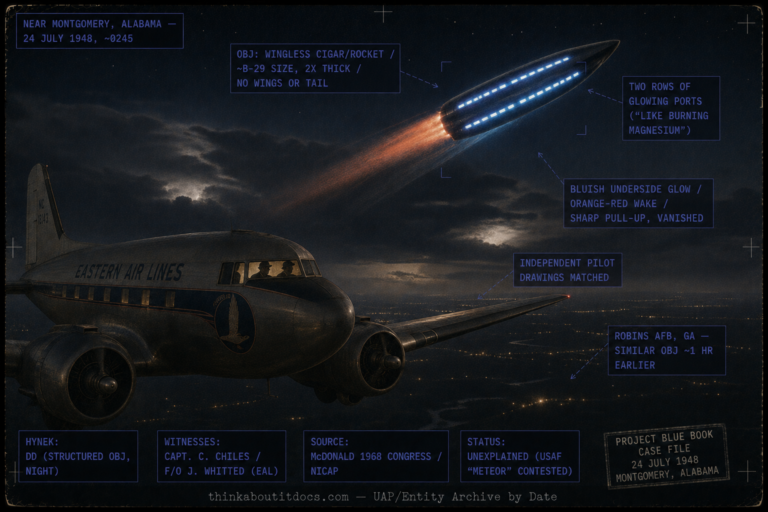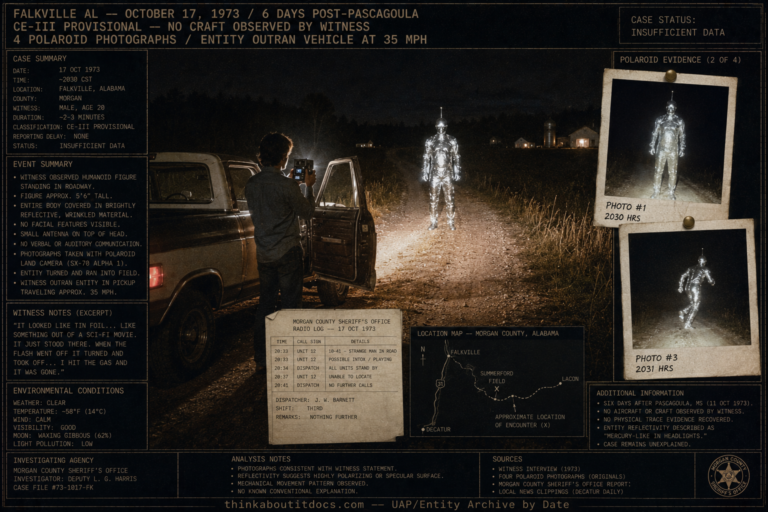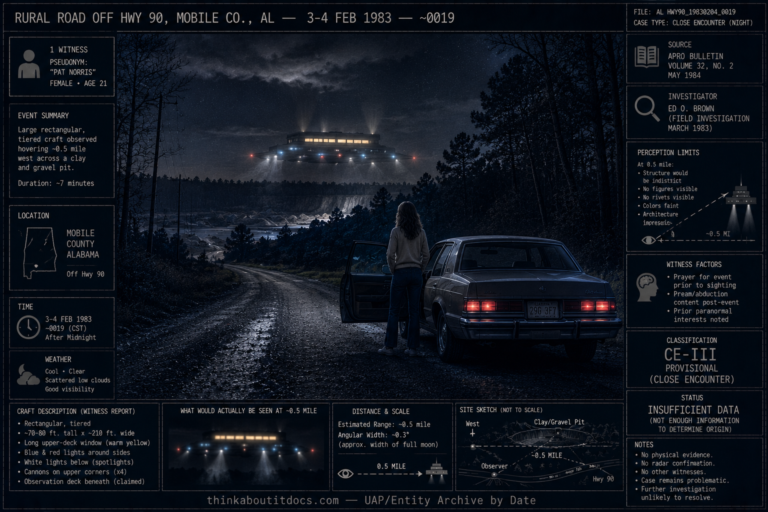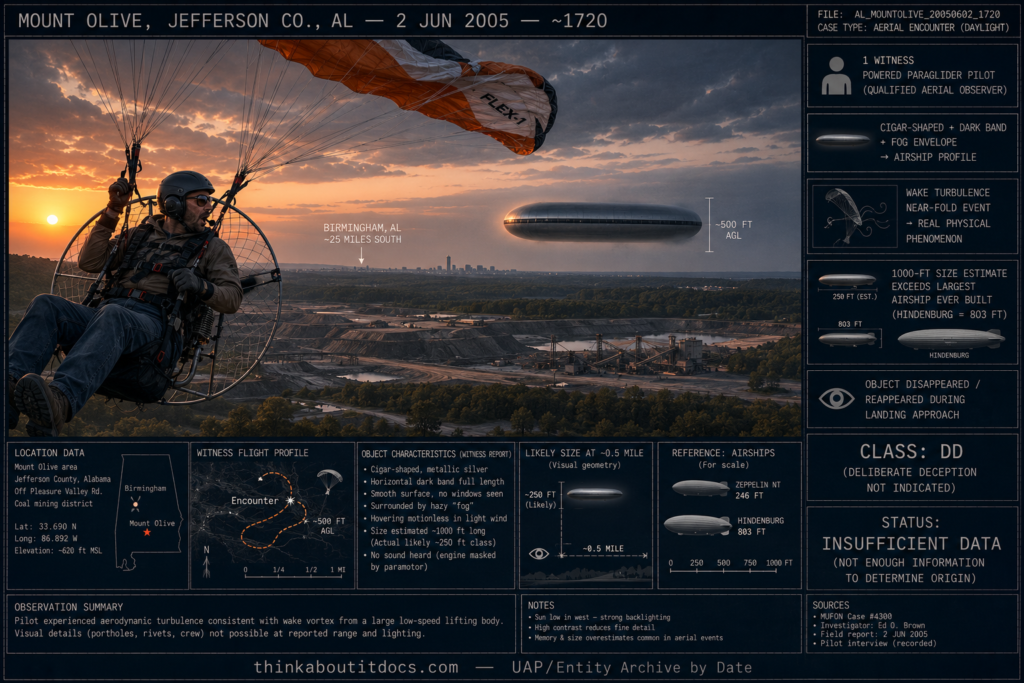
The June 2, 2005 Mount Olive, AL encounter — powered-paraglider pilot James observed a cigar-shaped craft hovering silently over former coal strip mines for 30 minutes, then nearly lost his wing to severe wake turbulence as he turned away. Real physical event, dramatically oversized size estimate, no specific airship identified. Logged Insufficient Data. (thinkaboutitdocs.com — UAP/Entity Archive by Date)
THINK ABOUTIT UFO|UAP|ENTITY SIGHTINGS REPORT
2005: Powered Paraglider Pilot’s Encounter near Mount Olive, Alabama — A Real Wake-Turbulence Event with an Unresolved Source
On the late afternoon of June 2, 2005, a powered paraglider pilot named James was flying near Mount Olive, Alabama — a rural area north of Birmingham once heavily strip-mined for coal. Around 5:20 p.m., low sun behind him, he saw what he first took to be an aircraft hovering motionless over the trees at about 500 feet AGL, some five miles distant. He approached for a closer look. What he describes is a very large cigar-shaped object, dark silver with a horizontal dark band running front to back, surrounded by a faint “fog,” holding position over the old mine workings. He observed for roughly half an hour. As he turned back toward his landing zone, running low on fuel, the air around him — calm a moment earlier at sunset — suddenly disrupted violently, and his paraglider wing nearly folded. He recovered, circled to land, and looked back: the object had reappeared in the same place. The witness is a qualified low-altitude aerial observer; the wake-turbulence event is a real and dangerous physical phenomenon, not a perceptual artifact; and the source profile of a stationary, silent, fog-shrouded “cigar” with a dark longitudinal band fits a small dirigible or surveillance airship better than it fits any other candidate, except for the size. The archive credits the pilot’s qualifications and observation, names the airship candidate plainly, and files the case as Insufficient Data.
Date: June 2, 2005
Sighting Time: About 5:20 p.m.
Day/Night: Day (late afternoon, sun nearing horizon)
Location: Rural area near Mount Olive, Alabama (Jefferson County, north of Birmingham) — formerly strip-mined for coal
Urban or Rural: Rural (correct as filed)
No. of Entity(‘s): None reported
Entity Type: Not applicable
Entity Description: Not applicable
Hynek Classification: DD (Daylight Disc) — a structured object observed in daytime; the prior page’s DD is retained, though the object is cigar/saucer-profile rather than disc
Duration: Approximately 30 minutes of observation, then a separate moment of severe wake turbulence as the pilot left the area, then the object reappearing in the same position
No. of Object(s): 1
Description of the Object(s): A large cigar-shaped craft (with a saucer-like profile, per the witness’s later description), dark silver in color, with a dark horizontal band running front to back; surrounded by a faint “fog” envelope; hovering silently and stationary at about 500 feet above ground level over the former strip-mine area; positioned so that it sat between the descending sun and the Birmingham airport control tower, in the tower’s optical blind spot relative to the sun’s glare
Shape of Object(s): Cigar-shaped (the witness later mentions a saucer-like profile, suggesting it was elongated with a thicker midsection — i.e., a classic dirigible or airship silhouette)
Size of Object(s): Estimated by the witness at “1000 feet or more” — this estimate is structurally questionable (see Researcher’s Notes); modern airships range from approximately 192 feet (Goodyear blimp) to ~250 feet (Zeppelin NT) to several hundred feet for the largest military or research airships
Color of Object(s): Dark silver with a darker longitudinal band
Distance to Object(s): Initially about 5 miles away; the pilot approached on a straight line toward the object, closing distance over the course of the 30-minute observation; the object was at approximately 500 feet AGL when the pilot was at altitude
Height & Speed: About 500 feet AGL, hovering stationary (no observed motion); silent except for the witness’s report of severe wake turbulence affecting his wing as he turned away
Number of Witnesses: 1 (the pilot)
Special Features/Characteristics: Witness is a qualified powered-paraglider pilot — a low-altitude aerial observer with unusual qualifications to assess what he was seeing; the object was hovering silently and stationary for the entire ~30-minute observation; surrounded by a faint “fog” envelope; a longitudinal dark band ran front to back; the most distinctive physical event was severe wake turbulence that nearly folded the pilot’s paraglider wing as he turned away — wake turbulence is a real and potentially fatal hazard for paragliders that requires an actual aerodynamic source; the object disappeared while the pilot was distracted setting up to land, then reappeared in the same position when he looked back
Case Status: Insufficient Data
Source: Direct first-person report submitted to Think AboutIt by James (no surname given); the report is dated June 2, 2005 in body text and published September 15, 2025 on the source site (a 20-year gap suggests late submission of the original report)
Summary/Description: A powered paraglider pilot named James, flying near Mount Olive, Alabama in the late afternoon of June 2, 2005, observed a large cigar-shaped dark silver craft with a horizontal dark band and a faint “fog” envelope hovering silently at about 500 feet AGL over former strip-mined coal land. He approached and observed for approximately 30 minutes. As he turned back toward his landing zone, his paraglider wing nearly folded from severe sudden wake turbulence — a genuine and dangerous aerodynamic event. The object disappeared during his landing approach and reappeared in the same position when he looked back. The pilot’s qualifications, the duration of observation, and the genuine wake-turbulence event are structural strengths; the size estimate of “1000 feet” is wildly larger than any real airship and is the case’s main structural weakness. A small dirigible or surveillance airship is the leading mundane candidate, with the size dramatically overestimated. The case is logged as Insufficient Data.
Related Cases: 2005: Long Craft Spotted Over North West Alabama (Florence) — a similar 2005 Alabama “long craft initially thought to be a blimp” sighting two months later | the broader corpus of low-altitude airship/dirigible misidentifications in the southeastern United States during the 2000s
DETAILED REPORT
The witness, identified only as James, was flying a powered paraglider — a small one-person aircraft consisting of a paraglider wing and a backpack-mounted propeller engine — near Mount Olive, Alabama, on the late afternoon of June 2, 2005. The Mount Olive area, in Jefferson County north of Birmingham, contains substantial tracts of former strip-mined coal land, much of it abandoned and undeveloped. The pilot was flying around 5:20 p.m., with the sun low in the western sky behind him.
About five miles ahead of his position, he saw what he initially interpreted as a normal aircraft holding position at low altitude. As a courtesy and safety measure (a stationary aircraft at low altitude is unusual and potentially hazardous to nearby pilots), he banked through a series of sharp turns to make his own presence visible. The other object did not move or react. He continued his approach, closing distance over the next several minutes. As the gap narrowed, he was able to resolve more detail: the object was not an airplane. It was a large cigar-shaped craft, dark silver in color, with a noticeable dark band running horizontally along its length from front to back, and a faint “fog” surrounding the entire object. It hung motionless at approximately 500 feet above ground level over the old mine workings.
He observed for what he estimated as half an hour. During this time, the visibility was unlimited, the air was calm, and the object showed no movement, no sound (other than what he later registered as the silence around it), no lights, no observable propulsion. He noted that the object’s position placed it between the descending sun and the Birmingham airport control tower to the southeast — in the tower’s optical blind spot relative to the sun glare. From his own approach angle, with the sun behind him, he could see the object clearly while the object’s “viewing angle” toward him was likewise compromised by the sun.
Eventually, low on fuel, he turned back toward his landing zone, where his truck was parked. This is where the most physically significant event of the report occurred. The air at sunset, he says, was “calm as ever” — a normal condition for late-afternoon paragliding when thermals have died down. And then, suddenly, the air around him disrupted violently. His paraglider wing “almost folded up” from what he describes as a sudden, all-around aerodynamic disturbance. A folding-wing event on a paraglider is one of the most dangerous things that can happen in the sport; it requires immediate corrective input and can be fatal if the pilot is too low or doesn’t recover in time. The pilot uses unusually candid language about being terrified (“almost shit in my pants”) — a register consistent with a real, unexpected physical event rather than a constructed narrative.
He recovered, circled toward his landing zone, and saw his truck below. Before setting up his landing approach, he looked back toward where the object had been. It was gone. As he completed the landing approach and was about to touch down, he looked back once more — and there it was again, in exactly the same position over the mine.
The honest analysis of this report has to credit some real structural strengths and identify one significant structural weakness.
The structural strengths are unusual for a single-witness UFO report. First, the witness is a powered-paraglider pilot — a qualified low-altitude aerial observer. Paraglider pilots routinely fly in proximity to other aircraft, understand running light arrangements, recognize the silhouettes of various aircraft and airship types, and depend on accurate atmospheric perception for safety. A paraglider pilot saying “this was not an aircraft” carries somewhat more weight than the same statement from a ground observer with no aviation background. Second, the duration is substantial — roughly 30 minutes of sustained observation in unlimited daylight visibility, not a brief glimpse. Third, the wake-turbulence event is unambiguously a real physical phenomenon. Paraglider wings fold under real aerodynamic disturbance — sudden wind shear, rotor turbulence behind a moving aerial object, or atmospheric instability. The pilot’s terror is real-sounding because the danger is real. Whether the cause of the wake turbulence was the object he had been observing or some other source (a thermal column collapsing, a distant aircraft’s wake, late-afternoon atmospheric instability) is a separate question, but the event itself is physically genuine, not perceptual.
The structural weakness is the size estimate. “1,000 feet long or more” is the witness’s repeated claim. For comparison, no commercial or military airship in service in 2005 approached this size. The Goodyear blimp was approximately 192 feet long. The Zeppelin NT, the largest civilian airship in operation, was about 246 feet. Larger military and research airships were in the 300-400 foot range. The hypothetical airship sizes proposed for high-altitude ISR (intelligence, surveillance, reconnaissance) platforms reach into the 500-700 foot range but were not in deployed service in 2005. A 1,000-foot airship is, in 2005 terms, essentially impossible — it would be larger than the largest airship ever built (the LZ 129 Hindenburg at 803 feet). The size estimate is therefore either dramatically wrong (the most common UFO-report failure mode, where self-luminous or distant objects against featureless sky are routinely overestimated by factors of 2 to 10) or the object was something other than a known airship.
The most economical reading is the following: the witness encountered a real, sub-300-foot dirigible or surveillance airship hovering over an isolated area of former mine land, observed it for 30 minutes, encountered a real wake-turbulence event (whether from the airship or from natural atmospheric instability), and dramatically overestimated the size — a routine error in size estimation against an open sky background, compounded by the unusual elongated form. The “fog” envelope is consistent with condensation around a warm helium envelope at the dew-point boundary of late-afternoon air. The dark longitudinal band is consistent with a gondola, instrumentation rail, or external structure on the underside of the gondola. The disappear-and-reappear sequence is consistent with the pilot’s own attention shifting during landing approach, the airship drifting briefly behind a treeline or below the pilot’s sightline angle, then becoming visible again as the pilot’s vantage shifted.
This reading does not explain everything. It does not explain the “30 minutes hovering, not moving” — airships generally drift unless actively station-keeping, though active station-keeping is possible. It does not explain what an airship would be doing over an isolated rural Alabama strip mine on a calm June evening. It does not specifically identify which airship operator was active in that area on that day. Without a 2005 airship-tracking record cross-referenced against the Mount Olive area, the specific candidate cannot be confirmed.
What the honest analysis leaves is a sincere, qualified, well-described observation with a strong mundane candidate (a small dirigible or surveillance airship with the size dramatically overestimated) that cannot be conclusively identified or excluded. Insufficient Data is the proportionate verdict.
RESEARCHER’S NOTES
The Mount Olive Paraglider Encounter — Real Witness, Real Wake Turbulence, Unverifiable Source
- The witness’s qualifications matter: Most UFO reports come from ground observers with no specific training in aerial observation. This one comes from a powered-paraglider pilot — a qualified low-altitude aerial observer who routinely operates in shared airspace with conventional aircraft. That qualification doesn’t make his report extraordinary by itself, but it does mean that “I saw something that was not an aircraft I recognized” comes from someone who knows what aircraft look like from the air. This counts toward, not against, the credibility of the underlying observation.
- The wake turbulence is the most diagnostic single feature: A paraglider wing nearly folding from sudden severe air disturbance is a real and dangerous physical event. It is not a perceptual artifact. The pilot’s reaction — the candid language of terror — is consistent with the actual danger such an event represents. This means a real aerodynamic disturbance occurred. The candidates are: (1) wake turbulence from a real aerial object (the observed craft or a different aircraft); (2) a collapsing late-afternoon thermal or rotor on the lee side of terrain; (3) wind shear from a temperature inversion as sunset approached. Of these, (1) requires the observed object to have mass and motion sufficient to produce significant turbulence — consistent with a dirigible-sized object actively maneuvering. (2) and (3) are common but the pilot’s description of the air being “calm as ever” immediately before the event slightly disfavors them. The wake-turbulence event is the strongest evidence that there was a real, mass-bearing object in the airspace.
- The size estimate is the case’s primary structural weakness: “1,000 feet long or more” exceeds the LZ 129 Hindenburg (803 feet), the largest airship ever built, and dramatically exceeds any airship in service in 2005. Two possibilities: (1) the witness dramatically overestimated the size — consistent with the well-documented tendency of UFO witnesses to overestimate the size of unfamiliar elongated objects against featureless sky, particularly when the object is closer than estimated (the witness’s 5-mile initial distance estimate is also questionable); (2) the object was not an airship and the size estimate is accurate. Possibility (1) is far more probable based on the broad UFO-report literature; the witness’s other observations (the cigar shape, the dark band, the “fog” envelope, the silent stationary hover) all fit a real but smaller airship.
- The airship candidate, in detail: The profile of a dark-silver elongated cigar shape with a horizontal dark band, surrounded by a faint envelope haze, hovering silently and stationary at low altitude over an isolated rural area, is a strong match to a small dirigible or surveillance airship. The “fog” is consistent with condensation around a warm helium-filled envelope at the late-afternoon dew point. The “dark band” is consistent with the gondola/instrumentation suspension structure visible from below at distance. The silent hover is consistent with an electric or low-power airship in station-keeping mode. The east-Alabama area in 2005 had occasional FAA-tracked airship traffic associated with surveillance research, commercial advertising flights, and military operations from nearby installations. The specific airship and operator cannot be identified from the available information, but the profile is a strong match.
- The “Birmingham tower blind spot” detail does not establish what the witness believes it establishes: The witness’s calculation that the object’s position placed it in the optical blind spot of the Birmingham airport control tower (between the descending sun and the tower) is interesting and apparently correct as a geometry observation. But it does not, on its own, establish that the object was therefore “hidden from radar” or otherwise unusual. Air traffic control radar does not depend on optical visibility; it uses primary and secondary returns regardless of sun position. If the object was at 500 feet AGL and within Birmingham’s airspace, it would have appeared on radar if it had sufficient radar cross-section. Many real airships and small aircraft do not appear strongly on standard ATC radar, particularly at low altitude over rural terrain. The “blind spot” observation is consistent with a real low-altitude airship below standard radar coverage; it does not require an unusual or anomalous source.
- The 2025 publication date and the 2005 event date: The source page reports the event as June 2, 2005, but the page itself was published on September 15, 2025 — a 20-year gap between event and report submission. Late reporting is common in UFO testimony and does not by itself invalidate the report, but it does mean the testimony was reconstructed from memory rather than recorded contemporaneously. Specific details (the precise time, the size estimate, the duration) should be weighted accordingly.
- Why Insufficient Data: The case has real strengths (qualified pilot witness, sustained observation, real wake-turbulence event with documentary candor) and a real structural weakness (impossible size estimate, late reporting). The strongest mundane candidate (small dirigible or surveillance airship with size overestimated) is not provable from the available information, and the witness’s testimony is not detailed enough to rule it in or out conclusively. The proportionate verdict is Insufficient Data, with the airship candidate named openly so the page does not implicitly endorse a more anomalous reading than the evidence supports.
The Mount Olive paraglider encounter is one of the better-structured single-witness 2000s sightings the archive holds — a qualified aerial observer, sustained observation, candid candid testimony including a real and dangerous physical event. What it does not have is corroboration, photographs, or a size estimate that survives mundane comparison. Credited honestly, with the airship candidate named openly, it stands as Insufficient Data.