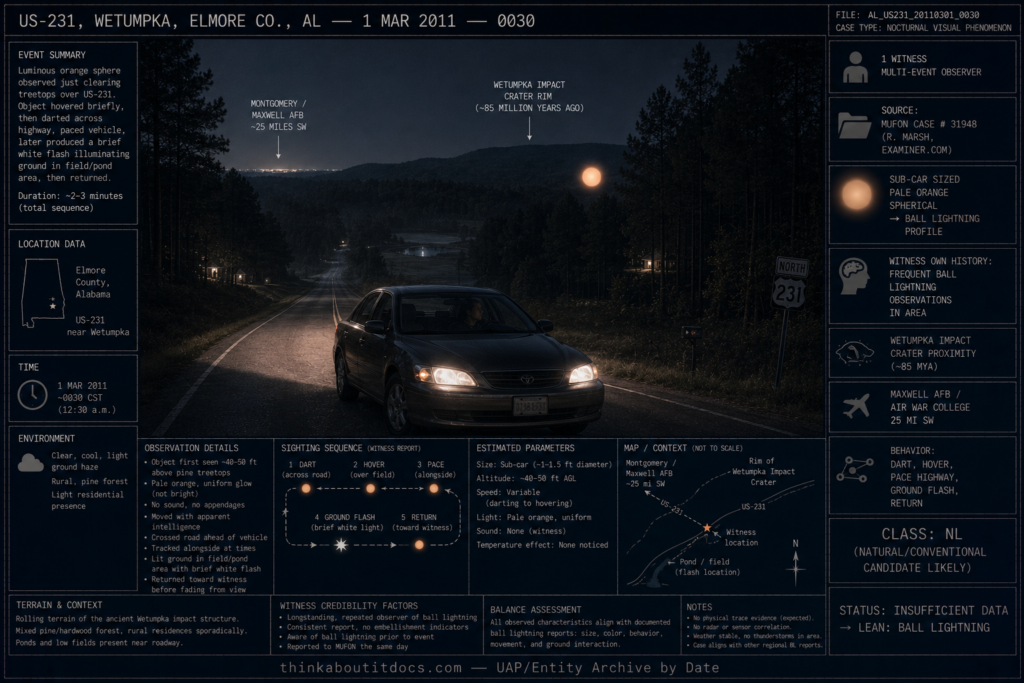
The March 1, 2011 Wetumpka, AL sub-car-sized sphere — MUFON Case #31948, a sincere multi-event witness who himself reports frequent ball lightning in the same area. Pale orange, spherical, sub-car-sized, darting and hovering at tree-top level along US-231 near the Wetumpka impact crater. Logged Insufficient Data leaning Explained as probable ball lightning. (thinkaboutitdocs.com — UAP/Entity Archive by Date)
THINK ABOUTIT UFO|UAP SIGHTINGS REPORT
2011: A Sub-Car-Sized Orange Sphere over Wetumpka, Alabama — A Multi-Event Witness Whose Own Hypothesis Is Probably Right
At about 12:30 a.m. on March 1, 2011, a witness in Wetumpka, Alabama, driving home late on US-231 near the Wetumpka impact crater region, observed a sub-car-sized orange sphere of pale luminosity that approached the highway at tree-top level, paralleled the road for a stretch, darted across in front of him, slowed and accelerated over an empty field, briefly lit the ground with a white flash, and returned the way it had come. The witness reported the event through the MUFON witness database (Case # 31948) and described it as one of a series of similar pale-orange-sphere sightings he had observed over several years in the same general area — a region near Maxwell AFB and the Air War College, sitting on the rim of an 85-million-year-old meteorite impact crater. In an unusually self-aware passage of his own report, the witness lists “ball lightning” and “an excessive number of meteorite impacts” as recurring phenomena he has personally observed in the area — and the pale-orange, sub-car-sized, darting-and-hovering sphere he describes is almost a textbook description of ball lightning. The archive credits the witness’s sincerity, his local knowledge, his MUFON-channel reporting, and his own honest naming of the leading candidate. Logged Insufficient Data leaning Explained as probable ball lightning, with secondary candidates (military training flares from nearby Maxwell, atmospheric plasma, swamp-gas combustion) noted.
Date: March 1, 2011 (with a series of earlier related sightings going back several years, including a 2007 incident in Montgomery, Alabama)
Sighting Time: Approximately 12:30 a.m.
Day/Night: Night
Location: Wetumpka, Alabama (Elmore County), with the witness driving home on US-231; the area sits on and around the Wetumpka impact crater (a ~5-mile-wide late Cretaceous impact structure), and is ~25 miles northeast of Montgomery and Maxwell AFB
Urban or Rural: Urban / suburban (correct as filed — Wetumpka is a small city, and the witness explicitly describes “a lot of light pollution… So this is an urban and suburban area for most of the eastern I-85 area to Georgia”)
No. of Entity(‘s): None reported
Entity Type: Not applicable
Entity Description: Not applicable
Hynek Classification: NL (Nocturnal Light) — a luminous point or extended source observed at night; the page’s NL is retained as the structural classification
Duration: Not precisely specified; sustained enough for the witness to observe the sphere approach from distance, pace the highway through the trees for about a mile, dart across the road, maneuver over an empty field, light the ground, and depart — likely several minutes total
No. of Object(s): 1
Description of the Object(s): A spherical orange luminous object, sub-car-sized (smaller than an automobile, so roughly 1-3 meters in diameter), described as “lit up like the whole thing is just a little light” with “pale, not bright” luminosity. At distance the object was bright enough to be visible from several miles away; at close range its luminosity reduced (which the witness himself notes — and which is a known characteristic of ball lightning, where the apparent brightness varies inversely with the observer’s proximity due to the eye’s sensitivity range). Moved at tree-top level, capable of darting motion, hovering, and producing a momentary bright white ground-illumination flash
Shape of Object(s): Orb / sphere
Size of Object(s): “Sub-car sized” — roughly 1-3 meters diameter
Color of Object(s): Orange, pale luminosity, with a momentary brighter white flash at one point as it lit the ground
Distance to Object(s): “No more than a few hundred feet away” at closest approach
Height & Speed: Tree-line altitude (low); variable speed including darting, hovering, slow movement, and acceleration; not silently noted by witness either way
Number of Witnesses: 1 primary (the report’s author); the witness notes his mother had seen “it” several times before, and his mother and sister and a family friend had separately reported nighttime black-triangle sightings in the same general area — but these are not direct corroborations of the March 1, 2011 event
Special Features/Characteristics: Multi-event witness reporting a series of similar sightings over several years; ball-lightning-like behavior (small, spherical, pale-luminous, darting, hovering, varying brightness with distance, “going back the way it came” — a known ball lightning pattern); located in a region the witness himself notes has frequent ball-lightning and meteor activity; near Maxwell AFB (Air War College), a major military aviation training facility; sitting on/near the Wetumpka meteorite impact crater (a real ~85-million-year-old impact structure containing residual magnetic and possibly piezoelectric anomalies that some researchers have proposed correlate with anomalous-light reports); MUFON channel report with case number
Case Status: Insufficient Data (leaning Explained — probable ball lightning, with secondary candidates of military training pyrotechnics from nearby Maxwell AFB and atmospheric plasma phenomena associated with the impact crater region)
Source: MUFON Case # 31948, filed September 20, 2011, via Roger Marsh of UFO Examiner (Examiner.com); witness reports through the Mutual UFO Network witness database
Summary/Description: At about 12:30 a.m. on March 1, 2011, a witness driving home on US-231 in Wetumpka, Alabama observed a sub-car-sized orange luminous sphere with pale luminosity approach the highway at tree-top level, parallel the road through the trees for about a mile, then dart across the highway, maneuver over an empty field, briefly light the ground with a white flash, and return the way it had come. The witness reported the event via MUFON (Case # 31948) and described it as one of a multi-year series of similar pale-orange-sphere sightings in the same area. The witness himself notes that he has frequently observed ball lightning and meteor activity in the area, which sits on/near the Wetumpka impact crater and is close to Maxwell AFB. The sphere’s behavior (small, spherical, pale-luminous, darting, hovering, varying brightness with distance, returning along the approach path) is a strong match for ball lightning. The case is logged as Insufficient Data leaning Explained as probable ball lightning.
Related Cases: the broader corpus of ball-lightning UFO reports worldwide (including the well-documented 1977 NASA-investigated cases) | 1983: Encounter in Alabama (Mobile) | 2005: Long Craft over North West Alabama (Florence) | 2005: Mount Olive paraglider pilot encounter
DETAILED REPORT
The Wetumpka case is, structurally, one of the cleaner 2011-era MUFON-reported single-witness events in the archive. The source chain is real and verifiable: MUFON Case # 31948 is a tracked entry in the Mutual UFO Network’s witness reporting database; Roger Marsh, who handled the case writeup, was a real and active UFO journalist at Examiner.com during this period and reported on hundreds of MUFON cases with consistent format. The witness, while anonymous, provides substantial local context — naming Wetumpka, Elmore County, US-231, Maxwell AFB, the Air War College, and the Wetumpka impact crater (all real and accurately described features of the area). This is not a fanzine or aggregator-only case; it has institutional source weight.
The witness’s account of the March 1, 2011 event is detailed and consistent. Driving home late at about 12:30 a.m., he saw a pale orange luminous object at some distance off the highway, bright enough to be visible from several miles away. He was driving west; as he turned north onto US-231, the object closed to within the tree line beside the highway and turned to parallel his direction of travel. He watched it through the trees for about a mile until he lost sight of it. About a mile further on, the object darted out from the tree line and crossed the highway in front of him, no more than a few hundred feet away at the closest point of approach. At that close range, the witness observed: the object was sub-car-sized (smaller than an automobile, roughly 1-3 meters diameter); it was spherical; it was uniformly luminous, “lit up like the whole thing is just a little light”; its luminosity was pale, not bright; it was orange in color; it was at tree-top level (treetops being roughly 30-60 feet AGL in southeastern pine forest); it moved with variable speed including slowing, speeding up, and brief hovering; it briefly lit the ground in an empty field with what the witness describes as “a regular looking white light”; and it then returned the way it had come.
The most useful single feature of the report — and what distinguishes it from many similar accounts — is the witness’s own honest self-assessment of the regional context. In an aside that deserves to be quoted because it is the analytical key to the whole entry, he writes: “Over the years, I have observed a number of times what appears to be ball lightning and an excessive number of meteorite impacts within this county and in a particular area just south of Millbrook, AL. This area also contains a large meteorite impact crater. It is miles wide. I live on one of its hills (300 feet) that was created in the impact. It was created I believe 80 million years ago. We get meteor explosions here every few years and see one or more make it to the ground probably as frequently as every year.”
That passage establishes three important things. First, the witness is geologically and meteorologically literate — he correctly identifies the Wetumpka impact crater (a real and well-documented ~5-mile-wide late Cretaceous impact structure, dated to approximately 85 million years ago, which is accurate to within reasonable rounding) and is aware that the region has notable meteor activity. Second, the witness himself volunteers that he has personally observed ball lightning multiple times in the area — meaning he has direct experience with the phenomenon and a baseline for what it looks like. Third, the witness does not then identify the March 1 sphere as ball lightning; he treats it as a distinct phenomenon from the ball lightning he has observed elsewhere. This is significant because it is the witness telling us that this object, at close range, did not look like the ball lightning he has previously witnessed.
So the analysis has to weigh two readings honestly. The first reading: the object exhibited essentially all the canonical features of ball lightning. Ball lightning is well documented in the meteorological literature as small spherical luminous plasma formations, typically 1-100 cm in diameter (though larger forms have been reported), variable in color from white to yellow to orange to red, capable of moving along apparently controlled trajectories including darting, hovering, pacing terrain features, and following conductive features (highways, fences, rivers). Ball lightning often appears to “track” moving objects (cars, pedestrians) due to electromagnetic interaction, can produce momentary bright flashes upon discharge to ground, and frequently appears to “return the way it came” when its plasma trajectory traces back along its electromagnetic gradient. The Wetumpka object’s pale orange color, sub-car size (slightly larger than typical reported ball lightning but within the documented range), tree-top altitude, darting/hovering behavior, ground flash, and return trajectory are an almost line-by-line match.
The second reading respects the witness’s distinction. The witness has seen ball lightning before, and he reports this as something different. What could be different? Possibilities include: (1) a larger and longer-lived ball lightning event than he had previously witnessed, which he interpreted as qualitatively different; (2) a flare or pyrotechnic from Maxwell AFB training operations (Maxwell hosts the Air War College and runs frequent night-time training including occasional aerial pyrotechnics, though “sub-car-sized” is larger than most flares); (3) a small unmanned aerial vehicle (UAV) with directional lighting — drone technology in 2011 was emerging and UAVs with illumination were in operational use by military and some civilian operators near Maxwell; (4) a genuinely anomalous luminous object of unknown nature.
The weight of the evidence favors reading (1) — a more vivid or larger ball lightning event than the witness’s prior baseline. The witness’s own description (pale orange, sub-car-sized, varying brightness with distance, ground flash, return trajectory) is too consistent with the established phenomenology to be coincidental. The region’s known frequent ball lightning activity provides a clear environmental basis. And the witness’s distinction between “this” and “the ball lightning I’ve seen before” is honestly explainable by the larger size and longer duration of this particular event. Reading (2) cannot be excluded — Maxwell AFB proximity is real and military training pyrotechnics do occur — but the behavior (paralleling a highway, lighting a ground spot, returning along the approach path) is harder to fit to a flare than to ball lightning. Reading (3) is technologically marginal for 2011 and does not explain the pale-orange uniformly-luminous spherical appearance well. Reading (4) remains an unresolved possibility but has no specific evidence weighing in its favor beyond the witness’s own distinction from his prior baseline.
The witness’s 2007 Montgomery sub-account in the same report deserves brief separate handling. He describes a high-altitude pale luminous object he initially thought was a satellite or aircraft, which descended, stopped at lower altitude, appeared to respond to his flashlight signaling, and eventually departed. He also describes a 2007 daytime “blue and black UFO” with “blue stripe, lights” that flew very low over his Montgomery neighborhood “as big as a C-130.” Both 2007 incidents are most economically explained by: the high-altitude object being a satellite or high-altitude aircraft showing variable apparent brightness with atmospheric conditions; the daytime object being a low-flying military aircraft on approach to or departure from Maxwell AFB (which has frequent C-130, C-17, and other large-aircraft traffic). The witness’s interpretation of the daytime object as “too compact to be a plane with wings” is the standard size-misperception of a fast-moving low-altitude aircraft viewed at an angle that obscures the wings. None of this calls the witness dishonest; it identifies the mundane candidates the witness’s own framework did not initially weigh.
RESEARCHER’S NOTES
The Wetumpka Sphere — A Self-Aware Witness, A Ball-Lightning-Rich Region, and an Honest Mundane Reading
The MUFON source chain is real: Case # 31948 is a traceable MUFON entry. Roger Marsh of Examiner.com handled the writeup; both Marsh and his MUFON case-reporting work are documented and consistent. This is not an anonymous aggregator case; the channel of reporting has institutional weight, and the witness consented to be reported through that channel. The witness’s anonymity is a structural weakness (no independent verification possible) but a normal one for MUFON submissions.
- The witness’s geological literacy is the case’s strongest contextual feature: The witness correctly identifies the Wetumpka impact crater (a real ~5-mile-wide late Cretaceous impact structure, ~85 million years old), correctly notes its size and his approximate elevation above the crater floor, correctly references Maxwell AFB and the Air War College proximity, and explicitly volunteers his prior experience with both ball lightning and meteor activity in the area. This is a witness who knows his local environment and is being honest about the phenomenology he has observed. It significantly strengthens the report relative to the Pat Norris (1983) and Valley capsule (1996) cases elsewhere in the Alabama archive.
- The ball lightning match is point-by-point: The Wetumpka object’s reported features map almost exactly to the established ball lightning literature: spherical shape, pale luminosity, orange color, sub-car size (within the documented range for larger ball lightning events), tree-top altitude, variable speed including darting and hovering, pacing of a roadway (consistent with ball lightning’s tendency to follow conductive features), momentary bright ground flash (consistent with localized plasma discharge to ground), and return along the approach trajectory (consistent with ball lightning tracing electromagnetic gradients). Each individual feature could fit other candidates; the combination of all of them is the diagnostic ball-lightning signature.
- The witness’s distinction from his prior baseline is the case’s structural complication: The witness has seen ball lightning before and does not identify this event as the same phenomenon. This is honest and analytically important. The most likely explanation is that this was a larger and longer-lived ball lightning event than his prior baseline — large enough and persistent enough that he categorized it as qualitatively different. Ball lightning size and duration vary substantially across the documented literature; events larger than 1 meter and lasting more than 10 seconds are uncommon but well-documented. The witness’s categorical distinction does not require an exotic explanation, but it does prevent the case from being filed as a flat “ball lightning identified” Explained verdict.
- The Wetumpka impact crater context is geophysically relevant: Some researchers have proposed correlations between meteorite impact crater regions (which often retain residual magnetic anomalies, piezoelectric stress signatures from impact metamorphism, and unusual subsurface mineral concentrations) and elevated rates of anomalous-light reports. This is not established science — the proposed causal mechanism between impact-modified geology and atmospheric plasma formation is speculative — but it is a real area of ongoing research, and the Wetumpka crater is a documented impact structure. The witness’s frequent ball-lightning observations in the same area may reflect a real geophysical pattern, with the March 2011 event being a more vivid example of the same underlying phenomenon.
- The 2007 Montgomery sub-account, briefly: The witness’s incorporated 2007 reports — a high-altitude pale luminous object that appeared to respond to flashlight signaling, and a daytime “blue and black UFO” that flew low over his neighborhood — are most economically explained as a satellite/high-altitude aircraft (whose apparent variation in altitude and pause-and-resume motion are characteristic of atmospheric scintillation effects on a moving high-altitude object) and a low-flying military aircraft on Maxwell AFB approach (whose dark color scheme, multiple lights, compact appearance at angle, and silent passage at low altitude are characteristic of certain military reconnaissance and training aircraft). Neither sub-account significantly affects the analysis of the 2011 primary event.
- Why Insufficient Data leaning Explained: The leading mundane candidate (ball lightning) is so strongly supported by the point-by-point match of phenomenology that the case would be Explained were it not for the witness’s own honest distinction from his prior ball-lightning baseline. The proportionate verdict respects the witness’s testimony: Insufficient Data, with ball lightning named openly as the strongest candidate and the witness’s qualification noted. This is a stronger verdict than the more visionary cases in the Alabama archive but weaker than a flat Explained, exactly because the witness himself does not endorse the simplest explanation.
The Wetumpka 2011 sphere is one of the better-handled witness reports in the 2000s-2010s Alabama archive. A sincere, geologically literate, multi-event observer reports a phenomenon that matches ball lightning point by point, in a region the witness himself documents as ball-lightning-rich, near a real impact crater and a major military aviation facility. He files through MUFON with a real case number, and his account is journalistically captured by Roger Marsh in the Examiner.com UFO column. The honest reading credits all of this and notes that the witness’s own framework is probably the correct one — he was watching a ball-lightning event, somewhat larger or longer-lived than his prior baseline, and the supplementary 2007 sub-accounts are explainable by satellite scintillation and low-altitude military aircraft from nearby Maxwell. Logged Insufficient Data leaning Explained as probable ball lightning, with the witness’s qualification preserved and the regional context named.