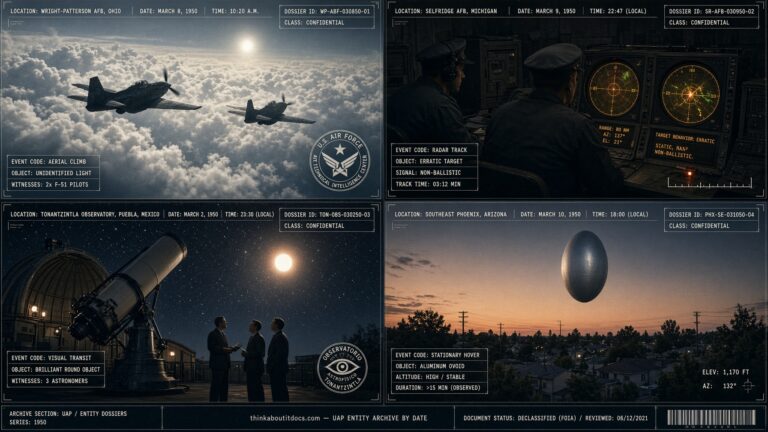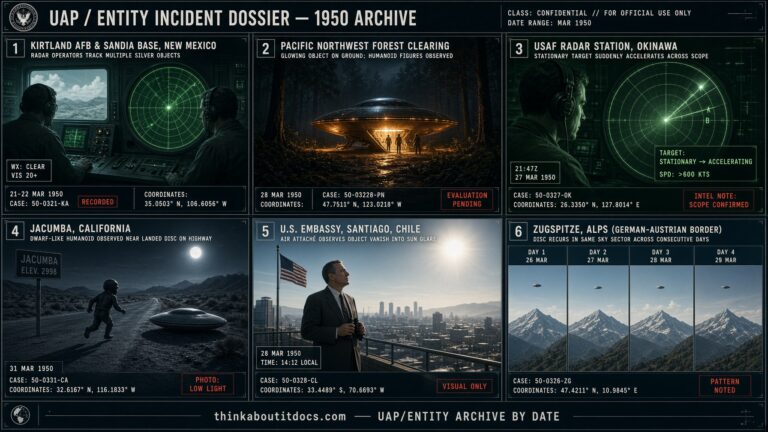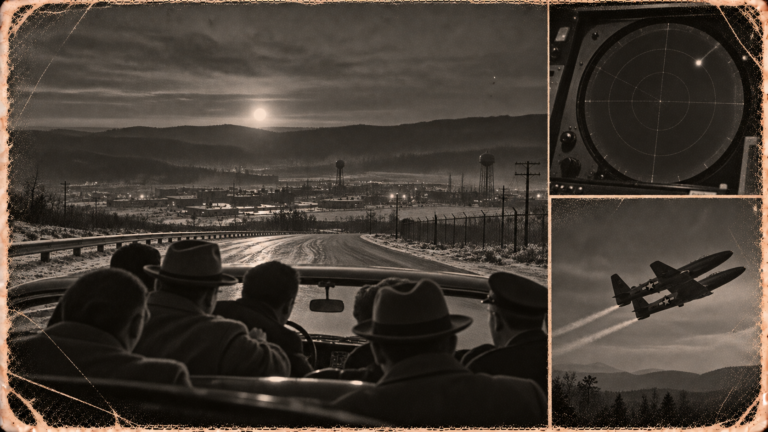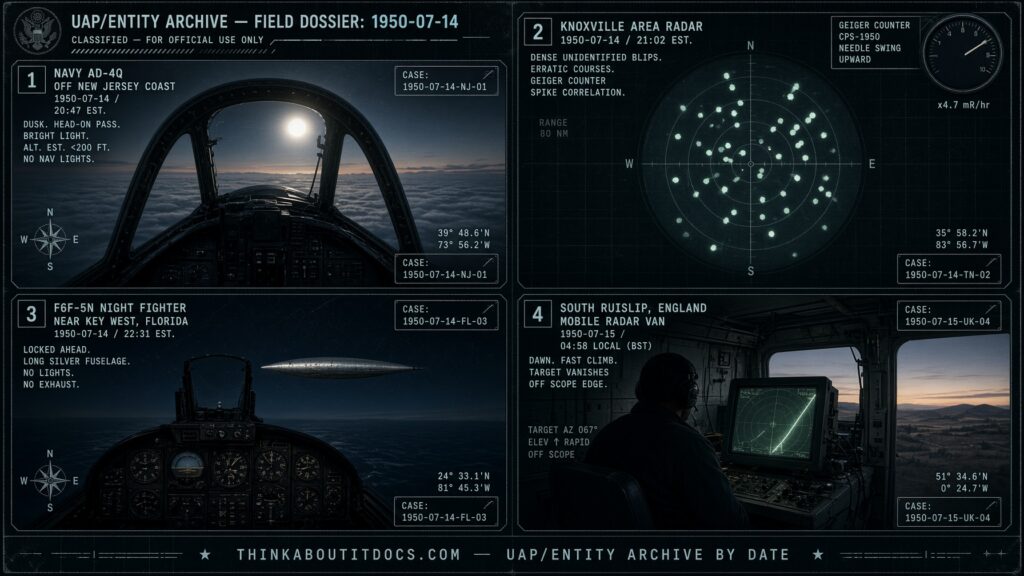
Four cases from November 1950, headlined by the Robert Haven aerial pursuit and the Oak Ridge/Knoxville radiation-anomaly incident.
1950: November UFO|UAP & Entity Sightings Archive
November 1950 opens with a Navy pilot’s head-on passes with a maneuvering light east of Lakehurst, New Jersey, and builds through a Mississippi National Guard pilot’s 25-minute chase of a milky-white bar over Meridian, four brilliant white discs over Thanksgiving Day at Maxwell AFB, and radar targets that swamped the Oak Ridge restricted area on the same nights a Geiger counter jumped. Along the way come Navy radar-and-visual intercepts off Key West, the Heston Airdrome radar contacts outside London, a blue flash that lit up Anchorage, a still-unexplained report from Okinawa, and a contactee-style entity encounter in Columbus, Ohio. Several of the month’s best-documented sightings are linked below as full reports.
Date: November 2, 1950
Location: North-northwest of Rome, New York (Griffiss AFB); also reported from Michigan, Ohio, New England and Ontario
Time: 7:35 p.m. EST (1935 hours)
Summary: Two flying officers at Griffiss AFB, described by the Office of Special Investigations as apparently reliable, reported a blue-white flash north of Rome that built up for two or three seconds and suddenly disappeared. No object, sound, unusual radio static, or crater was associated with it. The same evening, Eastern Air Defense Force logged a Beechcraft pilot flying from Chicago to Detroit who saw a “rocket burst” at about 6,000 feet, some 20 miles north of Romulus, Michigan, at 7:37 p.m., and the 32nd Air Division reported an hour of calls about rockets or balls of fire from Watertown, Syracuse, Cleveland, Westover and West Point. Boston CAA relayed word from Harvard Observatory that this was the “Wright meteor,” which the observatory had expected that night; the Quonset Point tower operators also identified it as a meteor. Hq USAF closed the file in February 1951, writing that the phenomenon “has been confirmed as a meteor by several sources.”
Source: Hq USAF teletypes AFOIN 57159 and radnote AFOIN-C/DD-10; 22nd OSI District, Griffiss AFB, message of November 24, 1950; Hq USAF 2nd Indorsement, February 1951
Source Status: Identified as a meteor; no Project Blue Book unknown listing.
Date: November 3, 1950
Location: San Francisco, California
Time: About 9:30 a.m.
Summary: A witness from East Palo Alto and eight to ten other railway workers in the Southern Pacific freight yard watched a bright, round, white object directly overhead, about the size of a silver dollar held at arm’s length, for 20 to 30 minutes. It seemed suspended in the air, made no sound, showed no aerodynamic features, trail, exhaust, or propulsion, and crossed about 10 degrees of sky during the observation. Comparing it with a medium aircraft, the witness put it at about 20,000 feet. None of the observers had aeronautical experience. The 19th OSI District took no further action. Project Blue Book evaluated the sighting as a balloon.
Source: Office of Special Investigations, 19th District (Fairfield-Suisun AFB), letter of November 3, 1950, forwarded by 5th District OSI on November 8, 1950; Project Blue Book record card
Source Status: The witness’s name is redacted in the released file.
Date: November 5, 1950
Location: Jonesville (Catahoula Parish), Louisiana
Time: About 1:45 p.m.
Summary: A farm family southwest of Jonesville ran out when the family cook, on her way home from washing the dinner dishes, came rushing back shouting that something was hovering over the tractor shed. Six family members saw an object that had risen to roughly 50 feet above the ground. It was “so bright and shiny we couldn’t tell anything about its shape or size.” It went up to the northwest, trailing what looked like twin exhausts such as a jet makes, though the two trails did not stay parallel; one man watched through a pocket telescope, saw the object take its time and disappear in about five minutes, and said the trail looked red and then bluish at the end. The cook said there were two objects, long and round like a cigar. Project Blue Book evaluated the report as Insufficient Data, most likely aircraft contrails.
Source: Shreveport Times, November 7, 1950 (special report from Jonesville), quoted in 9th OSI District (Barksdale AFB) Spot Intelligence Report DO #9, November 7, 1950; Project Blue Book record card
Source Status: The family’s names are redacted in the released file. The same OSI report also covers the October 10 and 10-11 New Orleans sightings (see the October 1950 archive).
Date: November 5, 1950
Location: Oak Ridge, Tennessee
Time: 11:55 a.m.
Summary: Fairchild Aircraft illustrator Don Patrick, an employee of the NEPA Division with a “Q” clearance, watched a translucent, light-grey object with a darker core, shaped like a pear or bean, change shape rapidly and move in quick, darting motions within the area of a small circle for five to ten minutes. It hung over the northwest corner of Oak Ridge, near a mountain ridge about six miles away, and had sharply defined edges and a constant mass. Its core took the shape of the whole object as it changed. It seemed to move in and out of a cloud, which Patrick thought might be due to its semi-transparent character; it gave off no sound or specular reflection. His first impression was a balloon, which he rejected as the movements were too rapid and random and the changes of shape too extreme. Weather was 61 degrees with a 9 to 12 mph west wind and unlimited visibility. The object vanished while he was trying to find another witness. The OSI investigator calculated that at six miles it would have been comparable to a three-story building half a block long, and recorded no known cause. Part of the ongoing Oak Ridge/Knoxville pattern that began the previous month. See the Full Report.
Source: Berliner; Office of Special Investigations report (Maxwell AFB OSI district), with witness sketch; Project Blue Book record card (BBU 829)
Date: November 7, 1950
Location: East of Lakehurst, New Jersey
Time: About 7:15 p.m. EST (1915)
Summary: Navy pilot Lt. j.g. Robert Haven, flying an AD-4Q on a routine night radar navigation flight from NAS Atlantic City and homing in on NAS Lakehurst at about 3,500 feet, saw a single steady white light about five miles to starboard, slightly above him at about 4,000 feet and moving southeast at about his airspeed. Taking it for another aircraft, he told his radar operator to switch to “intercept” and climbed to get on its tail. Without a turn, the light bore down on him in a slight dive and passed 100 to 200 feet over his canopy at an incredible speed. He reversed in a tight turn; the light made another head-on pass, veering low enough that his crewman saw it too, a single white light 10 to 12 inches across. After five or six passes, he and the object settled into a port orbit while he flew a 60-degree climbing bank at 130 to 135 knots; the light turned about him in wider climbing turns, making about two orbits to his one. He abandoned the chase at 11,500 feet. The CO of his squadron and his wingmen, answering in two F9Fs, arrived over McGuire AFB at 14,000 feet as Haven put the object near 18,000 feet and still climbing; by the time they reached him it was faint at about 25,000 feet. The CO never saw it; his wingmen did. Haven judged the object’s speed at least twice a jet’s, about 800 knots, and could find no wash or slipstream when he tried to fly through its path. The sighting lasted 25 to 30 minutes. Hq USAF noted that a lighted balloon was a possibility but that Haven’s description, if accurate, ruled out a weather balloon; Blue Book’s card is marked “Balloon.” See the Full Report.
Source: Letter of Lt. j.g. Haven (USNR) to Hq USAF, November 29, 1950, with endorsement of Air Development Squadron Three, November 30, 1950; Hq USAF Technical Capabilities Branch indorsement; Hynek, UFO Report, pp. 68-70; NARCAP; Project Blue Book record card
Source Status: Blue Book’s evaluation is “Balloon.” Hq USAF’s own indorsement says the balloon possibility was explored when Haven was interviewed and that a lighted weather balloon was not possible if his description was accurate. AMC replied that no definite conclusion could be reached on the facts presented and asked OSI whether anyone else reported a similar light at that time and place.
Date: November 10, 1950
Location: Heston Airdrome, South Ruislip (Greater London), England
Time: 8:59 a.m. to 10:26 a.m. GMT (first contact 0859Z)
Summary: Four radar contacts were made on an unidentified airborne object over England at altitudes from 1,000 feet or less to 30,000 feet or more, giving returns comparable to a B-29. Speeds varied from about 30 mph to over 1,000 mph. In one case the object climbed from 13,000 to 30,000 feet in under five seconds, a climb rate over 1,000 mph, while covering 3,600 feet laterally. It made abrupt turns, in one case 90 degrees right for 600 yards, then 160 degrees left for 200 yards, then 150 degrees right for 300 yards, continuing about 70 seconds, and in another case 18 turns of 100 degrees or more in 2,500 yards. The first contact lasted from 8:59 until 9:07 and was lost in ground clutter after about 6.5 miles; the second ran from 9:09 to 9:12; the third, from 9:46 to 9:47, ended when acceleration and ascent exceeded the capability of the automatic tracking circuits; a fourth, brief contact came at 10:25. The set was an AN/MPQ-2 (SCR-584) radar with an MC-627 plotting board at Heston, operated by Detachment H, 3903rd Radar Bomb Scoring Squadron; the operators, a captain, a first lieutenant with eight and a half years in radar, a sergeant and a corporal, checked the set for malfunction and found none, and it tracked other aircraft normally. Visual contact was not made. Cloud was 10/10 at 1,000 feet with rain and 65-knot winds at 20,000 feet. Air Materiel Command concluded that the targets were spurious echoes from abnormal weather, citing a similar case at Wright-Patterson AFB on March 8, 1950, when interceptors found ice-laden clouds at 10,000 feet; Blue Book’s record card reads “Other (Wx returns).” See the Full Report.
Source: Air Intelligence Information Report IR-1-50, Hq Third Air Division, November 20, 1950; 3AD-DIC 3998 message of November 10, 1950; AMC letters; Project Blue Book record card; Dan Wilson
Source Status: The McDonald list’s separate “South Ruislip, November 20, 1950” entry is this case: November 20 is the date of IR-1-50, which gives the date of the incident as November 10. The Third Air Division’s message says RAF Fighter Command dispatched a fighter with no result, while the final report says no aircraft were scrambled because of weather and the lack of a common frequency; both are recorded in the file. A December 1950 SAC wire about a sighting “one week previous to November 17” confused this case with a September report, which AMC pointed out.
Date: November 13, 1950
Location: Rome, Georgia
Time: About 2:30 p.m.
Summary: Five people, including the Russell Field airport manager and a U.S. Weather Bureau observer, saw two disc-shaped objects for several minutes at about the time an Air Force AT-6 trainer buzzed the runway. One disc dropped toward the field and then climbed away; both disappeared, one to the north and one to the northeast. The witnesses could not estimate altitude or size. Eastern Air Lines flights were alerted. Project Blue Book recorded the report with the note “Insufficient Data.”
Source: Atlanta Constitution, November 14, 1950 (via Rome News-Tribune), quoted in Air Intelligence Information Report, Hq Air Force Communications Service (AACS), January 26, 1951; Project Blue Book record card
Source Status: The clipping dates the sighting “Monday, 14 November,” but November 14, 1950 was a Tuesday and the article ran in that day’s paper; Monday was November 13, the date used here. Blue Book’s record card gives November 14, the date of the news report, and a time of 1430.
Date: November 13, 1950
Location: Meridian, Mississippi (also seen from Jackson, McComb, Monroe, Brookhaven, Florence and Vicksburg)
Time: About 4:35 p.m. to 6:15 p.m. CST (pilot’s chase about 4:50 p.m.)
Summary: A Mississippi Air National Guard pilot, Maj. B.D. Stephens of the 153rd Fighter Squadron, flying an F-47 at 3,000 feet about eight miles east of Meridian, saw a milky-white, bar-shaped object silhouetted against the sky near the sun, traveling due west. He climbed to 21,000 feet at an indicated 210 mph to pursue it, radioing every aircraft and station in range (Jackson Radio, Meridian Radio, Maxwell Air Force Base and Monroe Radio received the broadcast). From the air he estimated it at 450 to 500 feet long and 50 feet wide, like a horizontal bar with one end slanting down, at 55,000 to 60,000 feet and about 600 mph, with no exhaust, lights, vapor trail, controls or airducts and no reflection; it showed no change of course or altitude during 25 minutes of observation. Newspapers reported he chased it for 66 miles and that it resembled “the edge of a bright tilted plate,” and Stephens said it could have been the vapor effect of a high-flying B-36. Three Mississippi National Guard enlisted men at Key Field independently watched it from the ramp from about 4:50 p.m. to 5:10 p.m. and called it diminishing in size; two weather forecasters gave clear skies. Two control tower operators at Jackson Air Field watched through six-power binoculars from 4:35 p.m. for 40 minutes, describing what looked like an aircraft wing with a constant-length vapor trail that suddenly disappeared, dull white, with no reflection and no scheduled flights in the area. A Jackson woman described a very fast object heading west whose rear looked like a cylinder of flame five or six feet long; local papers called it a “mysterious streak of light” that changed from orange to lemon to white. The Mississippi Military District headquarters separately reported a “bright sliver of light” about half the size of a flattened new moon, ten degrees above the horizon in the direction of the already-set sun, slowly shrinking and moving away to the west until it vanished at 5:25 p.m. Blue Book’s card is marked “Balloon.” See the Full Report.
Source: OSI Spot Intelligence Report DO #9, November 25-26, 1950 (Special Agent interviews), with clippings from the Jackson Clarion-Ledger, Vicksburg Evening Post and Jackson Daily News; Hq Mississippi Military District message, 14th Air Force transmittal; Project Blue Book record card
Source Status: The pilot’s name comes from the Vicksburg and Meridian newspaper accounts; it is redacted in the OSI file. The OSI report and some clippings give November 13 and 14 for the same Monday-evening events.
Date: November 13, 1950
Location: South of Meridian to Vicksburg, Mississippi (from a C-47 in flight)
Time: About 5:15 p.m. until dark
Summary: The crew of a C-47 flying at about 160 mph and 4,000 feet, heading 250 degrees about 25 miles south of Meridian, first saw a long, slender white or silver-white object about 20 degrees right of the nose and 10 degrees above the horizon. It looked like a parachute with no shrouds, at times seemed to have a tail, flew in a wing-low attitude and gradually righted itself, and was visible for roughly an hour until darkness hid it near Vicksburg. The weather was clear with a wind of 5 to 10 knots and a red haze at sunset, and no interception was attempted. The 14th Air Force rated the report C-2 and noted no unusual weather or meteorological condition known.
Source: Hq 14th Air Force, Robins AFB, report under Hq USAF letter of September 8, 1950, forwarded to AMC in November 1950
Source Status: The report gives the time as 1715 with the letter “E”; the time zone is unclear. Likely the same evening as the Meridian pursuit above, but no document links the two.
Date: November 14, 1950
Location: Key West, Florida
Time: About 8:00 p.m. to 8:15 p.m.
Summary: Ground radar picked up an unidentified aircraft at 15,000 feet, 30 miles north of NAS Key West, tracked intermittently at 480 mph on a heading of 180 degrees; it turned right and faded from the scope. An F6F-5N night fighter picked it up on its own radar at a mile and a half but could not close for a visual contact. At about 8:15 p.m. the pilot of an F6F-5N sighted an unidentified aircraft traveling at high speed near the base. The weather was clear with excellent visibility. The Navy later reported that the return was slightly smaller than a B-29 and weak, like that of an F-80, and concluded that the target had probably been making runs on the interceptor with its running lights on, noting that jets give poor returns on straight courses but better ones in steep turns. Project Blue Book’s card is marked “A/C,” and Hq USAF wrote in April 1951 that the targets were more probably non-scheduled DC-6 or Constellation transports or military training flights.
Source: Fleet All Weather Training Unit, Atlantic (NAS Key West) speed letter ser 988 of November 21, 1950, with endorsements through Eastern Air Defense Force and Hq USAF (2nd Indorsement, April 12, 1951); Project Blue Book record card; Dan Wilson; McDonald list
Source Status: The ground set was an SX general-purpose search radar (2,870 MHz) and the interceptor carried AN/APS-6 (X-band) radar. The pilot who sighted the aircraft was flying the F6F that had been the target for the interceptor’s radar contact.
Date: November 15, 1950
Location: Key West, Florida
Time: About 9:00 p.m.
Summary: Ground radar on a GCI flight picked up an aircraft at 15,000 feet within three miles of two F6F-5Ns, 42 miles from NAS Key West on a bearing of 270 degrees. One experienced night fighter pilot made visual contact with an aircraft with a long silver fuselage and no lights, which then followed the two F6F-5Ns as ground control vectored them. The radar return was twice the size of an F6F’s, and the object’s speed was estimated at more than twice the F6Fs’ 160-knot cruising speed. Military Flight Service reported no known aircraft scheduled or on a flight plan for the area. Hq USAF concluded that the targets were more probably non-scheduled civil transports of the DC-6 or Constellation type, or military training flights, and the Blue Book card is marked “A/C.” Related to the sighting near the same location the previous night.
Source: Fleet All Weather Training Unit, Atlantic (NAS Key West) speed letter ser 988 of November 21, 1950; Hq USAF 2nd Indorsement, April 12, 1951; Project Blue Book record card; Dan Wilson; McDonald list
Date: November 21, 1950
Location: Northern Okinawa (near the northern tip of the island)
Time: After 7:00 p.m. local time
Summary: Airmen at a hilltop outpost playing pinochle heard a sound like a motor that died, unlike any conventional aircraft one of them knew from twelve years of service, and soldiers returning from town saw a big white light like a landing light come in from the northeast and fall near the mouth of a lagoon, where a native village lay. The witness waited about half an hour and called island control, which reported no aircraft down; the radio log was later discarded under standing rules. The airmen who saw the light did not see a splash. The account surfaced in 1952, when the witness, by then a technical sergeant at Wright Air Development Center, volunteered it to Project Blue Book, and Captain Edward Ruppelt interviewed him; USAF headquarters studied charts to decide whether recovery was practicable and concluded that an attempt would require diving in about 10 fathoms over half a square mile or more and would be impractical. Project Blue Book’s record card reads “Insufficient Data: too old to investigate.” See the Full Report.
Source: Project Blue Book record card; Memorandum for Record of the Ruppelt interview (1952); USAF Directorate of Intelligence DFs, August 1952
Source Status: The record card gives November 21, 1950 with a date-time group of 22/0700Z; the interview places the event two days before Thanksgiving (November 21) after 7:00 p.m. local time. The location is also uncertain: the witness’s sketch matched the lagoon at Oku better than the northern tip, and he estimated the water four fathoms deep where the sketch implied about 10. This is a recollection given about two years after the event.
Date: November 23, 1950 (Thanksgiving Day)
Location: Maxwell AFB, Montgomery, Alabama
Time: Between 3:08 p.m. and 3:25 p.m.
Summary: Two Air University officers at Maxwell AFB reported unidentified objects over the base. One, a major, saw four objects he could not identify, about 3/8 inch across at arm’s length, perfectly circular and very thin, brilliantly white “almost porcelain white.” The first came from the south-southwest, rose to a great height over Montgomery, and as it descended appeared to turn over and over before moving off to the northeast; his wife saw it too, and he could tell it was round from below and thin from the side. A second passed over quickly in level flight in the same direction. A few minutes later two more came over together from about the south-southeast: one rose rapidly north, out of sight, the other turned back, then rose and vanished, and one seemed to have an antenna. A captain who came out at once also saw them. The major ruled out balloons, noting clear skies and a northwest wind at all altitudes with the objects crossing the wind. The captain’s separate statement adds that another officer called him out to see two objects, white and directly over their quarters, one looking like a seagull with stiff, motionless wings and the other like a white ball, which hung still for about a minute before moving north and rising out of sight in 30 seconds. Project Blue Book’s card reads “Other,” with an unclear note. See the Full Report.
Source: Hq Air University letter of December 19, 1950, forwarding two statements dated December 1, 1950, to Hq USAF; Project Blue Book record card; McDonald list; FUFOR Index
Source Status: The cover letter’s date reads like November 28 on the copy; both statements and the record card give Thanksgiving Day, November 23, which is used here. The witnesses’ names are redacted.
Date: November 25, 1950
Location: Columbus, Ohio
Time: Late night
Summary: The witness, who had gone to bed with a strange feeling of being watched, was awakened by a tall, human-like figure with angelic features. The figure raised a hand, apparently causing the bedroom door to open, and explained he had come from a distant planet, inviting the witness to accompany him there. The witness agreed, reportedly returning two days later. The being was said to have melted large snowdrifts around the witness’s home using a laser-like weapon. No further detail is available.
Source: Lillian Crowner Desguin, UFO’s: Fact or Fiction?
Date: November 27, 1950
Location: West of Bakersfield, California (en route to Burbank)
Time: 9:08 p.m. PST
Summary: The crew of a scheduled DC-3 airliner flying at about 11,000 feet on a heading near 120 degrees saw a brilliant blue-white light, the size of a very large star, that was at first stationary. It made a sharp turn toward the DC-3, then a slow left turn until it flew parallel to the aircraft for a short distance, and then pulled ahead to the left and headed toward the Tehachapi-Palmdale area. The pilot applied full power, over 200 mph, but the object drew away rapidly on a straight course until the light gradually faded. The sighting lasted about five minutes. The 22nd Bomb Wing intelligence officer, reporting through 15th Air Force, said the crew’s experience made the report reliable and that a star, planet, meteor or balloon was ruled out because the object neither held a fixed position nor followed a constant path. Project Blue Book’s card is marked “A/C.”
Source: Air Intelligence Information Report, 22nd Bomb Wing, December 2, 1950, forwarded by Hq 15th Air Force (March AFB), December 6, 1950; Project Blue Book record card
Source Status: This is a different case from the November 27 Huron, South Dakota entry below.
Date: November 27, 1950
Location: Huron, South Dakota
Time: Unknown
Summary: CAA personnel saw a hovering, maneuvering UFO.
Source: McDonald list; FUFOR Index
Date: November 27, 1950
Location: Evansville, Wisconsin
Time: Unknown
Summary: A flying instructor reported six elliptical objects in loose echelon formation.
Source: McDonald list; FUFOR Index
Date: November 29-30, 1950
Location: McGhee Tyson Airport / Oak Ridge, Knoxville, Tennessee
Time: Beginning 5:55 p.m. November 29, continuing intermittently into November 30
Summary: Numerous unidentified radar “paints” appeared on the AN/CPS-1 early-warning set of the 662nd Aircraft Control and Warning Squadron detachment at McGhee Tyson Airport, so numerous they almost covered the Oak Ridge restricted area. They seemed to form near the center of the northwest boundary and drift southeast at about six to eight mph, some changing course slightly in the six-mph southwest wind, at estimated heights of 2,500 to 3,000 feet. Maintenance crews found no malfunction, and the controller switched between high and low beams and had another radar expert confirm the picture. A scrambled fighter was vectored through and around the targets and saw nothing; its own radar picked up nothing. A background Geiger counter in the restricted area recorded a pronounced rise in alpha particles and a slight rise in gamma rays at about 7:00 p.m. on November 29 that were unaccounted for; the AEC advised that no “argon releases” had been scheduled. Most targets stayed on the scope for two or three hours and a few were still there at 5:00 a.m. On November 30 a single target appeared in the early afternoon and moved from 17 to 12 miles at azimuth 310 to 285 degrees before vanishing at about 2:05 p.m.; numerous further targets, too many to count or plot, reappeared about 4:30 p.m. and stayed until 11:30 p.m. or midnight, watched by a group that included NEPA project personnel, an Oak Ridge National Laboratory scientist, and CIC and OSI representatives. Photographs of the scope with a 35mm camera produced no image. Air Materiel Command investigators visited on December 5 and 6 and concluded that the targets were ground objects made visible by anomalous propagation of the radar beam (a temperature-inversion “duct”); a January 1951 AMC engineering report agreed and noted that flights of ducks had been detected on this set at 6,900 feet, but recommended scope photographs and soundings because only photographs could settle the question. The radiation readings were not explained. The most striking single incident in the ongoing Oak Ridge/Knoxville pattern. See the Full Report.
Source: Army CIC Summary of Information, Knoxville, December 1, 1950; Hq Third Army letter of December 11, 1950; AMC Intelligence Department note of December 12, 1950; AMC Electronic Subdivision report, January 11, 1951; McDonald list; Dan Wilson
Source Status: The files do not support the earlier figure of “at least nine” named witnesses; most names on the November 30 witness list are redacted. The CIC summary also notes concern over an unrelated report of a truck carrying a covered silver cylindrical object in the Oak Ridge hills on November 30; AMC saw no relation to the radar targets.
Date: November 30, 1950
Location: Anchorage and South-Central Alaska (seen from Kodiak, Seward, Whittier, Palmer and a ship 50 miles south of Kodiak)
Time: About 7:53 p.m. AST (0553Z December 1)
Summary: A brilliant blue-white flash lit the whole Anchorage area like daylight, rapidly increasing in intensity before it vanished high in the sky, with mountains clearly visible at 70 miles. A few seconds to half a minute later, many heard a rumbling or a series of up to five explosions, each fainter and farther away, some feeling the ground shake. Hundreds of residents saw it, and the Merrill Field weather observer logged a bright blue flash with a thunder-like rumble lasting two to three minutes; a pilot approaching Anchorage reported the object directly overhead, brightening until it was blinding and then appearing to explode northeast of him, leaving a faint trail visible 20 to 30 seconds. Descriptions varied from a meteor to a flare to a transformer explosion. It was seen as far north as Healy, about 185 miles away, but not at Fairbanks; radar contact was negative and the University of Alaska’s seismographs showed nothing. The Alaskan Air Command considered it a meteor, and Blue Book’s card reads “Astro (Meteor).” See the Full Report.
Source: Alaskan Air Command message AAOTD-8111, December 2, 1950; Fort Richardson message to the Department of the Army, December 1, 1950; Air Intelligence Information Report, Alaskan Air Command, December 28, 1950; Project Blue Book record card
Source Status: Identified as a meteor.
EXECUTIVE SUMMARY
A Navy Dogfight, a Guard Pilot’s Chase, and a Radar Storm at a Nuclear Site
November 1950’s strongest cases rest on trained observers and paper trails. Lt. j.g. Robert Haven’s Lakehurst encounter involved his radar operator and the CO’s F9F wingmen, who saw the light when they arrived, and the Air Force’s own indorsement concedes that a lighted weather balloon cannot account for his description even though Project Blue Book filed the card as a balloon. In Mississippi, a National Guard pilot, three enlisted men at Key Field, two Jackson tower operators, a C-47 crew and military district headquarters all reported something that evening, and OSI interviewed them within days. At Maxwell AFB, two officers and a spouse watched four white discs on Thanksgiving afternoon, and Alaska’s blue flash was seen by hundreds.
The month also shows how often the files reach an explanation: Key West became aircraft, Heston became weather echoes, Anchorage a meteor, Knoxville a temperature-inversion duct. Yet two threads stay open. Air Materiel Command ducting does not account for the unexplained alpha and gamma readings at Oak Ridge on November 29, and the Heston report records a target that climbed 17,000 feet in under five seconds on equipment the operators had checked for faults.
“Only this single steady white light that could move with phenomenal speed and maneuverability.”
— Lt. j.g. Robert Haven, USNR, letter to Headquarters USAF, November 29, 1950