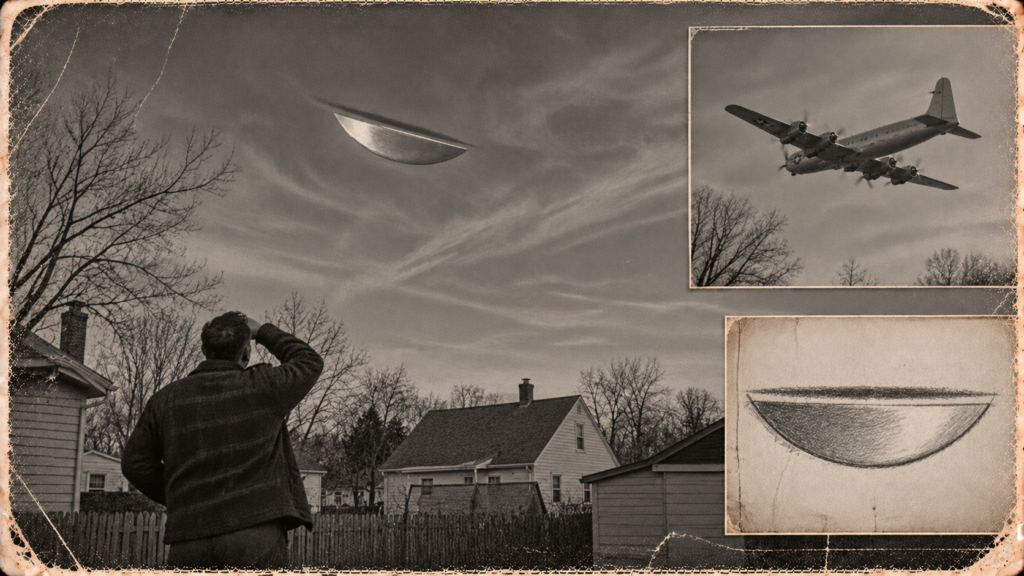
West Springfield, Massachusetts, December 6, 1950: an Air National Guard mechanic saw a silvery half-moon object fly south
THINK ABOUTIT UFO|UAP SIGHTINGS REPORT
1950: West Springfield, Massachusetts
A Half-Moon Object, a Whistle and a Radar That Was Down
At 8:16 on the morning of December 6, 1950, an Air National Guard mechanic standing in his yard in West Springfield, Massachusetts, heard a continuous whistle like wind over wires and looked up. On his second look he saw a half-moon-shaped object with a silvery outline and a shadow line above it, about 60 degrees up, flying south at a speed that seemed to far exceed any known aircraft before it vanished suddenly.
Westover Air Force Base, a few miles away, investigated within days, and the report went up through Hq MATS as IR-372-50. The wing intelligence officer found him sincere, then offered an explanation: a sound from a commercial vehicle and a false vision from bright sun on some reflecting object. Westover’s approach radar happened to be out of service. Earlier listings placed this case at the base; this Westover AFB, Massachusetts UFO report was really filed from West Springfield.
Date: December 6, 1950
Sighting Time: 8:16 a.m. EST
Day/Night: Day
Location: Over West Springfield, Massachusetts, from the observer’s yard, near Westover AFB
Urban or Rural: Suburban
No. of Entity’s: Not Applicable
Entity Type: Not Applicable
Entity Description: Not Applicable
Hynek Classification: Daylight Disc (DD)
Duration: Less than 45 seconds by the witness; 5 to 10 seconds in the interrogator’s opinion
No. of Object(s): One
Description of the Object(s): A half-moon-shaped object, rounded edge downward, with a silvery outline and a shadow line above it; apparent construction possibly metallic; a continuous whistle like wind over wires with some resemblance to a jet
Shape/Size/Color of Object(s): Half moon; size not determined; silvery outline
Distance to Object(s): Not determined; the observer could not judge distance
Height & Speed: 10,000 to 20,000 feet if the size of a C-54; speed appeared to far exceed known aircraft, accelerating in straight flight
Number of Witnesses: One
Special Features/Characteristics: Continuous whistling sound; first seen about 60 degrees up, above and to the right of the sun; disappeared suddenly at about 45 degrees; no exhaust, lights or clouds; sketch included
Case Status: Evaluated A/C by Blue Book; the interrogator suggested a sound from a commercial vehicle and a false vision from bright sun or a reflecting object.
Source: Air Intelligence Information Report IR-372-50, Hq MATS Intelligence Division, December 21, 1950, with sketch; Project Blue Book record card; Dan Wilson; Bruce Maccabee
Summary/Description: An Air National Guard mechanic saw a silvery half-moon streak south over West Springfield on December 6, 1950; Blue Book called it aircraft.
Related Cases: Same day: the radar alert, Fort Myers and Del Rio, in the December 1950 archive; a Westover radar case appears in the January 1951 files.
Detailed Report
The report was written at Westover AFB by the wing intelligence officer, Captain Lloyd A. Olsen, who interrogated the witness and sent the results to Hq MATS in Washington, where Lt. Col. William L. Travis, chief of the Intelligence Division, issued it as Air Intelligence Information Report IR-372-50 on December 21, 1950. It was prepared under the September 8, 1950 USAF file letter on reporting unconventional aircraft, and it carries a sketch of the object.
The sighting took place at 8:16 a.m. EST over West Springfield, Massachusetts, from the yard of the observer’s home. The observer, a service man for a business machine company, was a member of the Air National Guard at Westfield and an aircraft mechanic with experience in World War II. He told the interrogator that his attention was drawn by a sound: a continuous whistle, which he described as a wind blowing over wires or objects of slight resistance, with some resemblance to the sound of jet propulsion. He did not see the object on his first search of the sky but picked it up immediately when he looked a few seconds later.
He described a half-moon appearance with the rounded edge downward, a silvery outline and a shadow line above it, possibly metallic. He first saw it about 60 degrees above the horizon, above and to the right of the sun, and since he could not judge its distance he reckoned its altitude at 10,000 to 20,000 feet if it were the size of a C-54 transport. It flew south in a straight line, appeared to accelerate, and disappeared suddenly without apparent reason at about 45 degrees above the horizon. There was no exhaust, no lights and no clouds, and no other witnesses were reported.
The interrogator’s comments are the heart of the file. The observer appeared sincere and asked for no publicity; he was nervous and reluctant about details, said he did not want anyone to think him carried away by the “flying disc” theory, and had been told by Air National Guard officers to report anything unusual. The interrogator wrote that the attracting noise “may possibly have been caused by some commercial vehicle or apparatus in vicinity of observer and object sighted may have been false vision due to bright sun or other reflecting object nearby.” Although the witness said the object was in view about 30 seconds, the interrogator thought it was more likely 5 to 10. A T-33 jet departed Westover at 8:12 a.m. and returned at 9:30, and at least three C-54/R5D transports were flying near the base at the time. No test devices had been released. Westover’s approach control radar was inoperative and the sighting position was beyond the range of the GCA scopes, so radar could not help. The weather was 20,000 to 30,000 feet of cirrus, visibility over 15 miles, a temperature of 27 degrees and a 22 mph north-northwest wind. Project Blue Book’s record card carries the annotation A/C.
RESEARCHER’S NOTES
A Careful Witness and a Cautious Interrogator
- Classification issues: A single-witness daytime sighting of an object he could not size, with no radar and no photograph, so the classification rests on his sketch and his word. The A/C annotation on the Blue Book card tells us how the Air Force read the case.
- Source chain assessment: The report was written by a base intelligence officer within 15 days and forwarded under the official reporting directive. The observer’s name and address are in the file but are not given here. The date is firm: December 6, 1950.
- Location correction: Earlier listings put the sighting at Westover AFB. The report places it over West Springfield from the observer’s yard, with Westover recorded only as the investigating base.
- Aircraft in the area: A T-33 and at least three C-54 transports were near the base at the time, and the observer judged size and height as if the object were a C-54. The report does not say any of them was the cause, but it makes the A/C annotation understandable.
- The sound: The whistle that drew his attention is the odd detail. He said he knew the sounds of conventional and jet aircraft and that this was different, while the interrogator suggested a commercial vehicle. Neither theory is tested in the file.
- Why the radar gap matters: The approach radar being down and the position being beyond the GCA scopes mean no radar record exists either way, so the case cannot be confirmed or excluded by instruments.
The West Springfield half-moon is a modest but carefully documented single-witness report whose own interrogator offered a mundane explanation and whose evaluation, A/C, agrees. It is preserved here for the detail of the file and to correct the location.
“Observer appeared sincere and requested no publicity.”
— Interrogator’s comment, Air Intelligence Information Report IR-372-50, Hq MATS, December 21, 1950