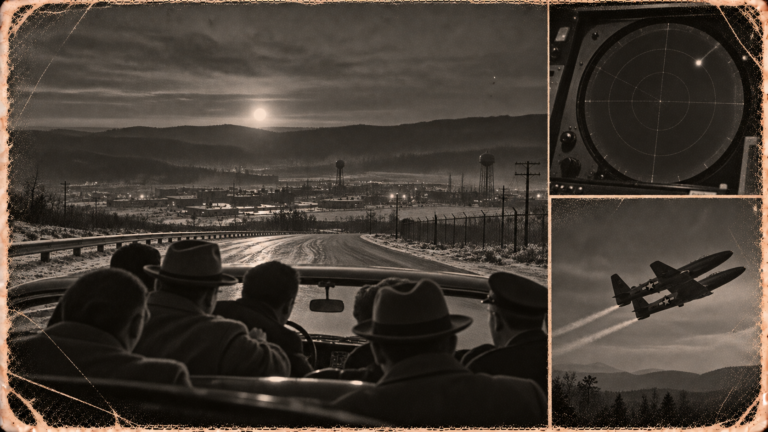
Oak Ridge, Tennessee, December 18, 1950: NEPA officials saw a bright light over the turnpike and a faint radar paint followed.
THINK ABOUTIT UFO|UAP SIGHTINGS REPORT
1950: Oak Ridge, Tennessee
A Bright Light Over the Turnpike and a Radar Paint Fourteen Minutes Later
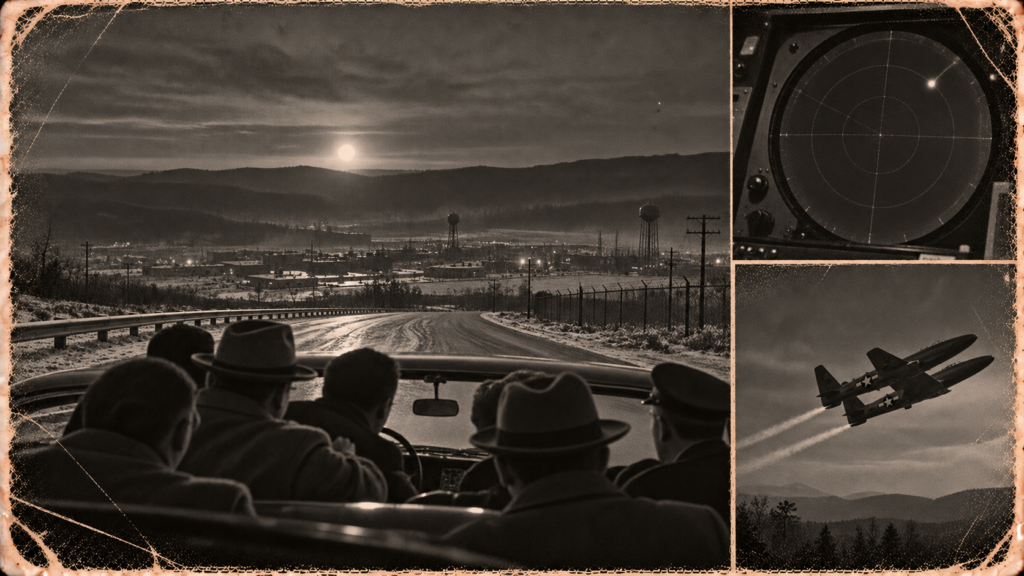
At about 8:27 on the freezing morning of December 18, 1950, a carload of NEPA Division officials, among them an Army Reserve lieutenant colonel, a USAF major and a Navy commander, were driving to work along the turnpike inside the Oak Ridge Controlled Area when one of them noticed a very bright light in the west. Some saw a reflection, as of the sun on a metal surface. Others saw a white circle of light much brighter than the moon that seemed to shrink and darken as it moved northwest.
At 8:39, 12 minutes after their sighting, a small radar paint appeared near the southeast corner of the restricted area, moved at about 60 mph for six minutes and vanished. A fighter sent after it found nothing. The sighting has long been presented as the cleanest visual-then-radar case of the Oak Ridge flap, but the documents are more cautious: the Air Force engineer who reviewed the radar called it inadequate to establish a track. This Oak Ridge, Tennessee UFO report is one of December 1950’s best-documented and most disputed cases.
Date: December 18, 1950
Sighting Time: Visual about 8:20 to 8:30 a.m. (about 8:27); radar paint 8:39 to 8:45 a.m. EST
Day/Night: Day, shortly after sunrise
Location: The turnpike inside the Oak Ridge Controlled Area, about one mile from the White Wing entrance and the Y-12 plant, Tennessee
Urban or Rural: Rural, inside a restricted nuclear facility
No. of Entity’s: Not Applicable
Entity Type: Not Applicable
Entity Description: Not Applicable
Hynek Classification: Daylight Disc (DD) for the visual sighting; radar contact separately
Duration: About 30 seconds visually; about 6 minutes on radar
No. of Object(s): One
Description of the Object(s): A bright white circle of light much brighter than the moon, giving an impression of form, with no sign of color separation; to another group only a bright reflection of the sun from an apparently metal surface
Shape/Size/Color of Object(s): Circle of white light; size not determined
Distance to Object(s): Not determined; the observers could not say whether it was over the Controlled Area or far away
Height & Speed: 15 to 30 degrees up in the west to northwest (about 25 degrees west-southwest in the other statement); the radar paint was estimated at 2,500 feet and about 60 mph
Number of Witnesses: Seven riders in the vehicle or vehicles; three saw a reflection in one statement, and all but one saw a light in the other
Special Features/Characteristics: Appeared to diminish and darken; no vapor trail and no clouds; radar paint began after the visual reports; fighter interception negative
Case Status: The Blue Book card appears to read Visual: A/C, with a radar note I cannot read; the AMC electronics section judged the radar detection inadequate to evaluate.
Source: OSI report, 6th District (Maxwell AFB); Army CIC Summary of Information, Knoxville, January 2, 1951; NEPA Project letter of December 28, 1950; Hq Third Army letter of January 5, 1951; AMC Electronics Section comment, January 1951; Project Blue Book record card; McDonald list; FUFOR Index
Summary/Description: Officials on the Oak Ridge turnpike saw a bright light on December 18, 1950, and a faint radar paint appeared minutes later; the Air Force judged the radar inadequate.
Related Cases: Part of the Oak Ridge/Knoxville flap; see also the December 5 Oak Ridge sighting in the December 1950 archive.
Detailed Report
The documentary trail begins with an Army Counter Intelligence Corps Summary of Information from Knoxville dated January 2, 1951, prepared under a Third Army instruction of November 15, 1950, and with two certified witness statements. The visual sighting took place on the turnpike, inside the Controlled Area, about one mile from the White Wing entrance and the Y-12 plant, between 8:20 and 8:30 a.m. EST. At 7:30 a.m. the AEC Meteorological Division recorded a northeast wind of 7 mph and a temperature of 20 degrees F, with excellent visibility.
The first statement was signed by an Army Reserve lieutenant colonel, a USAF major and a Navy commander, who were among the passengers. It says that at about 0827, riding southwest on the turnpike just outside the restricted area, the lieutenant colonel sighted a very bright reflection through the windshield; the major next to him saw the same thing, and the commander also saw it, but three others in the car did not. The reflection was visible only for a moment because the road turned right and the left front window was frosted. “The object appeared only as the bright reflection of the sun from an apparently metal surface, much as might be expected from an aircraft at a great distance.” It appeared west-southwest of the Oak Ridge townsite at about 25 degrees elevation.
The NEPA Project letter of December 28, 1950, describes the same trip differently. The passengers, with the exception of one who did not attempt to look, saw “a light emanating in the shape of a circle, of an intensity much greater than that of a bright moon,” through the windshield. They had the impression that there was form to the light rather than a point source. It was white, showed no refraction into a spectrum, stood 15 to 30 degrees above the horizontal on a bearing between west and northwest, and appeared to travel northwest, diminishing considerably in size during about 30 seconds. The car, still moving, changed its relative position so that the object was seen during the last few seconds from the side windows; a ridge then blocked the view, and it was not seen again. The circular area appeared to darken from about the 7 to 9 o’clock position around the perimeter until the light was concentrated in a very small area near the 1 to 3 o’clock position. The observers did not agree whether the object was moving fast enough to shrink or was itself shrinking, and they could not estimate its size, speed or elevation. There was no vapor trail and there were no clouds.
The radar record comes from the log of the McGhee Tyson Air Force radar station, quoted in the CIC summary. At 0832 hours the AEC reported an aircraft over the northeast end of the area, with no radar paint. At 0839 a small paint appeared near the southeast corner of the area on a magnetic bearing of 190 degrees, which the OSI summary gives as a speed of 60 mph and an estimated height of 2,500 feet; at 0845 contact was lost, and “fighter interception was attempted with negative results.” The OSI report from the 6th District at Maxwell AFB, signed by Lt. Col. Patrick W. Hayes, said it would take no further action but would maintain contact with NEPA officials and the radar stations. The OSI synopsis says the seven officials were in two cars; the statements describe one vehicle.
Air Materiel Command’s electronics section commented in January 1951 that the “brief period of radar (weak signal) target detection, immediately following reports of visual sighting of an aircraft over the Northeast end of the restricted area, is not sufficient to provide an evaluation.” It added that radar targets were not detected until after the visual sightings were reported, which “could indicate that radar operators were not doing a good job prior to receipt of visual report, or that they were doing too good a job (reporting minor radar points due to random noise, etc.) after receipt of visual reports,” and that the signal strength and short detection time “were wholly inadequate to establish a ‘radar track.'”
RESEARCHER’S NOTES
The Clearest Case Is Less Clear Than Claimed
- Classification issues: The visual sighting is a daylight light with no shape beyond a circle, seen by a group in a moving car; the radar paint is a separate detection. The case classifies as a visual sighting with a weak radar correlation, not a radar-visual confirmation.
- Source chain assessment: The trail is strong: an OSI report, an Army CIC summary with certified statements, a company letter and an Air Force engineering comment. The witnesses’ names are redacted in the released file; ranks are given only as they appear in the OCR.
- Conflicting witness accounts: The statement signed by three of the occupants calls the object a reflection of the sun from a metal surface, like a distant aircraft; the NEPA letter calls it a white circle of light with form. Both are recorded, because the file does not reconcile them.
- The radar claim: The AMC electronics engineer wrote that the radar detection was too brief and weak to be a track and began only after the visual reports. The claim, repeated in earlier listings, that this is the flap’s cleanest radar-visual case does not survive his comment.
- The evaluation: Blue Book’s card appears to read Visual: A/C, with an additional note on the radar I cannot read. Earlier listings called this a Blue Book unknown; the card does not support that.
- Why it stays in the archive: It was investigated by OSI and CIC, reported through Army channels to Air Materiel Command and criticized by an Air Force engineer, which makes it a useful test of how a flap case looked on paper.
The December 18 Oak Ridge sighting is a well-documented case that the documents themselves undercut: conflicting statements, a weak radar paint that began after the visual reports, and an A/C annotation. It stays in the archive with all of that visible.
“The brief period of radar (weak signal) target detection, immediately following reports of visual sighting, is not sufficient to provide an evaluation.”
— AMC Electronics Section comment, Technical Analysis Division, January 1951