NAS Lakehurst, New Jersey, December 27, 1950: two tower operators watched a flashing white light make one tight turn.
THINK ABOUTIT UFO|UAP SIGHTINGS REPORT
1950: NAS Lakehurst, New Jersey
A Flashing White Light and One Tight Turn Over the Airship Field
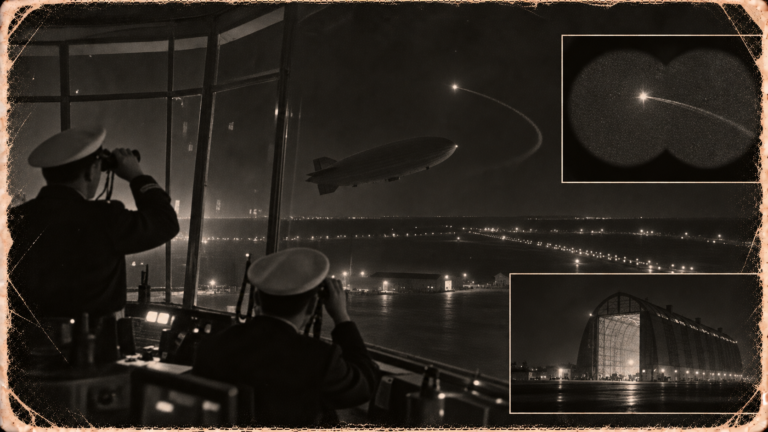
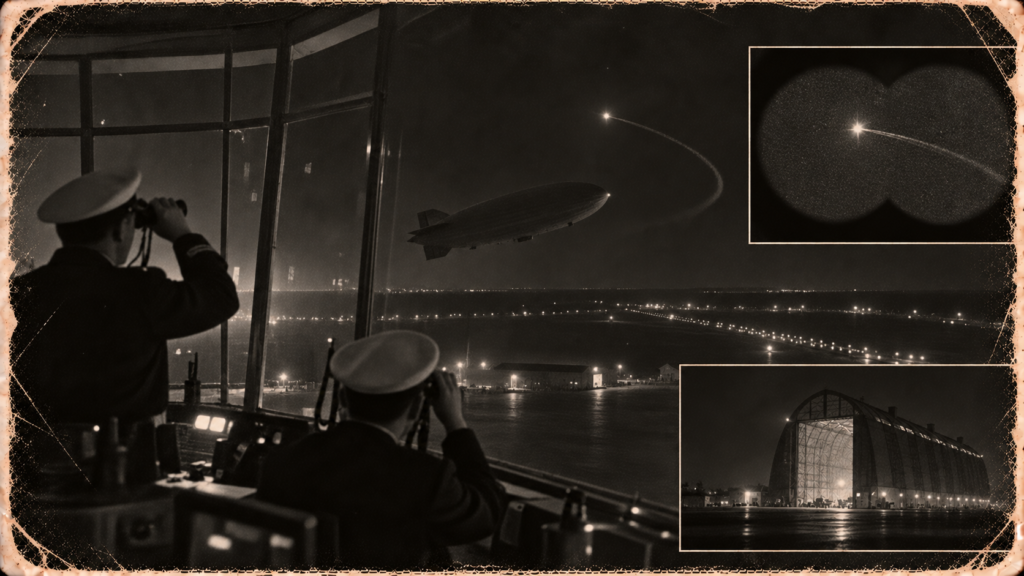
At 9:19 on the night of December 27, 1950, two Navy operators in the control tower at NAS Lakehurst, 265 feet up on top of Hangar No. 5, watched a star-like white light appear to the southeast, circle very suddenly and head off at very high speed. An airship was making a left-hand turn out from runway 30 at the time. With binoculars the light looked circular or oval and lit up at regular intervals; it flashed on and off like the lights of a commercial aircraft.
They timed it at no more than 45 seconds and ruled out a jet because the turn was too tight. The District Intelligence Officer of the Fourth Naval District sent the report to Washington in January 1951 and the Director of Naval Intelligence forwarded it to Air Materiel Command, where Blue Book marked the card A/C. Seven weeks earlier Lakehurst had been the site of Lt. Robert Haven’s pursuit. This NAS Lakehurst UFO report is a fully documented but modest case.
Date: December 27, 1950
Sighting Time: 9:19 p.m. EST (2119R)
Day/Night: Night
Location: NAS Lakehurst, New Jersey, seen from the control tower on Hangar No. 5, 265 feet high
Urban or Rural: Rural air station
No. of Entity’s: Not Applicable
Entity Type: Not Applicable
Entity Description: Not Applicable
Hynek Classification: Nocturnal Light (NL)
Duration: Not more than 45 seconds
No. of Object(s): One
Description of the Object(s): A white star-like light that flashed on and off like commercial aircraft lights; with binoculars it looked circular or oval and became illuminated at regular intervals
Shape/Size/Color of Object(s): Believed circular or oval; size not determined; white
Distance to Object(s): About one to one and a half miles southeast of the tower, over the southeast end of runway 30
Height & Speed: About 5,000 feet; very high speed
Number of Witnesses: Two Navy tower operators, on duty in the tower for 21 months and considered reliable
Special Features/Characteristics: Made one very tight circular turn and departed; an airship was making a left-hand turn out from runway 30 at the time; the operators discounted a jet because the turn was too tight
Case Status: Annotated A/C on the Blue Book card.
Source: District Intelligence Officer, Fourth Naval District letter of January 16, 1951, with the statement of a Navy tower operator; Director of Naval Intelligence letter to Air Materiel Command; Project Blue Book record card
Summary/Description: Two Navy tower operators saw a flashing white light circle once and race off over Lakehurst on December 27, 1950; the card says aircraft.
Related Cases: Seven weeks earlier at Lakehurst: Lakehurst, New Jersey (November 7); see also the December 1950 archive.
Detailed Report
The Lakehurst report is a Navy intelligence file. The District Intelligence Officer, Fourth Naval District, in Philadelphia, wrote to the Director of Naval Intelligence on January 16, 1951, following instructions that required reporting possible unconventional aircraft, and attached the statement of one of the two tower operators. The Director of Naval Intelligence then forwarded it to the Commanding General, Air Materiel Command, noting the Air Force’s continuing interest. The sighting was first reported to a District Intelligence Office representative on January 3, 1951, and the Air Force’s Office of Special Investigations in Philadelphia was told on January 4.
According to the report, the object was a white light that flashed on and off in the manner of the lights of commercial aircraft at night. It was believed to have been circular. The witnesses could give no other detail of shape, size, color, trail or exhaust, propulsion or sound. It traveled at high speed, made one tight circular turn and disappeared traveling in a south-southeasterly direction at an estimated altitude of 5,000 feet. The observers discounted a jet aircraft because the turn was too tight for an aircraft to make. It was sighted at 2119R and seen for not more than 45 seconds.
The observers watched from the control tower, which is on top of Hangar No. 5 at a height of 265 feet, using binoculars. The object was about one to one and a half miles to the southeast of the tower, over the southeast end, south side of runway 30, a northwest-southeast runway, at an estimated 5,000 feet. There were no other known witnesses. The two operators had been assigned to tower duty for 21 months and were considered reliable, sincere and intelligent. The Lakehurst aerological office reported the sky clear and visibility over 15 miles.
The operator’s own statement, typed in capitals, says that at about 2119 on December 27 “an airship was making a left-hand turn out from runway 30, when a star-like light appeared over her to the southeast. It circled very suddenly, and headed southwest at an altitude of about 5,000 feet.” Further examination with binoculars showed it to be circular or oval, it became illuminated at regular intervals and was traveling at very high speed, and the incident took place in no more than three-quarters of a minute. The statement says the light headed southwest; the district letter says south-southeast. Project Blue Book’s record card lists the course as southwest, and the handwritten evaluation reads A/C.
RESEARCHER’S NOTES
A Tower Light and an Airship in the Pattern
- Classification issues: A nocturnal light seen at about one mile from a tower with binoculars, so it is a close observation by trained operators but of a point of light, with no shape beyond “circular or oval.”
- Source chain assessment: The Navy file is clean: a statement, a district letter, a forwarding letter and an Air Force card. The operators are unnamed here because their names are redacted in the released file.
- The A/C evaluation: The light flashed on and off like an aircraft’s lights, an airship was operating nearby, and the card says A/C. The operators’ argument against a jet, a turn too tight for an aircraft, is exactly what a plane seen end-on can look like.
- Direction conflict: The statement says the light headed southwest and the district letter says south-southeast; the card says southwest. This archive keeps both rather than choosing.
- Correction to earlier listings: Earlier listings said no detail survives beyond a Blue Book unknown listing. The Navy file gives the full account above and the card is annotated A/C, so it is not a Blue Book unknown.
- The earlier Lakehurst case: Robert Haven’s November 7 pursuit east of Lakehurst involved a pilot at 3,500 feet and a light that outran jets. This one has no pilot and is far smaller; no connection between them is established.
The December 27 Lakehurst light is a small, well-documented Navy report that Blue Book read as aircraft. It is preserved with its direction conflict and its tight-turn argument, and as a reminder that the Haven case was not the only report from this field in 1950.
“A star-like light appeared over her to the southeast. It circled very suddenly.”
— Statement of a Navy tower operator, NAS Lakehurst, December 27, 1950