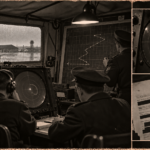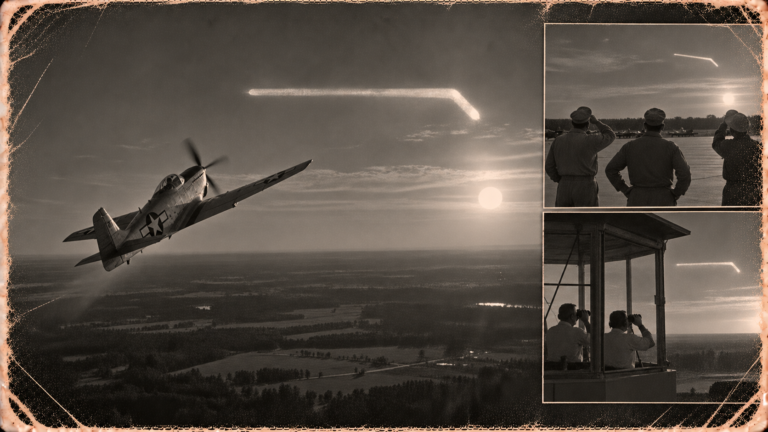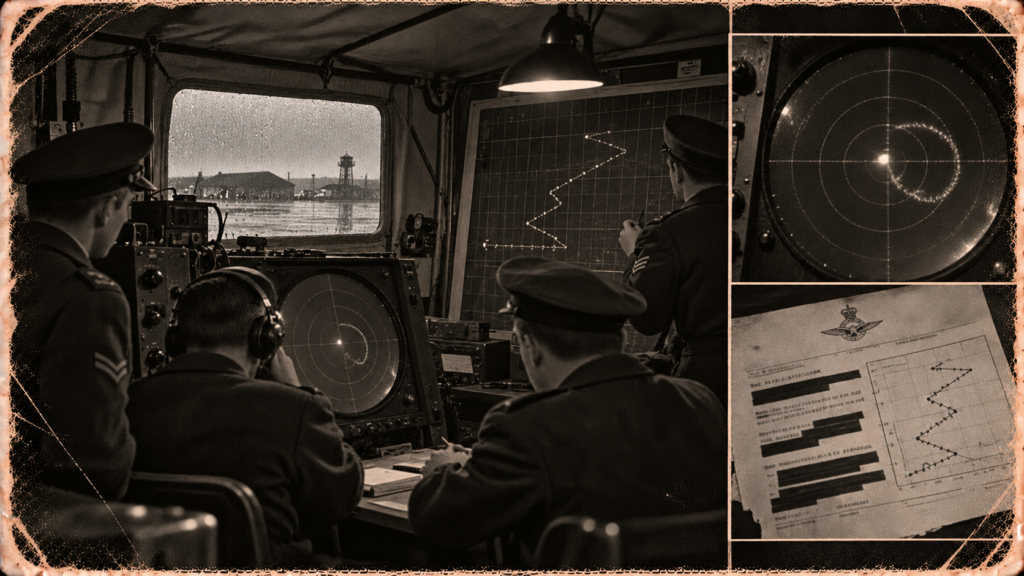
Heston Airdrome, England, November 10, 1950: radar operators tracked a target that made abrupt turns and a 17,000-foot climb in five seconds.
THINK ABOUTIT UFO|UAP SIGHTINGS REPORT
1950: South Ruislip (Heston Airdrome), England
Four Radar Contacts, a 17,000-Foot Climb in Five Seconds, and an Air Force Verdict of Weather
At 8:59 on the morning of November 10, 1950, radar operators of the 3903rd Radar Bomb Scoring Squadron at Heston Airdrome, outside London, began tracking a single target that behaved like nothing they knew. Over the next hour and a half it made four contacts at altitudes from under 1,000 feet to over 30,000 feet, at speeds from 30 to more than 1,000 mph. In one contact it climbed from 13,000 to 30,000 feet in less than five seconds. In another it made 18 abrupt turns of 100 degrees or more in 2,500 yards. The operators checked the AN/MPQ-2 set for faults and found none.
The Heston radar UFO report went to Air Materiel Command at Wright-Patterson as Air Intelligence Information Report IR-1-50, and AMC’s answer arrived within weeks: abnormal weather. The file records the rebuttal as faithfully as the report, and it also records a detail the explanation does not address: the Third Air Division said no fighter was sent, and its own first message said one was.
Date: November 10, 1950 (report dated November 20, 1950)
Sighting Time: 8:59 a.m. to 10:26 a.m. GMT (0859Z to 1026Z)
Day/Night: Day
Location: Radar van at Heston Airdrome (51°29′ N, 00°23′ W), 2 miles northeast of London Airport, Middlesex, England; contacts over Bovingdon, Luton and Eastbourne
Urban or Rural: Urban/suburban (radar site)
No. of Entity’s: Not Applicable
Entity Type: Not Applicable
Entity Description: Not Applicable
Hynek Classification: Radar only (outside Hynek’s NL/DD/RV categories)
Duration: Contacts of about 8 minutes, 3 minutes, 1.5 minutes and about 1 minute, across about 90 minutes
No. of Object(s): One (four contacts)
Description of the Object(s): A radar target giving returns comparable to a B-29 on the PPI and J scopes; no visual contact; object moved at 30 to over 1,000 mph with an exceptionally large number of abrupt course changes; first and second contacts were over Bovingdon and Luton; third was south of Luton; fourth was near Eastbourne
Shape/Size/Color of Object(s): Not applicable (radar return); estimated of the order of a B-29 or C-54 in return size
Distance to Object(s): Within about 40 to 60 thousand yards (about 23 to 34 miles) north on the island range
Height & Speed: 1,000 feet or less to 30,000 feet and more; 30 mph to over 1,000 mph; climbed 13,000 to 30,000 feet in under five seconds while covering 3,600 feet laterally
Number of Witnesses: 4 radar personnel named by rank in the file (a captain, a first lieutenant, a sergeant and a corporal); names redacted
Special Features/Characteristics: Four contacts; repeated abrupt turns (90°, 160°, 150°, 110° sequence over 70 seconds in one contact; 18 turns of 100° or more in 2,500 yards in another); lost when speed and rate of climb exceeded the automatic tracking gate; ground-clutter loss at low altitude
Case Status: Evaluated by Air Materiel Command as spurious radar echoes caused by abnormal weather; Blue Book’s record card reads “Other (Wx returns).”
Source: Air Intelligence Information Report IR-1-50, Hq Third Air Division, November 20, 1950 (with four affidavits, track chart and route diagram); 3AD-DIC 3998 message of November 10, 1950; AMC letters of 1950; Project Blue Book record card; Dan Wilson
Summary/Description: Radar operators at Heston Airdrome tracked a target in four contacts whose speed, climb and turns exceeded anything they expected; AMC attributed it to weather.
Related Cases: Similar radar returns at Wright-Patterson AFB (March 8, 1950) and over Oak Ridge: Oak Ridge/Knoxville flap; same month: Lakehurst, New Jersey (November 7); see the November 1950 archive.
Detailed Report
The Third Air Division at South Ruislip reported the sighting by message on November 10, 1950, as required by Air Force headquarters’ September 8, 1950 directive on reporting unconventional aircraft. The message estimated the object as the size of a B-29 and its speed at 30 to 2,000 mph, with a rate of climb of about 1,750 feet per second. It listed contacts at 0859Z, 0909Z, 0946Z and 1025Z, with a total observation time of about 93 minutes, on a surface radar, an SCR-584 plotted on an MC-627 board at the Heston radar bomb scoring site, from ground level to 20,000 feet, 40,000 to 60,000 yards north, island range. The operators were qualified, with two to eight years of experience; the equipment was working properly. Weather was 10/10 cloud at 1,000 feet with rain and winds from 230 degrees at 65 knots at 20,000 feet. The message said RAF Fighter Command dispatched a fighter to the area and that no reports were received, and that a report with photographs of the plotting record would follow.
That report is Air Intelligence Information Report IR-1-50, dated November 20, 1950 (the date of the report; the date of information is November 10), prepared by a major of the Third Air Division. It describes four radar contacts with an airborne object “comparable with those of a B-29 aircraft” between 0859 and 1026Z. The object “travelled at rates of speed varying from approximately 30 to 1,000 statute miles per hour. Its movement was characterized by its apparent capability to make an exceptionally large number of abrupt changes of course in a relatively short distance.” The returns on the PPI and J scopes were what a single aircraft would give. In one case the object climbed from 13,000 to 30,000 feet in less than five seconds, giving a climbing speed in excess of 1,000 mph, while covering 3,600 feet laterally. For the most part it moved at about 60 mph, making very undulating turns at great speed within short lateral and vertical distances: 90 degrees to the right for 600 yards, 160 degrees left for 200 yards, 150 degrees right for 300 yards at speeds from 60 to 120 mph, then 110 degrees abruptly left, a maneuver that continued about 70 seconds. In another case it made 18 abrupt turns of 100 degrees or more in a lateral distance of 2,500 yards. At one time it was so low, around 1,000 feet, that it was lost in ground clutter. Each time it disappeared, its speed was so great or its altitude so low that it exceeded the limits of the tracking circuits of the AN/MPQ-2 plotting equipment.
The first contact lasted from 0859 to 0907Z, during which the object covered about 6.5 miles before it was lost in ground clutter; after a 90-second break a second contact at 0909Z lasted to 0912Z over about 1.8 miles. A third at 0946Z lasted to 0947Z, when the object was lost due to acceleration and ascent in excess of the radar’s automatic tracking ability; a last brief encounter at 1025Z lasted a minute. The set was an AN/MPQ-2 (SCR-584) radar with an MC-627 plotting board, used as radar bomb scoring equipment, operated from a van at Heston Airdrome. The first two contacts began about 5 miles northeast of Bovingdon Airfield on a heading of 45 degrees true and dropped about two miles southeast of Luton; the object was observed at 20,000 feet, descending to about 1,000 feet and then ascending to an unrecorded high altitude. The third began about six miles south of Luton on a course of 360 degrees and the object climbed from 1,000 to 13,000 to 30,000 feet; the fourth, near Eastbourne, ran on headings 225, 270 and 360 degrees at 6,000, then 1,000, then 5,000 feet.
The report says no aircraft were scrambled by the USAF or RAF to attempt interception, because of the weather and, in the case of the RAF, the absence of a frequency channel common to Heston RBS. An affidavit from the officer in charge, who saw the first track at about 0905, said the altitude and low ground speed seemed very unusual; he had the operator and plotters keep the plane under radar surveillance and immediately checked the equipment, and no malfunction was indicated. Other aircraft in the area were picked up and tracked without difficulty. The second contact’s track was composed of very sharp turns “which would be very unusual for conventional aircraft.”
Air Materiel Command answered in two steps. Its first indorsement, signed by Col. Harold E. Watson, concluded that the targets “were due to abnormal weather conditions,” citing unidentified targets detected by an SCR-584 at Wright-Patterson on March 8, 1950, when interceptors found ice-laden clouds at 10,000 feet; a longer AMC letter explained that spurious weather echoes occupy more range on the scope and fluctuate faster than aircraft returns, that rain, water-laden and ice-laden clouds are the usual cause and that the 3,000-megacycle SCR-584 is susceptible to them, and that the unusual speed and rate of climb could be explained by echoes disappearing in one place and appearing in another. It asked for scope photographs if any future sighting occurred, and noted a similar report at Oak Ridge where fighters were vectored onto echoes with “several perfect interceptions” yet pilots saw nothing. In December, a SAC wire about a sighting “one week previous” was found to be confusing; AMC suggested it might be this case or a September sighting and asked the Third Air Division for details. Blue Book’s record card gives the date as November 10, the time as 0905Z, the size as “B-29 a/c,” the speed as 60 to 2,000 mph, and the evaluation as “Other (Wx returns).”
RESEARCHER’S NOTES
The Report and the Rebuttal
- Same set, same scope: The operators say they checked the equipment for malfunction immediately and that it tracked other aircraft normally that morning. AMC’s weather explanation does not dispute that; it argues the set was behaving as expected under unusual atmospheric conditions.
- What the AMC argument predicts: AMC said weather echoes are larger in range than a single target and fluctuate faster. The report says the returns looked like a single aircraft on both scopes. The report and the rebuttal disagree on exactly this point, and neither side had scope photographs to settle it.
- Speed figures: The 1,000-plus mph speeds come from plotting a target that vanished and reappeared, which AMC argues is what spurious echoes do. The five-second 17,000-foot climb is a plotted value on the same terms.
- The fighter question: The Third Air Division’s first message says RAF Fighter Command dispatched a fighter with no reports received; its formal report says no aircraft were scrambled by USAF or RAF because of weather and the lack of a common frequency. Both statements are in the file.
- Names and ranks: The four radar personnel are listed by rank (captain, first lieutenant, sergeant, corporal); names are redacted. The first lieutenant had eight and a half years of aircraft-warning experience.
- A different November 20: The McDonald list shows a separate “South Ruislip, November 20” case. That is the date of this report, not a second sighting.
Heston is a technical case. The operators saw something they judged to be a real target on checked equipment; AMC replied from a general principle and a precedent. With no scope photographs, no visual contact and no interception, the file leaves two readings standing side by side, with the Air Force’s weather verdict as the official one.
“Its movement was characterized by its apparent capability to make an exceptionally large number of abrupt changes of course in a relatively short distance.”
— Air Intelligence Information Report IR-1-50, Hq Third Air Division, November 20, 1950