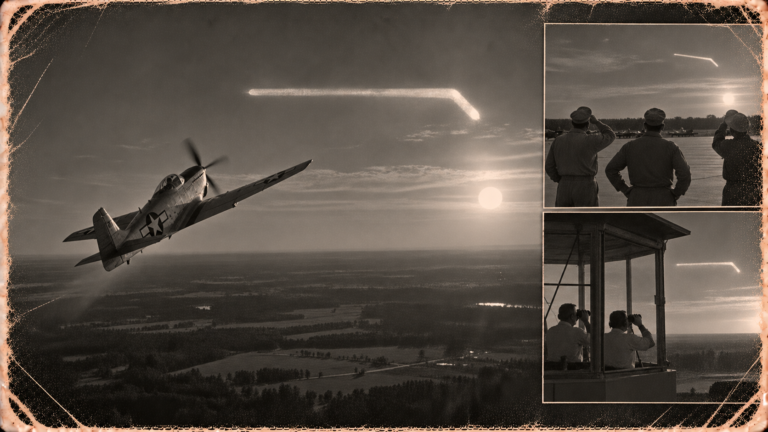
Meridian, Mississippi, November 13, 1950: a National Guard pilot chased a milky-white bar to 21,000 feet.
THINK ABOUTIT UFO|UAP SIGHTINGS REPORT
1950: Meridian, Mississippi
A National Guard Pilot Chases a Milky-White Bar to 21,000 Feet While the State Watches
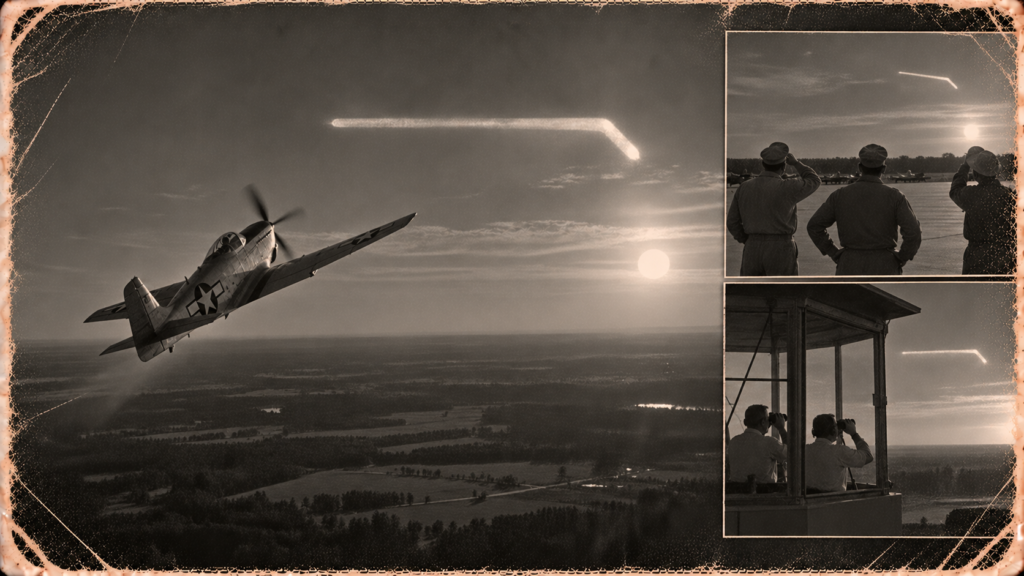
On the afternoon of Monday, November 13, 1950, a Mississippi Air National Guard major flying an F-47 over Meridian saw a milky-white object shaped like a horizontal bar, one end slanting down, silhouetted against the sky near the sun. He climbed to 21,000 feet to chase it, radioing every aircraft and station within range. “It resembled the edge of a bright tilted plate,” he told reporters, and by his estimate it was 450 to 500 feet long and flying at 55,000 feet or more, at about 600 mph, without exhaust, lights or a vapor trail. He pursued it, by one press account, for 66 miles without getting closer.
The Meridian, Mississippi UFO chase drew Office of Special Investigations agents within days. They interviewed the pilot, three Guard enlisted men on the ramp at Key Field, weather forecasters and two Jackson control-tower operators, and collected newspaper accounts from Jackson, Vicksburg and Brookhaven of a “mysterious streak of light” that changed from orange to lemon to white. The Air Force’s own card for the case reads “Balloon.”
Date: November 13, 1950 (Monday)
Sighting Time: About 4:35 p.m. to 6:15 p.m. CST; pilot’s chase about 4:50 p.m. (record card: 1650 CST)
Day/Night: Day, into dusk
Location: Over Meridian, Mississippi, with sightings from Jackson, McComb, Monroe, Brookhaven, Florence and Vicksburg
Urban or Rural: Urban and rural (statewide)
No. of Entity’s: Not Applicable
Entity Type: Not Applicable
Entity Description: Not Applicable
Hynek Classification: Daylight Disc (DD)
Duration: About 25 minutes (pilot); 40 minutes (Jackson tower operators)
No. of Object(s): One
Description of the Object(s): A milky-white object resembling a daylight-type neon bulb, comparable to a horizontal bar held lengthwise with one end slanting downward; no exhaust, lights, vapor trail, controls or airducts evident; no reflection; unchanged in perspective. Ground observers described a “sliver of light” like a flattened new moon, an aircraft wing with a vapor trail, and a cylinder of flame at the rear
Shape/Size/Color of Object(s): Bar-shaped; the pilot estimated 450 to 500 feet long and 50 feet wide; milky white
Distance to Object(s): Never closed by the pilot; he estimated it at 40 to 70 miles west of his position
Height & Speed: The pilot put it at 55,000 to 60,000 feet and about 600 mph, on a constant course; his F-47 reached 21,000 feet at about 210 mph indicated, estimated 300 mph ground speed
Number of Witnesses: Dozens: a National Guard pilot, three Guard enlisted men, two weather forecasters (negative observations), two tower operators, military district headquarters personnel and numerous civilians
Special Features/Characteristics: Pilot chase over about 66 miles; the pilot broadcast to Jackson Radio, Meridian Radio, Maxwell AFB and Monroe Radio; no vapor trail on the pilot’s account; shrinking size as it moved west; independent reports across the state
Case Status: Evaluated by Project Blue Book as a balloon. OSI took no action. Observers at Key Field and the Jackson tower suggested vapor trails.
Source: OSI Spot Intelligence Report DO #9, November 25-26, 1950, with clippings from the Jackson Clarion-Ledger (November 16), Vicksburg Evening Post and Jackson Daily News (November 14); Mississippi Military District message forwarded by Hq 14th Air Force; Project Blue Book record card
Summary/Description: A Mississippi Air National Guard major chased a milky-white bar-shaped object to 21,000 feet while military and civilian observers across the state reported it; Blue Book called it a balloon.
Related Cases: Same evening, C-47 crew south of Meridian (see the November 1950 archive); same month: Maxwell AFB, Alabama (November 23); see the November 1950 archive.
Detailed Report
The Office of Special Investigations’ Spot Intelligence Report DO #9 of November 25-26, 1950 opens with a synopsis of the Mississippi reports: a pilot, a Guard officer, flying an F-47, who sighted an unconventional aircraft and flew in pursuit of it; three National Guard enlisted men who watched a flying object from the ramp at Key Field; two weather forecasters who reported conditions; two control-tower employees at Jackson who saw something that could have been a conventional aircraft; radio stations at McComb and Monroe that reported a course; and newspaper accounts from Brookhaven, Vicksburg and Jackson.
The pilot was interviewed by a special agent on November 14. At 4:50 p.m. CST on November 13 he was flying an F-47 at 3,000 feet about eight miles east of Meridian when he first saw the object silhouetted against the sky near the sun, traveling due west at a location west-southwest of Meridian. He started to pursue it, climbing to 21,000 feet at an indicated 210 mph (an estimated 300 mph ground speed). Over Forest, Mississippi, at 21,000 feet, he estimated the object at 55,000 to 60,000 feet and a conservative 600 mph ground speed, “without variation in course and with negligible change in altitude,” 40 to 70 miles west of him. He saw it for about 25 minutes. He described it as milky white, resembling a daylight-type neon bulb, 450 to 500 feet long and 50 feet wide, “comparable to a horizontal bar held lengthwise, with one end slanting downward,” at an elevation of about 15 degrees to the horizon, with no exhaust, lights or vapor trail, “wingless without visible means of support or propulsion,” no controls or airducts evident, and no reflection. He said he was physically fit, had been in the air about 30 minutes, and denied any feeling of fatigue. Over Forest he radioed all aircraft and stations in range; Jackson Radio, Meridian Radio, Maxwell Air Force Base and Monroe Radio received the broadcast.
Three Mississippi National Guard enlisted men, all mechanics of the pilot’s fighter squadron, were interviewed separately and reported, simultaneously, seeing the object from the ramp at Key Field. They watched from about 4:50 p.m. until about 5:10 p.m., when they lost interest. The sky was clear; the object was at an azimuth of about 15 degrees with the horizon, and its diminishing size was the only sign that it was moving. The pilot vouched for their reliability; all three had recently received USAF physicals. Two weather forecasters at Key Field gave the 5:30 p.m. surface weather (clear; Meridian visibility eight miles; Jackson 15; McComb 15; Monroe 12). Two control-tower operators at Jackson Air Field, interviewed separately, said they watched through six-power binoculars from 4:35 p.m. for 40 minutes: the object “could have been an aircraft,” first looking like a wing with a vapor trail that obscured the fuselage and the opposite wing, a constant length until it suddenly disappeared, dull white, with no reflection from the sun and no lights. They told the agent that Memphis ATC messages showed no flights scheduled in the area. McComb Radio reported the object north of McComb on a westerly course, and Monroe Radio reported it south of Monroe at 4:50 p.m.
The Jackson Clarion-Ledger of November 16 reported that several Brookhaven residents had seen another “flying saucer” about 6 p.m. Monday, which some compared to an air sock towed in target practice and others to a vapor trail lit by the sunset, and one resident reported a pale pink fire in its path. The Vicksburg Evening Post of November 14 reported that the pilot, Maj. B.D. Stephens of the 153rd Fighter Squadron, had chased it for 66 miles at 21,000 feet at about 340 mph and that the object looked like the edge of a bright tilted plate and “could have been the vapor effect of a high-flying B-36.” The Jackson Daily News of the same date described a “mysterious streak of light” that changed color from orange to lemon to white as it vanished toward the horizon, said the Weather Bureau put it directly over the city moving east to west at “well above 50,000 feet,” and quoted callers who said it had a “burning tail”; control tower officials suggested a vapor trail from a jet. The Meridian pilot told that paper the object had no vapor trail and resembled “the edge of a bright tilted plate, bar or flattened out new moon,” and two Key Field mechanics said it could have been vapor trails from a B-36. A woman between Jackson and Clinton said the rear end looked like a cylinder of flame five or six feet long.
A separate message from the chief of the Mississippi Military District, forwarded to the 14th Air Force, reported that a major and a master sergeant at district headquarters saw a “bright sliver of light,” half the size of a flattened new moon, about ten degrees above the horizon in the direction of the sun, which was already below the horizon, at 2310Z; it moved slightly left to right but its steadily reducing size made it seem to travel west, and it disappeared at about 2325Z (rated A-2). The message adds that the pilot pursued the object by plane that Monday evening, went to 21,000 feet, and “did not get near” it (rated C-2). The OSI report took no action and Project Blue Book’s record card reads “Balloon.”
RESEARCHER’S NOTES
A Chase That Ground Observers Read as a Vapor Trail
- Why the Blue Book label is not the whole story: Blue Book’s card says “Balloon,” but no balloon launch or wind data appears in the file. The pilot’s estimate of 55,000 to 60,000 feet, a 450-foot bar and a constant 600 mph is incompatible with a balloon only if his estimates hold, and they come from a chase in which he never closed.
- The sun and the vapor-trail reading: The object was first seen against the sky near the setting sun at the hour contrails glow from high-altitude jets, which is exactly how the Key Field mechanics, the Jackson tower and a Vicksburg paper read it. The pilot says there was no vapor trail; the tower says there was.
- Estimates built on a chase: The pilot’s altitude and speed figures come from watching an object he could not close on from 21,000 feet; they are estimates, not measurements, and he gives them as such.
- Many observers, one direction: McComb, Monroe, Jackson, Vicksburg and Meridian all describe a westbound object in the same hour. That fits something very high and distant seen across a wide area, as with a high-altitude contrail or aircraft, but the file does not decide that.
- Tower versus pilot: The two Jackson tower operators saw it for 40 minutes through six-power binoculars and thought it could have been an aircraft with a vapor trail. The pilot, who was closest to it, described no trail. Both statements are recorded in the same OSI report.
- Names: The OSI file redacts the pilot’s name; the Vicksburg and Meridian newspaper accounts print it. The three enlisted men and the tower operators are unnamed in the released file.
The Meridian chase is a rare case in which a military pilot pursued a daylight object while the military and civilians on the ground reported it independently. The file explains it as a balloon without data, and the ground observers’ vapor-trail reading is plausible, but the pilot’s own account of a trailless, bar-shaped object that outran him remains in the record unresolved.
“It resembled the edge of a bright tilted plate.”
— Pilot, Mississippi Air National Guard, quoted in the Vicksburg Evening Post, November 14, 1950