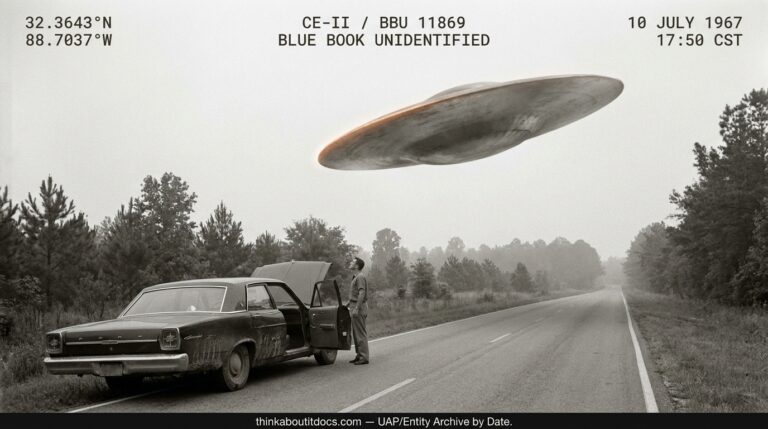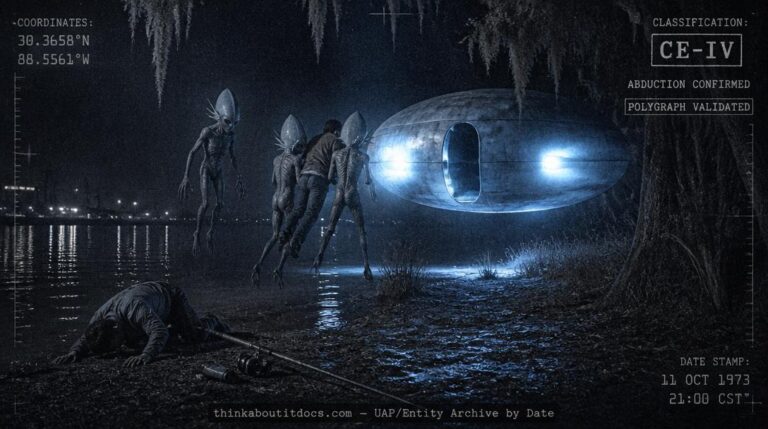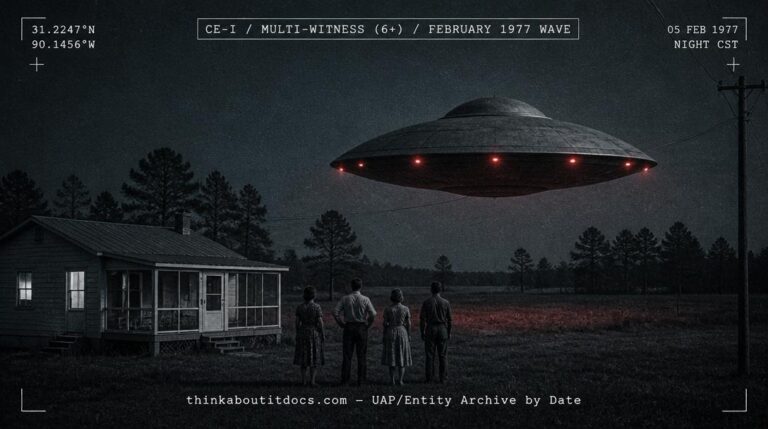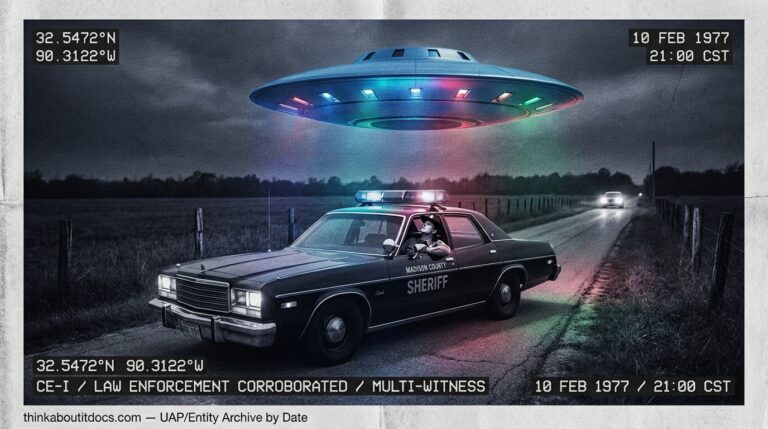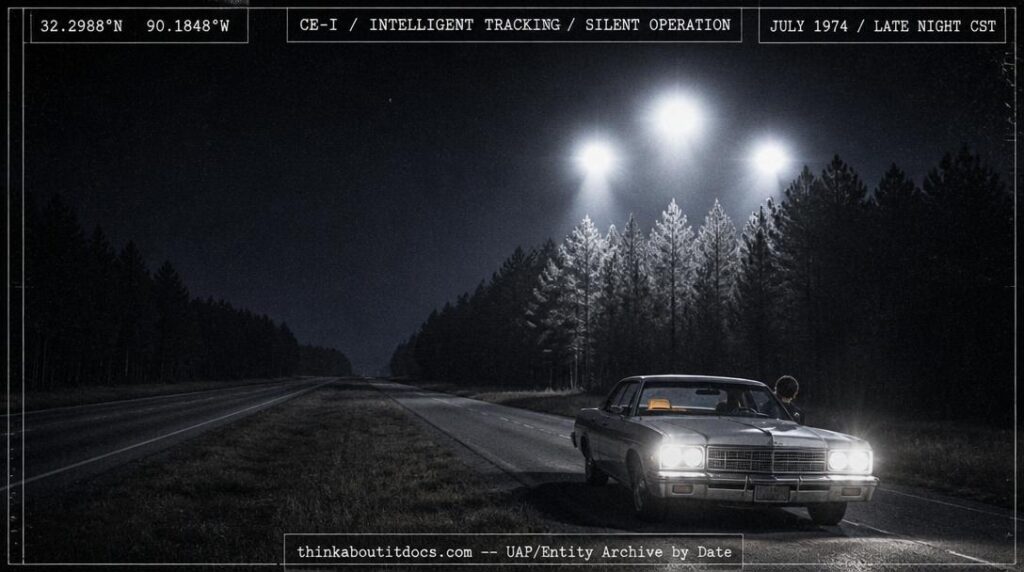
A dossier-style reconstruction of the 1974 Jackson, Mississippi, UFO sighting, where two college students observed three 80-to-100-foot lights rotate to track their vehicle in complete silence near the Jackson airport.
THINK ABOUTIT UFO|UAP SIGHTING REPORT
1974 Jackson MS UFO Sighting: Three Bright Lights Follow Witnesses
Near the Jackson, Mississippi, airport on a summer night in 1974, two college students watched three brilliantly lit objects — each estimated at 80 to 100 feet across — rotate to track their vehicle like a turret tracking a target. The lights, positioned in a formation resembling commercial jet landing lights, maintained perfect speed synchronization with the car while operating in absolute silence. When the vehicle accelerated to escape, the lights stopped forward motion, rotated to maintain orientation toward the fleeing car, then descended smoothly into a stand of trees and vanished. The encounter is technically significant for its demonstration of intelligent, reactive behavior: the object did not simply move — it tracked, adjusted, and responded to the witnesses’ actions in real time, suggesting a piloted or autonomously guided system with capabilities far beyond any known 1974 technology.
Date: Summer of 1974 (approximately July 4th)
Sighting Time: Late night
Day/Night: Night
Location: Jackson, Mississippi (road adjacent to Jackson airport, leading toward Lexington)
Urban or Rural: Rural (heavily wooded area)
No. of Entity(‘s): None observed
Entity Type: Not Applicable
Entity Description: Not Applicable
Hynek Classification: CE-I (Close Encounter I) Observation of an object in close proximity to the witness (i.e. within 500 feet)
Duration: 10 to 15 minutes
No. of Object(s): 1 (large object containing three lights)
Description of the Object(s): Three extremely bright lights positioned like jet landing lights — two outer lights at wing positions and one center light at a slightly higher position. The body behind the lights was obscured by the intensity of the illumination.
Shape of Object(s): Unable to determine due to light intensity; estimated triangular or deltoid configuration based on light placement
Size of Object(s): 80 to 100 feet across (estimated from spacing between outer lights)
Color of Object(s): Intensely bright white lights
Distance to Object(s): 50 to 100 feet above the treetops; laterally adjacent to the vehicle at closest approach
Height & Speed: Treetop level (50 to 100 feet above canopy); matched vehicle speed precisely, then descended into trees
Number of Witnesses: 2
Special Features/Characteristics: Intelligent interaction — the object rotated its orientation to stay pointed directly at the witnesses’ car as they moved. Absolute silence with no vibration detectable even at close range. Precise pace-matching with the vehicle. When the car accelerated, the object stopped forward motion but continued rotating to track the vehicle, then descended smoothly into a tree line and disappeared. No conventional navigation lights, no engine noise, no rotor wash, no aerodynamic sound of any kind.
Case Status: Unexplained
Source: UFO Evidence (witness testimony)
Summary/Description: Two college students driving from the Jackson airport toward Lexington, Mississippi, on a late summer night in 1974 observed three extremely bright lights positioned like commercial jet landing lights at treetop level. The lights were initially stationary, then rotated to track the witnesses’ vehicle as it turned onto a divided highway. The object matched the car’s speed while maintaining a position slightly behind and to the right. Upon acceleration, the object ceased forward motion but continued to rotate its orientation toward the fleeing car, then descended into a tree line on the opposite side of the road and vanished. The witnesses returned to the location but found nothing. The object operated in complete silence and displayed no vibration at any point during the encounter.
Related Cases: 1973: The Pascagoula Incident | 1977: Six Witnesses — Jayess, MS | 1977: Flora, MS — Deputy Creel
Detailed Report
The 1974 Jackson sighting is a high-quality close encounter report characterized by extended observation, intelligent object behavior, and a two-witness corroboration structure that elevates it above the typical single-observer nocturnal light event.
The two witnesses — college friends — had driven from Lexington, Mississippi, to the Jackson airport to drop off relatives catching a late-night flight to California. After the departure, they took a road adjacent to the Jackson airport that led back toward the Lexington highway. The road passed through a heavily wooded area with no street lights, buildings, or ambient illumination. The car windows were down and the radio was off, providing optimal conditions for both visual and auditory observation.
While driving, both men noticed three very bright lights ahead, positioned just above treetop level. The light configuration resembled commercial jet landing lights — two outer lights at wing positions and one center light at a slightly higher elevation, mimicking a nose landing light arrangement. The initial assessment was that an approaching aircraft was using landing lights. However, the lights remained completely stationary, ruling out an aircraft on approach. The second hypothesis — that the lights were mounted on a large water tower — was tested as the witnesses continued to drive toward them.
At a stop sign, with the lights directly ahead at an estimated 50 to 100 feet above the treetops, the witnesses sat with the engine idling and windows open. Complete silence. No engine noise, no rotor sound, no aerodynamic whistle, no hum. The lights were so bright that no structure behind them was visible — comparable to approaching a parked car with its headlights on in darkness, where the vehicle itself is invisible behind the glare.
The driver made a left turn onto a four-lane divided road, crossing two opposing lanes and the median before stopping on the shoulder of the correct lanes. At this point the lights were to the passenger’s right, slightly behind the vehicle. After idling forward 5 to 10 feet, the lights suddenly rotated — pivoting their orientation to remain pointed directly at the passenger side of the car. They then began moving alongside the vehicle at exactly the same speed, maintaining a consistent position slightly behind the car.
This was the behavioral inflection point that transformed the sighting from a passive observation into an active interaction. The rotation was precise, smooth, and immediate. The object was not drifting or coincidentally moving in the same direction — it was tracking the vehicle with the deliberateness of a guided system. The passenger described entering “heart pounding panic” as the scale of the object became apparent: 80 to 100 feet from the leftmost light to the rightmost, and the silence, precision, and complete absence of vibration were unlike anything either man had experienced.
The passenger urged the driver to accelerate. After a hesitation, the driver pulled onto the main road and accelerated away. As soon as the vehicle gained speed, the lights stopped their forward motion — but continued to rotate, keeping their orientation fixed on the receding car. At approximately 500 feet distance, the lights began moving laterally across the road, always maintaining their tracking orientation. When they reached the tree line on the opposite side of the road, they descended smoothly and disappeared into the trees.
With the object gone, the witnesses’ courage returned enough to turn around and drive back to the location. They found nothing — no lights, no sound, no trace. The drive back to Lexington was completed without further incident.
Researcher’s Notes
The Jackson Airport Encounter — Mississippi 1974 and the Problem of Intelligent Tracking
- Classification — CE-I Confirmed: The proximity of the object — laterally adjacent to the vehicle at treetop level, with an estimated span of 80 to 100 feet — places this firmly within Close Encounter of the First Kind (CE-I) parameters under the Hynek system. No physical effects were reported on the vehicle, the witnesses, or the environment, precluding a CE-II upgrade. The Nocturnal Light (NL) classification suggested by some sources understates the case: NL applies to distant, unresolvable lights, while this object was close enough to resolve structural scale and behavioral detail. CE-I is the correct classification.
- Source Chain Assessment — Anonymous but Detailed: The primary limitation of this case is the anonymous sourcing — the witness self-reported through UFO Evidence without providing a full name, and no formal investigation by a civilian research organization or government agency is documented. However, the narrative detail is unusually high for an anonymous report. The witness provides specific geographic references (Jackson airport, the road to Lexington, the divided highway with a dirt median), precise behavioral descriptions (the rotation, the pace-matching, the lateral retreat), and an honest admission of initial prosaic hypotheses (aircraft, water tower) that were systematically eliminated by observation. The internal consistency and lack of sensational embellishment give the report a degree of credibility despite the anonymous sourcing.
- Behavioral Analysis — Intelligent Tracking: The most analytically significant feature of this encounter is not the object’s appearance but its behavior. The rotation-to-track maneuver — where the object pivoted its orientation to remain pointed at the witnesses’ vehicle during and after a turn — demonstrates responsive, real-time adaptive behavior. This is not the behavior of a passive aerial object affected by wind currents or atmospheric phenomena. It is the behavior of a system that is either piloted or autonomously guided, with the ability to detect, track, and respond to the position and motion of a ground vehicle. The subsequent pace-matching further supports this interpretation: the object maintained identical speed to the car while holding a fixed relative position, a precision-flight requirement that exceeds the capabilities of any known 1974 technology operating at treetop level in complete silence.
- Pattern Context — Mississippi Close Encounters 1973–1977: The Jackson sighting falls within a documented concentration of close encounter events in Mississippi during the 1973–1977 period. The Pascagoula abduction (October 1973) preceded it by less than a year and occurred within 170 miles. The Jayess and Flora sightings of February 1977 would follow within three years. This clustering suggests either a persistent area of UAP activity in central and southern Mississippi during the 1970s, or a heightened period of public reporting awareness following the Pascagoula publicity. Both interpretations are analytically significant — the former points to geographic patterns in UAP activity, while the latter reflects the social dynamics of witness reporting behavior.
The 1974 Jackson sighting is not a glamorous case — no entities, no abduction, no physical trace. What it offers instead is something arguably more valuable to the analytical record: a clear, detailed, two-witness account of an object exhibiting intelligent, reactive behavior at close range. The rotation-to-track maneuver, the precision pace-matching, the silent lateral retreat into the treeline — these are not the behaviors of a misidentified aircraft, a satellite, a weather balloon, or any atmospheric phenomenon. They are the behaviors of a guided system with capabilities that were not available to any known technology in 1974. The witnesses drove back to look. They found nothing. The record is what remains.