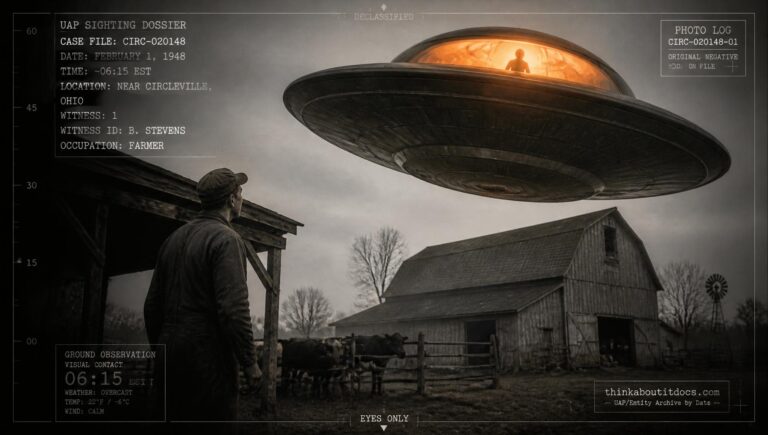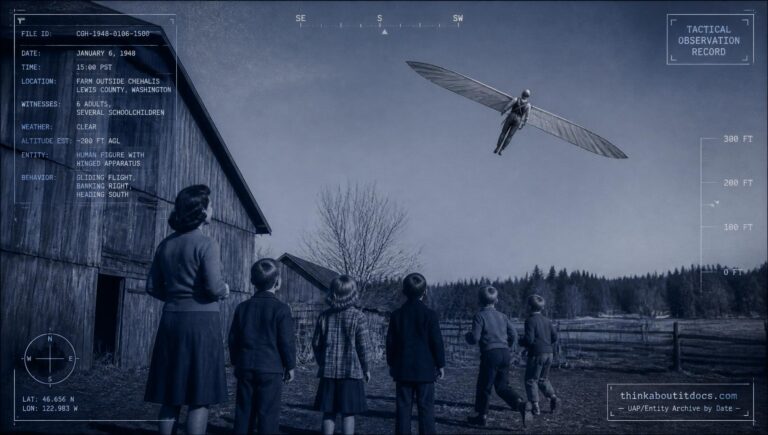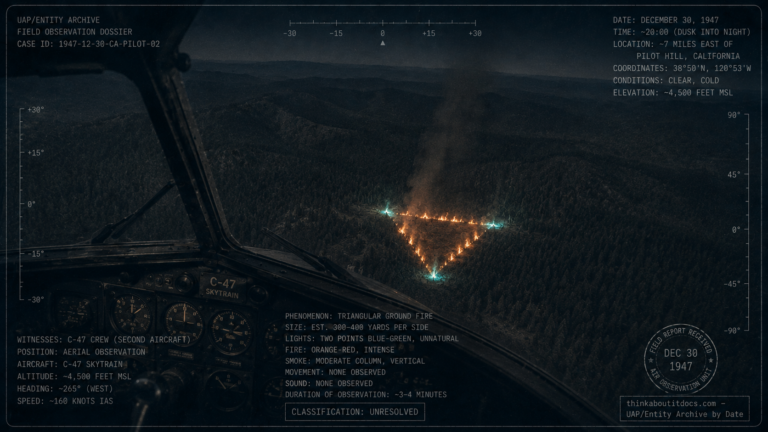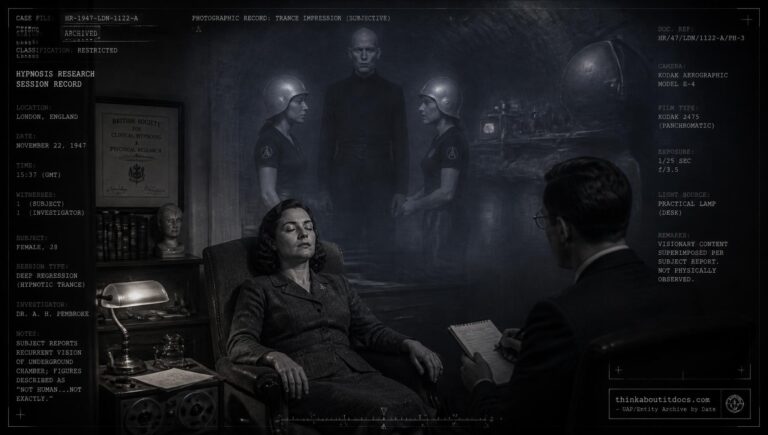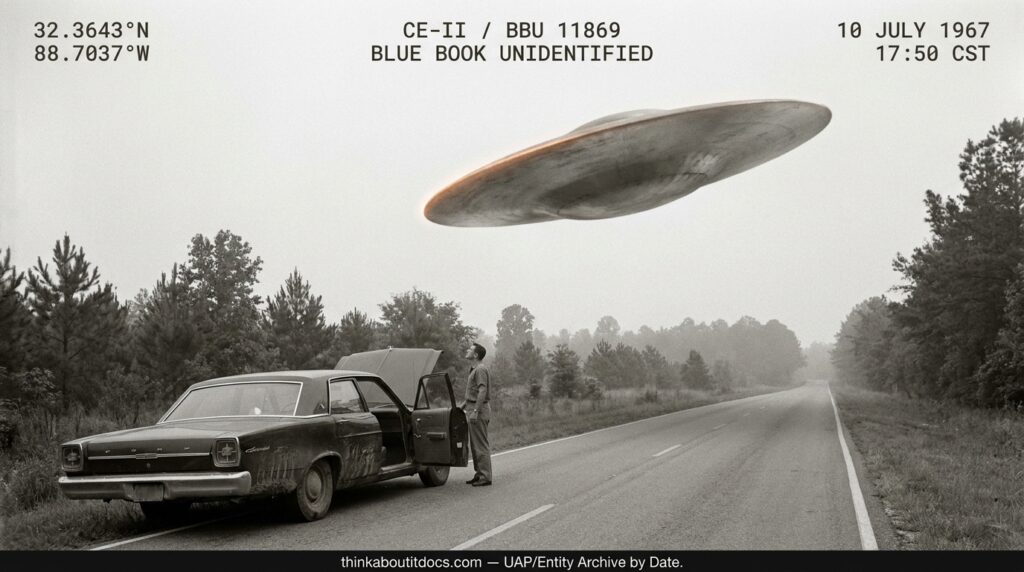
A visual reconstruction of the July 10, 1967, Meridian, Mississippi, encounter where Philip Lanning observed a house-sized, silent, cymbal-shaped craft at 300 feet while his car and radio experienced simultaneous electromagnetic failure — classified Unidentified by Project Blue Book as BBU 11869.
THINK ABOUTIT UFO|UAP SIGHTING REPORT
1967: Meridian, Mississippi UFO|UAP Sighting
On the evening of July 10, 1967, former military officer Philip Lanning was driving south of Meridian, Mississippi, when his car coasted to a dead stop and the radio faded to silence — textbook electromagnetic interference that would become one of the signature elements of the case. Seconds later, a house-sized, cymbal-shaped craft of dirty metallic gray swept overhead at roughly 300 feet, banked hard right at the treeline, and accelerated vertically into the clouds at tremendous speed. The Air Force investigated, found Lanning to be an exceptionally credible witness with extensive military training, and was ultimately forced to classify the case as “Unidentified” — one of the very last reports in the entire Project Blue Book archive to receive that designation.
Blue Book Unidentified — BBU 11869:
This case holds a unique position in the historical record as one of the final sightings to earn the “Unidentified” label from the U.S. Air Force’s Project Blue Book before its closure in 1969. Its combination of vehicle electromagnetic effects, a trained military observer, and an official institutional failure to explain the event makes it a cornerstone case in the Mississippi sighting archive.
Date: July 10, 1967
Sighting Time: 5:50 p.m.
Day/Night: Day
Location: Meridian, Mississippi
Urban or Rural: Rural
No. of Entity(‘s): None observed
Entity Type: Not Applicable
Entity Description: Not Applicable
Hynek Classification: CE-II (Close Encounter II) Observation of an object in close proximity to the witness, where physical effects on the environment are noted (electromagnetic interference, vehicle failure)
Duration: Approximately 30 seconds to one minute
No. of Object(s): 1
Description of the Object(s): A massive, cymbal-shaped craft with a dirty metallic gray underside. No portholes, hatches, seams, or visible propulsion systems were observed.
Shape of Object(s): Cymbal-shaped (like a cymbal on a drum set)
Size of Object(s): Estimated to be the size of a house
Color of Object(s): Dirty metallic gray
Distance to Object(s): Approximately 300 feet altitude
Height & Speed: Approximately 300 feet during flyover; accelerated at extreme speed vertically into low cloud cover
Number of Witnesses: 1
Special Features/Characteristics: Electromagnetic effects on the vehicle — the car coasted to a stop and the radio faded simultaneously. The object was completely silent throughout the encounter. The craft demonstrated an abrupt angular maneuver at the treeline, tilting upward before executing a sharp right turn and vertical acceleration.
Case Status: Unexplained (Air Force Unidentified — Blue Book Unknown, BBU 11869)
Source: Project Blue Book files, National Archives; Air Force unexplained case listing (BBU 11869)
Summary/Description: Philip Lanning was driving south of Meridian, Mississippi, on the evening of July 10, 1967, when his car coasted to a stop and the radio faded. Upon exiting the vehicle to inspect the engine, an enormous cymbal-shaped object of dirty metallic gray flew over his head at approximately 300 feet, silent and moving east. Just before reaching a stand of nearby trees, the object tilted upward, turned sharply to the right, and accelerated vertically into the cloud cover at tremendous speed. No portholes, hatches, or structural features were visible on the underside. Lanning forwarded the report to a contact in Naval Intelligence, and it was eventually routed to the Air Force for formal investigation. The investigation team found Lanning to be a highly credible witness due to his former military officer status and extensive observational training. After thorough research and interviews, the Air Force classified the sighting as Unidentified — one of the final cases in the entire Blue Book archive to carry that designation before the program’s closure in 1969.
Related Cases: 1966: Wanaque Reservoir Incident | 1973: The Pascagoula Incident
Detailed Report
The Meridian sighting of July 10, 1967, stands as one of the most carefully investigated and institutionally significant UFO events in Mississippi history, owing not to its sensational character but to its clean evidentiary profile and its ultimate placement among the last officially “Unidentified” cases in the Project Blue Book archive.
Philip Lanning was driving south of Meridian at approximately 5:50 p.m. in daylight conditions when his vehicle began to lose power. The car coasted to a stop, and simultaneously the car radio faded out — a dual-system failure consistent with the electromagnetic interference pattern documented in hundreds of vehicle-effect cases across the Blue Book and civilian research files. Lanning exited the vehicle and began to inspect the engine, attempting to identify a mechanical cause for the stall.
While examining the car, Lanning became aware of an enormous object passing overhead at an altitude he estimated at roughly 300 feet. The object was completely silent — no engine noise, no aerodynamic disturbance, no sonic artifact of any kind. It was moving eastward on a steady horizontal trajectory. Lanning described the craft’s shape as resembling a cymbal from a drum set, with a dirty metallic gray coloration on the underside. He observed no portholes, hatches, seams, rivets, or any structural features that might suggest conventional manufacture or propulsion. His size estimate placed the object at roughly the dimensions of a house.
As the object approached a stand of trees east of his position, it performed a sequence of maneuvers that defied conventional aerodynamic behavior. First, it tilted its leading edge upward. Then it executed a sharp right turn while maintaining altitude. Finally, it accelerated at extreme velocity on a vertical trajectory, climbing straight up into the low-lying cloud cover and disappearing from view. The entire event, from first awareness to disappearance, lasted less than a minute.
Lanning was uncertain which agency would want the report, but felt an obligation to notify someone in the U.S. government. He forwarded his account to a personal contact in Naval Intelligence. The report was eventually routed to the Air Force, which initiated a formal investigation under Project Blue Book protocols. The investigators were reportedly impressed with Lanning as a witness. He was a former military officer who had received extensive training in observation, identification, and reporting — precisely the kind of witness whose testimony carried institutional weight within the Blue Book evaluation framework.
After what the files describe as extensive research and interviews, the Air Force was unable to identify a conventional explanation for the sighting. The case was classified as “Unidentified” — Blue Book Unknown, catalogued as BBU 11869. This designation is particularly notable because it came during the final operational years of Blue Book, a period when the program was under increasing pressure to reduce its unexplained caseload ahead of its 1969 closure. That the investigation team assigned the “Unidentified” label despite this institutional pressure speaks to the strength of Lanning’s testimony and the absence of any plausible mundane candidate.
Researcher’s Notes
The Lanning Incident — Meridian 1967 and the End of Blue Book’s Honest Count
- Classification Upgrade — CE-II Over DD: The original page classified this case as DD (Daylight Disc), which describes only the visual appearance of the object. However, the dual electromagnetic effects — simultaneous vehicle engine failure and radio fadeout — place this squarely in Close Encounter of the Second Kind (CE-II) territory under the Hynek system. CE-II requires physical effects on the environment or the witness, and vehicle electromagnetic interference is one of the most common and well-documented CE-II indicators in the literature. The proximity of the object at 300 feet further supports the close encounter classification. The correction from DD to CE-II is analytically significant because it moves the case from a passive sighting into the physical-interaction category, where evidentiary standards and explanatory requirements are substantially higher.
- Source Chain Assessment — Institutional Documentation: This case carries an unusually strong source chain for a single-witness event. The report was not filed with a civilian UFO organization or a media outlet — it was routed through Naval Intelligence to the Air Force and entered the Project Blue Book investigation pipeline. The Blue Book file number (BBU 11869) is catalogued in the National Archives. The witness was vetted by military investigators who assessed his credibility based on his officer training and observational background. This institutional documentation chain — witness to Naval Intelligence to Air Force to National Archives — provides a level of provenance that most civilian reports cannot match.
- Pattern Context — Vehicle EM Effects in the 1960s South: The Meridian case fits neatly within a broader pattern of vehicle electromagnetic interference events documented across the American South during the 1960s. The simultaneous engine-stop/radio-fade signature is one of the most consistently reported physical effects in close encounter cases worldwide, catalogued extensively by researchers such as Mark Rodeghier in his 1981 vehicle interference study. The fact that Lanning’s vehicle resumed normal operation after the object departed (implied by his ability to report the case) is also consistent with the EM effect pattern, where the interference field appears to be generated by proximity to the object and dissipates upon its departure.
- Historical Significance — The Last of the Blue Book Unknowns: The placement of BBU 11869 among the final “Unidentified” cases in the Blue Book archive gives it a weight that transcends the individual event. By 1967, the Air Force was actively working to reduce the number of unexplained cases in its files, a process that would culminate in the Condon Committee’s recommendation to close the program. That the Meridian case survived this institutional pressure and retained its “Unidentified” classification indicates that the investigation team could find no plausible conventional explanation — not weather balloon, not aircraft, not atmospheric phenomenon — that fit the described object, behavior, and electromagnetic effects. The case stands as one of the last honest admissions by the U.S. Air Force that it had encountered something it could not explain.
The Meridian sighting of July 10, 1967, occupies a singular position in the American UAP record. A former military officer with verified observational training watches a house-sized, silent, cymbal-shaped craft pass overhead at 300 feet, experiences simultaneous vehicle and radio failure, and then observes the object execute an angular maneuver and vertical acceleration that no known aircraft of the era could replicate. The Air Force investigated, found the witness credible, and was unable to explain what he saw. The case file sits in the National Archives with the designation “Unidentified,” one of the last entries in a program that spent two decades trying to make the phenomenon go away. It did not go away. The record stands.