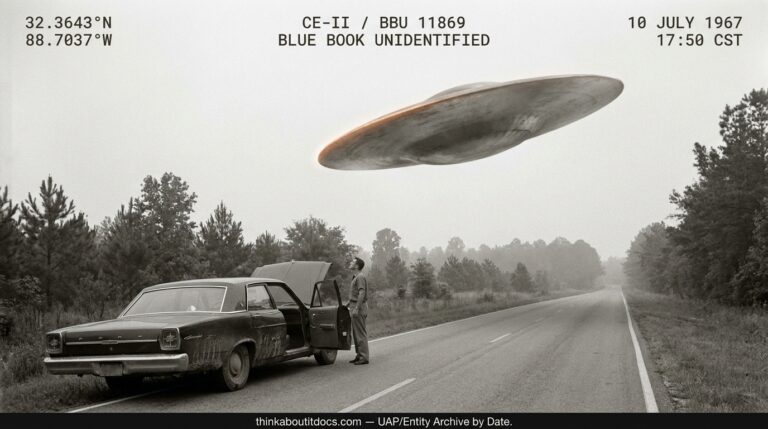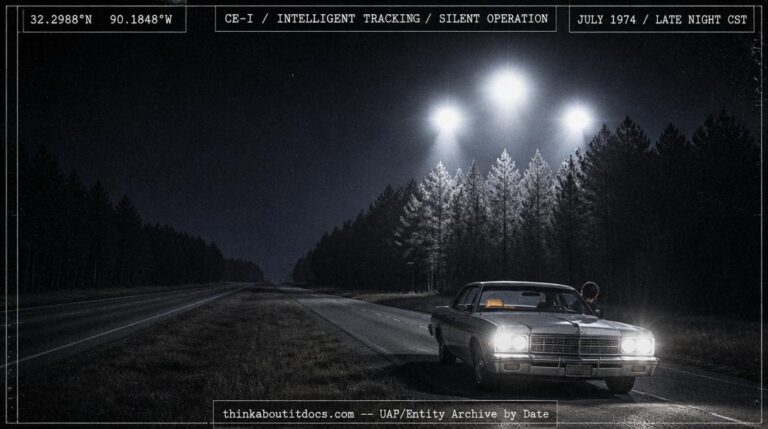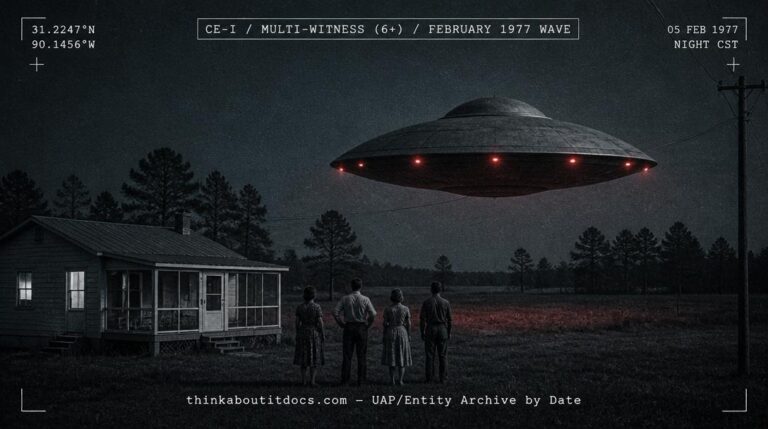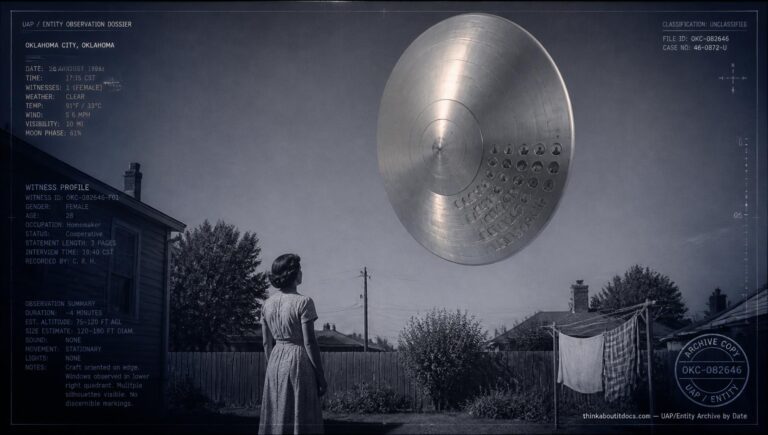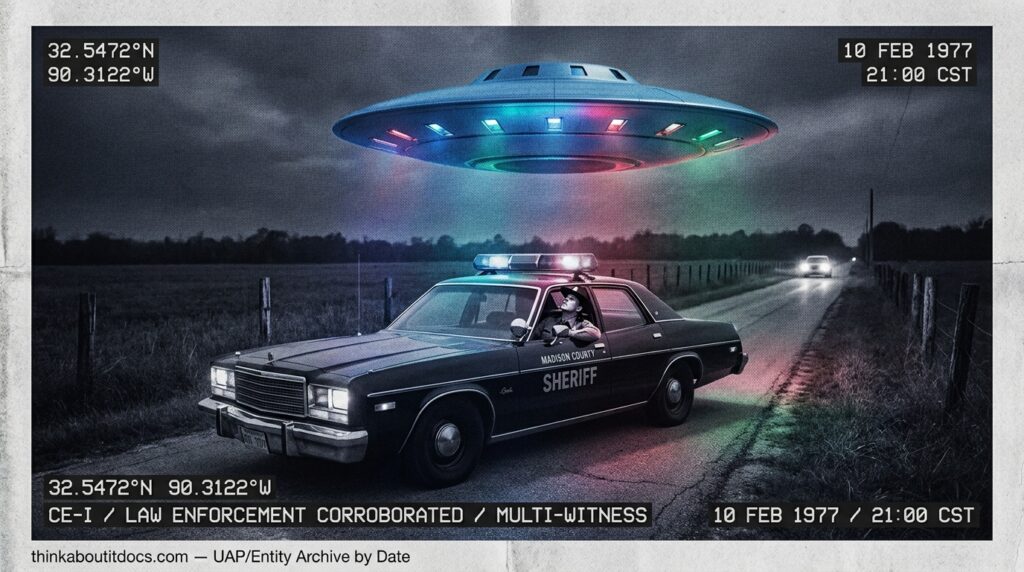
A dossier-style reconstruction of Deputy Kenneth Creel's close encounter near Flora, Mississippi, on February 10, 1977 — a 30-to-40-foot metallic-blue disc with window-like openings hovered directly over his patrol car for more than a minute.
THINK ABOUTIT UFO|UAP SIGHTING REPORT
1977 Flora MS UFO Sighting: Deputy Kenneth Creel’s Close Encounter
On the night of February 10, 1977, Madison County Sheriff’s Deputy Kenneth Creel and Constable James Luke were on a routine patrol west of Flora, Mississippi, when a perfectly round, metallic-blue disc — estimated at 30 to 40 feet in diameter — closed on their position, approached their patrol car as though it was “being piloted,” and hovered directly over the vehicle at just 20 to 30 feet altitude for more than a minute. Creel described the sound as a high-pitched whirring “like a blender straining on ice.” Lights visible through small window-like openings changed from soft blue to red to green. When Highway Patrolman Louis Younger arrived and confirmed the object, it departed at high speed toward the northwest. The Flora encounter is one of the most significant law enforcement UFO sightings in Mississippi history — corroborated by nearly two dozen officers and multiple civilian witnesses, documented in the Madison County Herald, and notable for Creel’s candid admission that the resulting national media attention was more distressing than the encounter itself.
Law Enforcement Multi-Witness Case:
Deputy Creel’s sighting was independently confirmed by Highway Patrolman Louis Younger (who observed the object at close range), Deputy Charles Bowering, Highway Patrolman Joe Chandler, and multiple Flora residents. The witness pool — nearly two dozen officers and civilians — establishes this as one of the most heavily corroborated CE-I events in the 1977 Mississippi-Louisiana wave.
Date: February 10, 1977
Sighting Time: 9:00 p.m.
Day/Night: Night
Location: Flora, Mississippi (Smith School Road, four miles west of Flora, near the county line)
Urban or Rural: Rural
No. of Entity(‘s): None observed (Creel could not determine if anything or anyone was inside the craft)
Entity Type: Not Applicable
Entity Description: Not Applicable
Hynek Classification: CE-I (Close Encounter I) Observation of an object in close proximity to the witness (i.e. within 500 feet)
Duration: Several minutes (the craft hovered over the patrol car for more than one minute; total encounter including approach and departure lasted several minutes)
No. of Object(s): 1
Description of the Object(s): A perfectly round disc with small window-like openings emitting colored light. The craft moved deliberately toward the patrol car, hovered directly over it, and departed at high speed.
Shape of Object(s): Round / Disc
Size of Object(s): 30 to 40 feet in diameter
Color of Object(s): Metallic-blue; lights changed color from soft blue to red to green
Distance to Object(s): 20 to 30 feet (directly above the patrol car at closest approach); first observed at approximately 200 yards distance across a field
Height & Speed: Hovered 20 to 30 feet above the patrol car; departed at high speed toward the northwest (toward Satartia)
Number of Witnesses: Multiple — Deputy Kenneth Creel, Constable James Luke (primary witnesses); Highway Patrolman Louis Younger (independent close-range confirmation); Deputy Charles Bowering, Highway Patrolman Joe Chandler, and multiple Flora residents (distance confirmation)
Special Features/Characteristics: Small windows or portholes emitting colored light that changed from soft blue to red to green and other colors. Audible sound described as a high-pitched whirring “like a blender” or “straining when you first put ice in it.” The craft approached the patrol car deliberately, as though piloted. No spinning or rotation of the disc body was observed. The craft hovered motionless at 20 to 30 feet for more than a minute before departure.
Case Status: Unexplained
Source: Madison County Herald (Canton, MS), February 17, 1977
Summary/Description: Deputy Kenneth Creel and Constable James Luke were on routine patrol on Smith School Road west of Flora when Creel observed what he initially took to be an evening star growing brighter and larger. As the object took shape, he contacted the Mississippi Highway Patrol by radio. At approximately 200 yards, he stopped and cut the engine and lights to listen, hearing a whirring noise like a blender straining on ice. The craft continued to close, approaching the patrol car as though being piloted. It hovered directly over the car at 20 to 30 feet for more than a minute while Creel looked straight up through the car window. Lights from small windows changed colors. Highway Patrolman Louis Younger arrived and independently confirmed the object. The craft then departed at high speed toward the northwest. Additional officers and Flora residents reported seeing lights from the same or a similar object that evening.
Related Cases: 1977: Six Witnesses — Jayess, MS | 1977: Louisiana UFO Flap — Yscloskey | 1973: The Pascagoula Incident
Detailed Report
The Flora encounter of February 10, 1977, is one of the most detailed law enforcement UFO reports in the American South, documented in the Madison County Herald of Canton, Mississippi, with named witnesses, a consistent physical description, and corroboration from an independent law enforcement observer who arrived at the scene during the event.
Deputy Kenneth Creel and Constable James Luke were driving on Smith School Road, a rural route approximately four miles west of Flora near the Madison County line, at approximately 9:00 p.m. Creel first noticed what appeared to be an evening star that was growing progressively brighter and larger. As the shape of the object began to resolve, Creel contacted the Mississippi Highway Patrol by radio — an early, official notification that would later serve as institutional documentation of the timeline.
Creel initially considered the possibility that he was observing a low-flying aircraft. At approximately 200 yards — visible across an adjacent field — he stopped the patrol car, cut the engine and headlights, and listened. In the silence, he heard a high-pitched whirring noise that he compared to a blender or the sound of a blender straining when ice is first introduced. The object then began closing the remaining distance, moving toward the patrol car in a deliberate, controlled manner. Creel described the approach as being “like it was being piloted” — not drifting or buffeted, but proceeding with purposeful direction.
The craft came directly over the patrol car and hovered at an altitude of 20 to 30 feet. For more than a minute, Creel looked straight up through his car window at the underside of the object. He did not exit the vehicle. The craft was perfectly round and estimated at 30 to 40 feet in diameter. Small window-like openings — “little windows” — emitted light that changed color sequentially through soft blue, red, green, and other hues. The object did not spin or rotate. It hovered in a fixed position directly above the patrol car.
Creel could not determine whether anything or anyone was inside the craft. The colored lights from the windows provided the only visual information about the object’s interior.
As the encounter continued, Creel began backing the patrol car — approximately 100 yards — to a point where he could turn around. At this point, Mississippi Highway Patrolman Louis Younger arrived in his own patrol car within a short distance of the UFO. Younger independently observed the same object and provided a description matching Creel’s account. Shortly after Younger’s arrival, the craft “picked up and took off” at high speed toward the northwest, in the direction of Satartia.
Additional officers — Deputy Charles Bowering and Highway Patrolman Joe Chandler — and several Flora residents reported seeing lights from an unidentified craft from a distance on the same evening. The total witness pool extended to nearly two dozen individuals across law enforcement and civilian populations.
In the days following the sighting, Creel was contacted by national media outlets and received dozens of inquiries from individuals and organizations seeking further investigation. Some were described by the Sheriff’s Department as “real cranks,” while others appeared to be serious investigators. Creel attempted to play down the incident, expressing regret at the attention and telling the Madison County Herald that had he known how much trouble reporting would cause, he would not have filed the report — a sentiment frequently expressed by law enforcement witnesses whose credibility and professional standing become entangled with the stigma of UFO reporting.
Researcher’s Notes
The Flora Patrol Car Encounter — Mississippi 1977 and the Weight of Law Enforcement Testimony
- Classification — CE-I at Minimum, CE-II Arguable: At 20 to 30 feet — directly above the patrol car — this is an extremely close CE-I event, well inside the 500-foot threshold. The whirring sound could be considered a physical environmental effect, but as Creel did not report vehicle electromagnetic interference, physiological effects, or ground traces, the standard CE-I classification is maintained. Some researchers might argue for CE-II based on the acoustic signature alone, but the Hynek system typically requires more substantive physical interaction for that upgrade.
- Source Chain Assessment — Law Enforcement Gold Standard: This case carries one of the strongest source chains in the Mississippi record. The primary witness is a named law enforcement officer on duty, accompanied by a constable, who radioed the Mississippi Highway Patrol during the event — creating a timestamped institutional record before the sighting concluded. A second law enforcement officer (Younger) arrived independently and confirmed the object. The account was published in the local newspaper of record with full attribution. Creel’s reluctance to seek attention — indeed, his active discomfort with it — supports his credibility as a witness reporting what he observed rather than seeking publicity. Law enforcement witnesses who express regret at having reported are among the most credible in the UFO literature, precisely because their professional incentive structure punishes rather than rewards disclosure.
- Acoustic Signature — The Blender Analogy: Creel’s description of the object’s sound — a high-pitched whirring like a blender straining on ice — is unusual in the UFO literature and potentially diagnostic. The analogy suggests a rapidly rotating mechanical or electromagnetic component under load, distinct from the humming, buzzing, or complete silence reported in most CE-I cases. This acoustic signature is functionally different from the roaring approach sound reported in the Jayess case five days earlier, suggesting either different craft or different operational modes. The fact that the sound was detectable at 200 yards but did not increase dramatically at 20 feet suggests a contained or directional emission pattern rather than omnidirectional acoustic radiation.
- Wave Context — The February 1977 Peak: The Flora encounter occurred five days after the Jayess Alexander family sighting and one week after the Madison County sighting referenced in the Jayess newspaper account (which actually describes this same event from a different reporting angle — the newspaper accounts reference a February 3 date for the Madison County sighting, but the Flora encounter may represent a second event or a corrected date). The temporal compression of these events — Jayess on February 5, Flora on February 10, with Louisiana’s Yscloskey and Chalmette events occurring in the same January-February window — establishes the February 1977 wave as one of the most concentrated periods of CE-I activity in the American South during the 1970s.
Deputy Kenneth Creel did not want to be a UFO witness. He said so explicitly: if he had known the consequences, he would not have reported the sighting at all. But the record he created — a law enforcement officer on duty, accompanied by a constable, who radioed the Highway Patrol during the event, was independently confirmed by a second officer who arrived on scene, and then gave a consistent, detailed account to the local newspaper — is exactly the kind of documentation that the phenomenon requires. The craft was 30 to 40 feet across. It hovered at 20 feet. It had windows. It made a sound like nothing Creel had ever heard. And then it left. The phone calls from reporters and investigators that followed were, by Creel’s own account, more distressing than the encounter itself. That may be the most honest thing anyone has ever said about what it costs to be a UFO witness in America.
Media

Illustration of the encounter (credit: Madison Co. Herald).