The "Fall 1952" Redding abduction — a period-plausible family craft sighting fused to a modern abduction narrative recovered via 1990s hypnotherapy from a since-discredited source. Date doubtful; logged Insufficient Data. (thinkaboutitdocs.com — UAP/Entity Archive by Date)
THINK ABOUTIT UFO|UAP|ENTITY SIGHTINGS REPORT
1952: Reported Abduction in Redding, California
Read with strong caution on both the date and the source.
The case begins with something ordinary enough for 1952: a family in Redding, California, watches a silent, silvery, oval craft with a glowing orange underside drift over their treetops at dusk. But the report then becomes a full modern abduction story — a twin brother in a trance, a bluish light, a tall pale being with a large hairless head and big black eyes, a telepathic “female” entity, levitation up a beam of light, an interior of corridors, a device clamped on each side of the head, visions of the future, and an “extensive medical examination.” Every element of that second half entered UFO culture long after 1952, and the account itself reaches us only through a 1994 book of hypnotherapy-derived abduction cases by a since-discredited clinician. The honest reading is that the dusk craft sighting may be a genuine 1952 family observation, but the abduction narrative bolted to it is a later construction, recovered under hypnosis and mis-dated. The archive keeps the entry and files it as Insufficient Data, with the date and source flagged.
Date: Given as Fall 1952 — but see Researcher’s Notes; the date is highly doubtful
Sighting Time: Dusk (initial craft sighting); later that night (the reported abduction)
Day/Night: Dusk, then night
Location: Redding, Shasta County, California
Urban or Rural: Rural
No. of Entity(‘s): 2 described (plus “other beings” reported aboard)
Entity Type: Tall “Grey”-type humanoids
Entity Description: A tall, thin figure with a large hairless head, large black eyes, and very pale skin, wearing a black cape to the knees; and a second, “female” being with an egg-shaped head, pointed chin, small mouth, large black almond-shaped eyes, a long neck, and pale grey skin, who communicated by telepathy
Hynek Classification: CE-IV (abduction / direct contact) — provisional; the abduction rests on a single hypnotically-recovered account, and its contents postdate 1952 (see Researcher’s Notes)
Duration: Not recorded (includes the reported onboard sequence)
No. of Object(s): 1
Description of the Object(s): A huge, silvery, oval-shaped craft seen moving slowly and silently above the treetops at dusk, with an orange light beneath it and a section on the underside that moved in a circular fashion; later, the witness reported being floated up a beam of light into an interior with many corridors
Shape of Object(s): Oval
Size of Object(s): Large (“huge”); not otherwise specified
Color of Object(s): Silvery, with an orange underside light
Distance to Object(s): Passed low over the family’s house; the entities were at close range indoors
Height & Speed: Moving slowly just above the treetops; silent
Number of Witnesses: The craft was seen by the family; the abduction was reported by a single witness (the main witness, with a twin brother present in a “trance”)
Special Features/Characteristics: Initial multiple-witness sighting of a silent silvery oval craft; later, a twin brother in an apparent trance; bluish light; telepathic communication; levitation up a beam of light; interior corridors and additional beings; a device placed on each side of the head; reported precognitive visions; an “extensive medical examination” — a cluster of abduction motifs that postdate 1952
Case Status: Insufficient Data
Source: Richard J. Boylan, PhD, & Lee K. Boylan, “Close Extraterrestrial Encounters” (1994) — a collection of hypnotherapy-derived abduction case histories; Boylan is a contested figure whose California psychology license was later revoked
Summary/Description: By a single account published in Richard Boylan’s 1994 book and dated to Fall 1952, a Redding, California family saw a silent, silvery, oval craft with an orange underside light pass over their home at dusk. Later that night the main witness reported seeing his twin brother in a trance, a bluish light, and two tall pale beings with large black eyes; a telepathic “female” being calmed him, and he was floated up a beam of light into a craft of corridors, where a device was placed on each side of his head, he saw future events, and he was medically examined before release. Because the abduction narrative’s features all postdate 1952 and the account is hypnotically derived from a contested source, the date is highly doubtful; it is logged as Insufficient Data.
Related Cases: 1952: Reported Abduction near Tucson, Arizona (another 1952-dated account with anachronistic abduction elements) | 1961: The Betty and Barney Hill Abduction, New Hampshire (origin of the onboard-exam template) | 1952: Sighting and Contact in Bakersfield, California
DETAILED REPORT
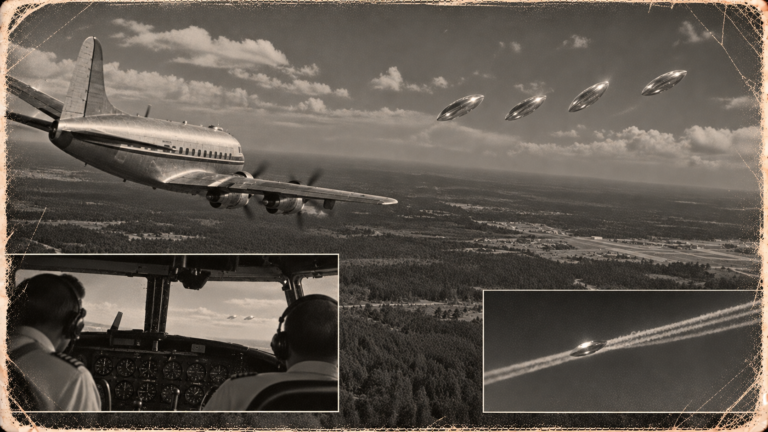
The account, published in Richard and Lee Boylan’s 1994 book “Close Extraterrestrial Encounters” and dated to the fall of 1952, opens with a family sighting. The main witness, at home at dusk, felt an urge to go to the bay window and look out. To the southwest he saw a huge, silvery, oval-shaped craft moving slowly above the treetops toward the house. He called out and the rest of the household came to look. Beneath the craft was an orange light, and a section on the underside moved in a circular fashion. The object passed silently over the house.
That portion of the report is unremarkable for its era and is the part most plausibly anchored to 1952: a silent silvery disc or oval with an underside glow, seen by several family members, is a thoroughly period-appropriate UFO observation. Had the report ended there, it would be an ordinary multiple-witness nocturnal sighting.
It does not end there. Later that night, the account continues, the main witness noticed his twin brother sitting upright in bed in an apparent trance as a bluish light filled the room from outside the window. Turning, he saw a tall figure in the room — large hairless head, large black eyes, very pale skin, thin, wearing a black cape to the knees. He ran for the open door but a second being blocked him: a “female,” with an egg-shaped head, pointed chin, small mouth, large black almond-shaped eyes, long neck, and pale grey skin, who communicated telepathically and calmed him. He then remembered being floated up a beam of light alongside her, finding himself inside an object of many corridors and other beings, seated in a chair while a device was placed on each side of his head, shown images of future events, given an extensive medical examination, and released.
For anyone who knows the chronology of the abduction phenomenon, the difficulty is immediate and governing: this second half is a textbook modern abduction narrative, and its defining features did not exist in 1952. The thin, pale being with the oversized hairless head and large black almond eyes is the classic “Grey,” an image that crystallized after the Betty and Barney Hill case of 1961 and became culturally dominant only after Whitley Strieber’s “Communion” in 1987. Levitation up a beam of light into the craft, the onboard examination, the device fitted to the head, and telepathic communication are all elements of the post-Hill abduction template, elaborated in the 1980s by researchers such as Budd Hopkins and David Jacobs. A witness genuinely describing an experience in 1952 — nine years before the Hills, decades before Strieber — could not have produced this imagery, because the culture had not yet produced it.
The source explains how a modern narrative comes to wear a 1952 label. “Close Extraterrestrial Encounters” was published in 1994; its author, Richard Boylan, states that he began this work in 1989, and the book is a collection of abduction “case histories” drawn from his practice as a clinical psychologist and hypnotherapist, complete with a proposed diagnosis he called “Close Extraterrestrial Encounter Syndrome.” A “Fall 1952” event reaching print this way is, in practice, a memory recovered or rehearsed under hypnosis four decades after the fact. That matters because hypnosis is not a reliability-enhancing tool: it is well established that hypnotic procedures can increase a subject’s confidence and the vividness of recall without increasing accuracy, and can generate detailed but confabulated narratives shaped by the intervening culture and by the interviewer’s framing. The richly detailed onboard sequence is exactly what such a process tends to produce.
The source also carries a specific reliability problem that the archive should state plainly. Boylan is a contested figure: a clinical psychologist whose California license to practice psychology was subsequently revoked, and who later moved into advocacy for “Star Kids” and “Star Nations.” None of that proves any particular witness insincere, but it places the case in a body of work whose methods and judgment have been seriously questioned, and it is the opposite of independent corroboration.
The honest separation, then, is between the two halves of the report. The dusk sighting of a silent silvery oval craft, seen by the family, may well reflect a real 1952 observation. The abduction that follows — recovered from a single witness under hypnosis, decades later, and composed entirely of post-1952 motifs — cannot be taken as a 1952 event. With a doubtful date, a hypnosis-derived narrative, a contested source, and no corroboration of the abduction, there is nothing here that rises to a documented anomaly.
RESEARCHER’S NOTES
The Redding Abduction — California and a Modern Narrative Dated to 1952
- The anachronism, which governs the case: The decisive point is chronological. The abduction half of this account — Grey morphology, beam-of-light levitation, onboard exam, head device, telepathy, precognitive visions — is built from motifs that postdate 1952, most flowing from the 1961 Hill case and the 1980s abduction research that followed. A 1952 narrative cannot authentically contain imagery the culture invented later. The “Fall 1952” date is therefore not a strength but a flag, and the report must be read as a modern account attached to a 1952 year.
- Source and method assessment: The case comes from Richard Boylan’s 1994 “Close Extraterrestrial Encounters,” a collection of abduction case histories derived from his hypnotherapy practice. Two facts bear directly on evidentiary weight: the narrative was recovered via hypnosis, a method that can produce confident, detailed, but unreliable recall shaped by later culture; and Boylan is a contested figure whose California psychology license was revoked. A therapy-derived account from a discredited clinician is not corroboration of a 1952 event; it documents that the story was told and recorded in the 1990s.
- Separating the two halves: The report should not be treated as a single block. The opening family sighting — a silent, silvery, oval craft with an orange underside light passing over the treetops at dusk, seen by several witnesses — is period-appropriate for 1952 and is the more credible element. The abduction sequence that follows is single-witness, hypnotically recovered, and saturated with later tropes. Honest analysis credits the former as a possible genuine sighting while declining to treat the latter as a documented 1952 abduction. The prior page’s “Men in Black” tag is also a mismatch — a caped, black-eyed bedroom being is not the suited-human MIB pattern — and has been dropped.
- Why Insufficient Data rather than Explained: The case can be confidently called inconsistent with its 1952 date and dependent on a hypnosis-derived account from a discredited source — which is why it cannot be a documented Unexplained event. It stops short of a flat “Explained (hoax)” only because the underlying family sighting may be real, the witness may be sincere, and the mis-dating is plausibly an artifact of late hypnotic recall rather than deliberate fabrication. The honest verdict is Insufficient Data, with the strong caveat that the abduction narrative is a modern template wearing a 1952 label.
The Redding case is a clear instance of a pattern the archive must watch for: a plausible period sighting fused to a modern abduction story and filed under the sighting’s year. The dusk craft over the treetops could be a genuine 1952 family observation; the beam of light, the corridors, the head device, and the medical examination are the furniture of an abduction culture that did not exist until decades later, recovered here from one witness under hypnosis by a clinician who later lost his license. Separated honestly and credited to its actual 1994 source, it stands as Insufficient Data — not a 1952 abduction, but a modern narrative attached to a 1952 night.