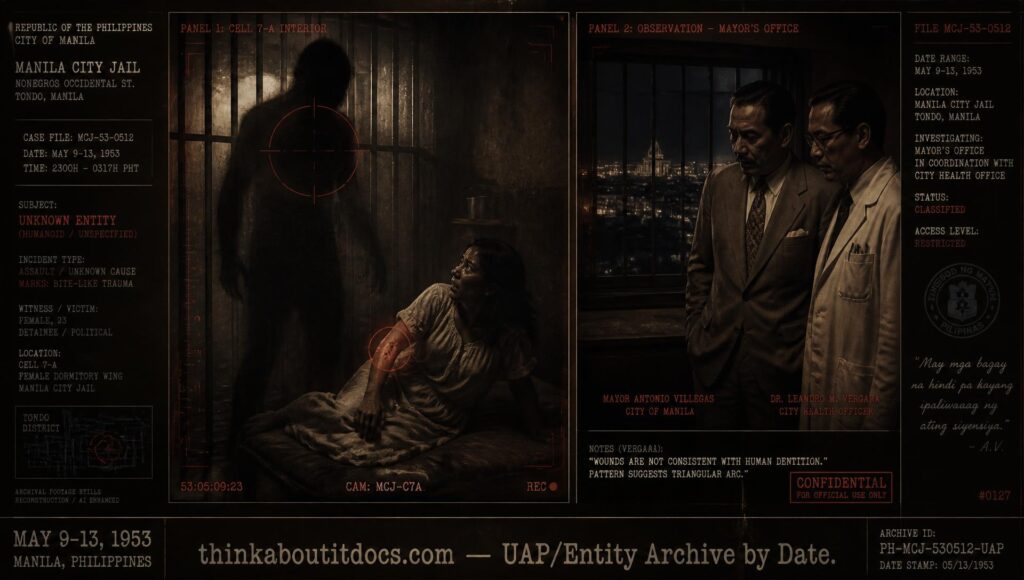
Manila, May 1953 — the Bilibid Prison entity case, corrected from its long-circulated 1951 misdating.
THINK ABOUTIT ENTITY ENCOUNTER REPORT
1953: The Clarita Villanueva Case — Manila, Philippines Entity Encounter
For nine days inside Manila’s Old Bilibid Prison, a teenage vagrancy inmate was bitten in front of the city’s mayor, its chief medical examiner, and a room of reporters and doctors — by something none of them could see.
Date: May 9 – 22, 1953 (widely miscopied in later retellings, including some of this archive’s own earlier sourcing, as May 1951 — see Related Cases)
Sighting Time: Night, recurring across multiple nights and days over the incarceration period
Day/Night: Both, though initial and most severe attacks were nocturnal
Location: Old Bilibid Prison (now Manila City Jail), Manila, Philippines
Urban or Rural: Urban
No. of Entity(‘s): 2
Entity Type: Invisible attacking humanoids, visible only to Clarita Villanueva
Entity Description: Descriptions vary by telling. The dominant account (Frank Edwards) describes a tall, black, hairy, human-like figure with two sharp canine teeth, a long beard, and oversized feet, accompanied by a second, roughly three-foot-tall black hairy figure. Other retellings describe a bug-eyed, caped figure that floated and passed through the cell bars, or a very tall dark, curly-haired figure with an oddly angelic face. All versions agree on two distinct entities that Clarita alone could perceive.
Hynek Classification: Not Applicable — no craft or aerial phenomenon was reported; this is an entity/possession-pattern case outside the standard Hynek taxonomy
Duration: Approximately 9–13 days of intermittent attacks (May 9 through roughly May 22, 1953)
No. of Object(s): Not Applicable
Description of the Object(s): Not Applicable
Shape/Size/Color of Object(s): Not Applicable
Distance to Object(s): Not Applicable
Height & Speed: Not Applicable
Number of Witnesses: Multiple — jail guards, Chief Medical Examiner Dr. Mariano Lara, Manila Mayor Arsenio Lacson, American pastor Lester Sumrall, wire-service reporters, and, per period accounts, dozens of attending doctors and press at the case’s height
Special Features/Characteristics: Bite marks ringed with saliva materialized on Clarita’s skin in real time, including while officials were physically holding her hands or standing beside her, ruling out (in witnesses’ own judgment) self-infliction. The case escalated from unexplained biting into what witnesses described as full possession, with Clarita reportedly speaking and acting as the entities, cursing at least two doctors and a jail warden. Resolved, according to Sumrall’s account, through a three-day exorcism.
Case Status: Insufficient Data / Unexplained — no physical evidence survives beyond eyewitness testimony; psychological and psychosomatic explanations have been proposed alongside the possession and entity-attack framings
Source: Contemporary Philippine and wire-service press, May 19–20, 1953 (United Press, reporter Rodolfo Nazareno); Lester Sumrall, “The True Story of Clarita Villanueva” (1954); Frank Edwards’ later popular retelling (which misdates the case to 1951); Wikipedia, “Possession of Clarita Villanueva,” synthesizing period newspaper accounts including the Beaver County Times, May 20, 1953
Summary/Description: An 18-year-old orphan named Clarita Villanueva, arrested for vagrancy and jailed at Manila’s Old Bilibid Prison, began screaming on the night of May 9, 1953, that an unseen creature was biting her. Guards found teeth marks appearing on her arms and neck with no attacker in sight. Over the following days the attacks escalated and were witnessed directly by the jail’s medical examiner, who ruled out self-infliction, and by Manila Mayor Arsenio Lacson, who personally held Clarita’s hands as fresh bite marks appeared. The case became international news. As the pattern shifted from biting into what witnesses described as possession — Clarita speaking in altered voices and cursing officials — American Pentecostal missionary Lester Sumrall was brought in and conducted a three-day exorcism, after which the attacks reportedly stopped. Clarita was later held for a 30-day psychiatric observation period, during which she showed no further symptoms.
Related Cases: 1951: May Archive — Manila entry (same case, misdated two years early; corrected here)
Detailed Report
The case reached the wider world through two wire dispatches in mid-May 1953, and from there it split into two very different lineages that this archive’s own earlier sourcing had, until now, conflated. One lineage — the possession narrative — comes from Filipino press coverage and from Lester Sumrall’s own later book, and is anchored to a specific, well-documented 1953 timeline: arrest on or around May 6, first attack on May 9, escalation through mid-May, exorcism culminating around May 22, and a subsequent 30-day court-ordered psychiatric observation at Welfareville. The other lineage — the version most familiar to UFO and entity researchers — comes from Frank Edwards, whose retelling strips out the religious resolution entirely and instead frames the case as an unexplained entity-attack story, misdated to May 1951. Edwards’ version is the one this archive’s May 1951 page has carried for years.
The 1953 dating is far better supported. It is anchored to dated newspaper articles, to Sumrall’s own account of arriving in response to a specific radio bulletin, and to a documented court-ordered follow-up observation period with a named judge, Natividad Almeda-Lopez. The 1951 date appears nowhere in the primary press record and traces only to Edwards’ later, secondhand retelling.
What both lineages agree on is the core physical claim: multiple credentialed, named adult witnesses — not a single frightened teenager alone — watched bite marks appear on Clarita’s body in real time, in some cases while physically holding her hands, and concluded on the spot that she could not have caused them herself. That convergence of witness testimony is what has kept the case alive across seven decades of retelling, even as the surrounding narrative frame shifted from “invisible monster” to “demonic possession” and the date itself drifted by two years.
No physical evidence beyond the marks themselves and eyewitness testimony was preserved. No photograph of an attack in progress is known to survive. The case rests entirely on the credibility of 1953-era Manila officials and press, and on Sumrall’s own retrospective account, published roughly a year after the events and later reprinted under variant titles to support his ministry.
RESEARCHER’S NOTES
The Clarita Villanueva Case — Manila, 1953, and the Two-Year Drift Problem
- Date correction, not new discovery: This is not a newly found case — it is a correction of an entry this archive has carried under the wrong year. The 1951 dating traces to Frank Edwards alone and is unsupported by any primary 1953 press record.
- Strong witness convergence, weak physical record: Named officials at the level of a sitting mayor and a chief medical examiner directly observed marks forming on the subject’s body. That is unusually high-status corroboration for an entity case in this archive — but it exists only as testimony; nothing physical was preserved.
- Two incompatible resolution narratives: The UFO/entity-attack framing (Edwards) and the demonic-possession framing (Sumrall, Filipino press) describe the same physical events but resolve them completely differently — one leaves the case permanently unexplained, the other treats it as solved by exorcism. Both are preserved here rather than adjudicated.
- Source has an incentive: Sumrall’s account, the fullest surviving narrative of the case’s second half, was published to support his own ministry and evangelistic reputation, and he credits the case with 150,000 conversions. That doesn’t make it false, but it is not a disinterested source.
- Pattern context: Sudden, witnessed, unexplained bite-mark phenomena on a single subject recur across this archive’s paranormal-adjacent entries; this is one of the best-witnessed examples of that pattern, independent of whether one reads it as entity attack or possession.
Seven decades on, the marks themselves are undocumented beyond memory and the newsprint of the week they appeared — but the fact that a city’s mayor was willing to put his own name to what he watched happen on Clarita Villanueva’s hands is the one thing every version of this story, however differently it explains the rest, has never disputed.
“These bites are genuine. And they are not self inflicted.”
— Dr. Mariano Lara, Manila Chief Medical Examiner, May 1953