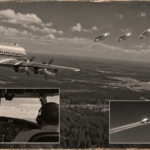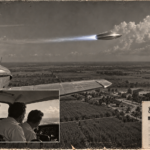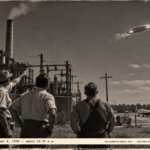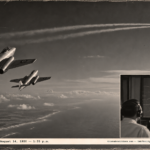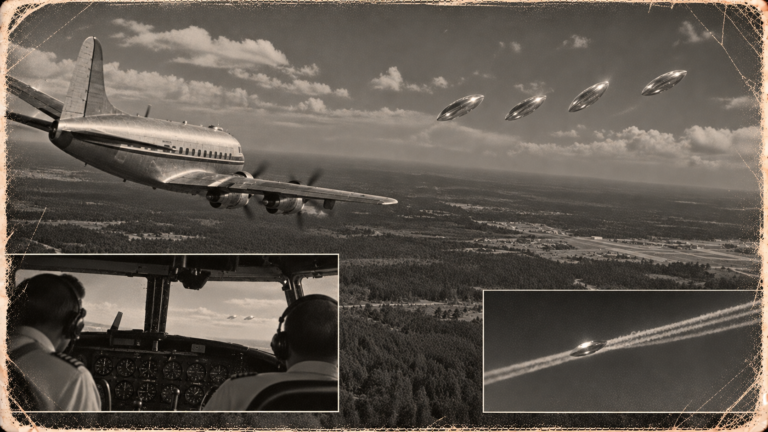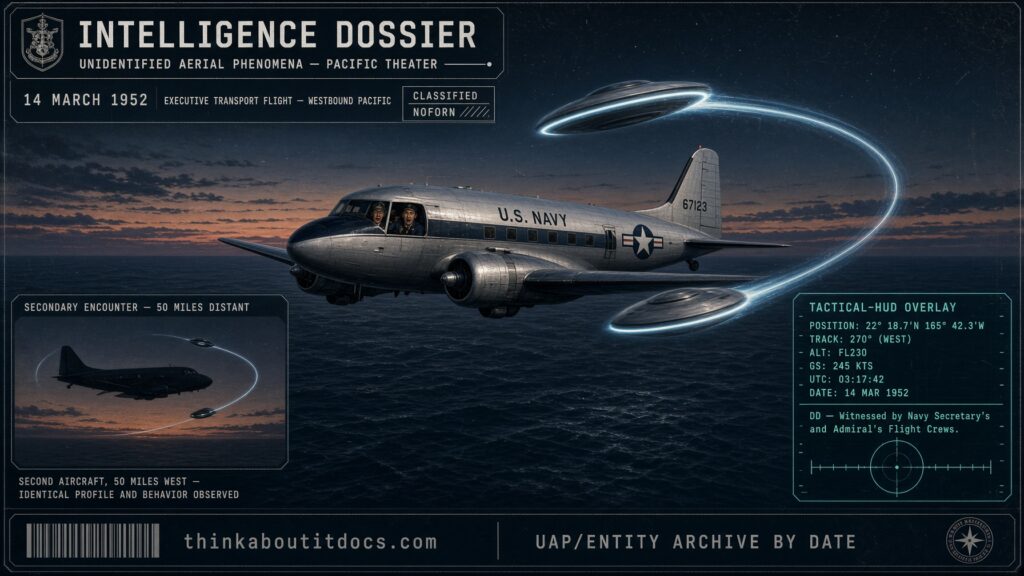
The March 14, 1952 sighting between Guam and Hawaii, in which flight crews carrying Navy Secretary Dan Kimball and Admiral Arthur Radford separately encountered fast-moving discs.
THINK ABOUTIT UFO|UAP SIGHTINGS REPORT
1952: The Kimball-Radford Sighting — Between Guam and Hawaii
On March 14, 1952, two Navy executive aircraft flying the long Pacific route from Guam toward Pearl Harbor, roughly fifty miles apart, were each approached by a pair of fast-moving discs that circled the planes before departing. What makes this case one of the most institutionally significant in the entire early Cold War UFO record is not the sighting itself, dramatic as it was, but who was aboard: Secretary of the Navy Dan Kimball in the first aircraft, and Admiral Arthur Radford — soon to become Chairman of the Joint Chiefs of Staff — in the second. Kimball did not simply file a report; he ordered a dedicated Navy UFO investigation into the incident, giving this sighting a direct, traceable institutional consequence that few cases in this archive can match.
Date: March 14, 1952
Sighting Time: Evening
Day/Night: Evening/Night
Location: Over the Pacific Ocean, along the flight route between Guam and Pearl Harbor, Hawaii
Urban or Rural: Airborne, over open ocean
No. of Entity(‘s): Not applicable
Entity Type: Not applicable
Hynek Classification: DD (Daylight Disc), applied loosely given the evening timing and limited visual detail beyond shape and maneuvering
Duration: Not precisely recorded; long enough for the discs to circle each aircraft twice before departing
No. of Object(s): 2 (encountered independently by each of the two aircraft)
Description of the Object(s): Fast-moving, disc-shaped craft
Shape of Object(s): Disc
Size of Object(s): Not specified
Color of Object(s): Not specified
Distance to Object(s): Close enough to approach and circle each aircraft directly
Height & Speed: Estimated by the pilots at between 1,500 and 2,000 mph — extraordinary performance for any known aircraft of the period; the objects circled each plane twice before departing, the first pair heading east
Number of Witnesses: The flight crews of both aircraft directly observed the discs; Secretary Kimball and Admiral Radford, as passengers, did not personally see the objects but received and relayed their crews’ reports
Special Features/Characteristics: Two independent sightings occurred roughly fifty miles apart on the same route within a short span, each involving a pair of discs behaving similarly (approaching, circling twice, departing); the case was not entered into Project Blue Book’s files and remained unpublicized for roughly two months; Secretary Kimball’s response — ordering a dedicated Navy investigation into the incident, reportedly headed by Cdr. Frank Lowell Thomas of Naval Intelligence — is a rare, directly traceable institutional consequence of a single UFO sighting.
Case Status: Unexplained
Source: Jan Aldrich, Project 1947 (“The Secret Story Behind the April 7, 1952 LIFE Magazine UFO Article”); Donald Keyhoe (relaying Kimball’s account); NICAP
Summary/Description: On March 14, 1952, two U.S. Navy executive aircraft were flying the long Pacific route from Guam toward Pearl Harbor, Hawaii, roughly fifty miles apart. The first aircraft, carrying Secretary of the Navy Dan Kimball, was approached by two fast-moving, disc-shaped objects, which circled the plane twice before departing to the east; the crew, not Kimball himself, made the direct visual observation. The second aircraft, carrying Admiral Arthur Radford — soon to become Chairman of the Joint Chiefs of Staff — independently encountered what appears to have been the same or a similar pair of discs, which circled that aircraft as well before disappearing. The pilots estimated the objects’ speed at between 1,500 and 2,000 mph. The incident was not entered into Project Blue Book’s files and was not made public until roughly two months later, in May 1952. Kimball later told the story to journalist and UFO researcher Donald Keyhoe and recounted it publicly at the Pensacola Naval Test Station in mid-March. In the aftermath, Kimball — after reviewing his own case alongside a broader pattern of Navy and Marine sightings and discovering that witnesses were routinely denied access to the Air Force’s analysis of their own reports — ordered a separate, dedicated Navy investigation into UFO phenomena.
Related Cases: 1951: The March Field Intercept, California | The Washington, D.C. UFO Flap, July 1952 (occurring four months later, amid the same broader wave)
Detailed Report
The Kimball-Radford case occupies a nearly unique position in this archive’s collection: its significance rests less on the details of the sighting itself — fast discs circling an aircraft is, by 1952, an already-familiar pattern — than on the institutional standing of the men who received the report and what they subsequently did with it. Dan Kimball was not a private citizen or a junior officer; he was the sitting civilian head of the entire U.S. Navy. Arthur Radford was one of the most senior military officers in the country and would, within eighteen months, become the nation’s top-ranking military officer as Chairman of the Joint Chiefs of Staff. That two men of this stature were both, independently and within the same short flight window, presented with their own flight crews’ reports of anomalous discs is a genuinely unusual convergence of high-level exposure to the phenomenon.
It is important to be precise about what Kimball and Radford actually witnessed, since secondary retellings sometimes blur this distinction: per Jan Aldrich’s Project 1947 research, it was the flight crews — the pilots and other aircrew — who directly observed the discs, not the passengers. Kimball and Radford’s role was to receive, credit, and act on their own subordinates’ testimony. This does not diminish the case’s significance, but it does reframe it: this is not primarily a story about two high officials seeing something themselves, but about two high officials taking their own personnel’s UFO reports seriously enough to order an institutional response — arguably an even more consequential outcome than a personal sighting would have produced.
Kimball’s specific motivation for ordering the Navy’s own investigation is documented and worth emphasizing: he did not act solely on the strength of his pilots’ report, but after reviewing the case alongside a wider body of unresolved Navy and Marine Corps UFO sightings, and after discovering that Air Force policy routinely denied witnesses access to whatever analysis had been conducted of their own reports. That grievance — an institutional complaint about transparency and follow-through, coming from within the military chain of command rather than from outside critics — is itself a significant and underappreciated data point in the broader history of official UFO investigation.
The two-month gap between the sighting and its public disclosure, and its absence from the official Project Blue Book files despite its extraordinarily high-profile witnesses, raises a genuine question this archive cannot resolve: whether the case was deliberately kept out of the Air Force’s official channel (given the Navy’s own separate and sometimes rival investigative interest in the subject during this period), or whether it was simply never formally submitted through Blue Book’s civilian-facing intake process. Either explanation is plausible, and neither can be confirmed from the sources available here.
RESEARCHER’S NOTES
The Kimball-Radford Sighting — Pacific 1952 and the Weight of Institutional Response
- Classification issues: DD is applied loosely; the case’s core detail (speed, maneuvering, disc shape) fits the category, though the evening timing and lack of finer visual detail leave some ambiguity in the classification.
- Source chain assessment: The case is unusually well-documented for its era given its high-profile principals — preserved through Jan Aldrich’s dedicated Project 1947 research, Kimball’s own account as relayed to Donald Keyhoe, and cross-referenced in NICAP’s files — though the direct witnesses (the flight crews) are not individually named in the surviving record, and Kimball and Radford’s testimony is itself secondhand relative to what their crews actually saw.
- Pattern context: This case occurred four months before the far more famous July 1952 Washington, D.C. UFO flap, and belongs to the same broader wave of escalating, increasingly high-profile military sightings that would culminate that summer — Kimball’s resulting Navy investigation is a direct institutional link between this incident and the government’s evolving approach to the subject.
- Physical evidence and evidentiary weight: No photograph, radar log, or named crew testimony survives in the sources reviewed by this archive. The case’s evidentiary weight rests almost entirely on the credibility conferred by its two extremely senior secondhand witnesses and the documented institutional response that followed.
- Geographic and historical context: The Guam-to-Hawaii Pacific corridor was, in 1952, an active and closely monitored military air route in the aftermath of World War II and amid the ongoing Korean War, making unauthorized or unidentified aircraft in the area a matter of genuine operational concern independent of any UFO interpretation.
The Kimball-Radford sighting endures not for the novelty of its central details — fast discs circling military aircraft were, by 1952, already a familiar pattern in this archive’s record — but for the unmatched seniority of the men who received, credited, and acted on their crews’ reports. A sitting Secretary of the Navy ordering a dedicated internal UFO investigation, in direct response to his own flight crew’s testimony, is a rare and genuinely traceable institutional consequence. It is catalogued here as Unexplained: a high-level Navy incident whose real significance lies as much in what it prompted afterward as in what was seen that evening over the Pacific.
“Their speed was amazing. My pilots estimated it between fifteen hundred and two thousand miles an hour.”
— Secretary of the Navy Dan Kimball, on the March 14, 1952 sighting between Guam and Hawaii