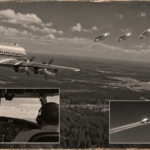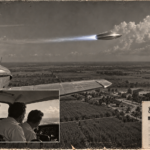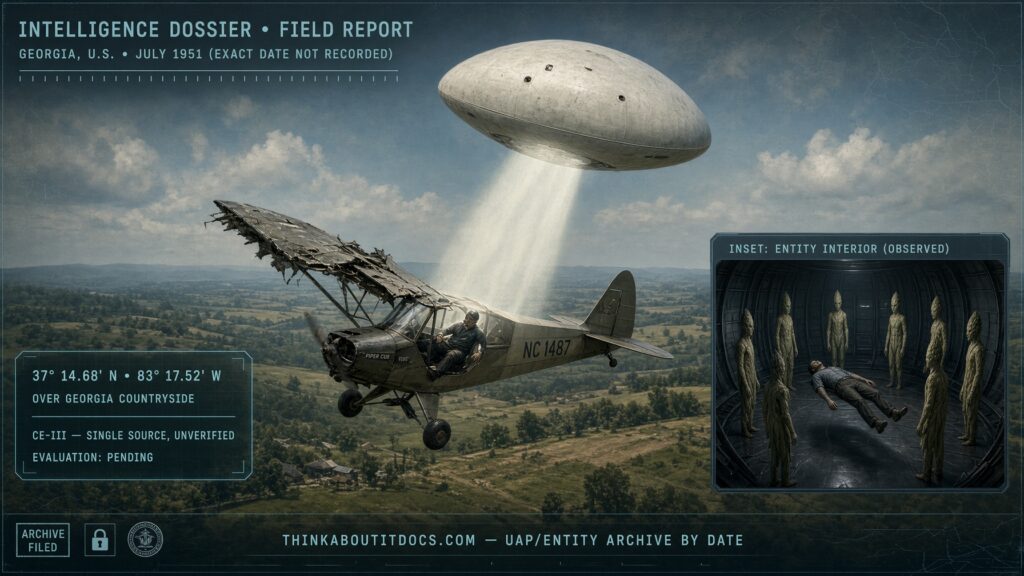
Fred Reagan's July 1951 mid-air collision with a UFO over Georgia, after which he claimed to be pulled aboard and treated by asparagus-like beings
THINK ABOUTIT
UFO|UAP & ENTITY ENCOUNTER REPORT
1951: The Fred Reagan Collision — Over Georgia
Of all the strange encounters this archive has documented, few combine the ordinary and the extraordinary as jarringly as this one: a small private plane, piloted by a man named Fred Reagan, colliding mid-flight with a lozenge-shaped object over Georgia — and instead of crashing, being pulled upward into the craft by an unseen force. Inside, he reportedly found beings resembling metal stalks of asparagus, roughly three feet tall, who apologized for the accident, gave him a medical examination, and claimed to have cured him of cancer, before setting him down beside the wreckage of his own plane without a mark on him. Reagan died less than a year later, in May 1952, of what was described as brain deterioration attributed to radiation exposure — an ending that turns an already bizarre story into a genuinely unsettling one, regardless of how it is ultimately explained.
Date: July 1951 (exact date not recorded)
Sighting Time: Unknown
Day/Night: Unknown
Location: Over Georgia (exact location not given)
Urban or Rural: Airborne
No. of Entity(‘s): Multiple (exact number not specified)
Entity Type: Non-humanoid
Entity Description: Described as resembling metallic stalks of asparagus, roughly three feet tall; no further physical description survives beyond this striking comparison
Hynek Classification: CE-III (Close Encounter of the Third Kind), though the involuntary, collision-triggered abduction structure places it at the more extreme end of that category
Duration: Not recorded
No. of Object(s): 1
Description of the Object(s): A lozenge-shaped craft, substantial enough to collide with and disable a small aircraft (a Piper Cub) without apparent damage to itself
Shape of Object(s): Lozenge
Size of Object(s): Not specified
Color of Object(s): Not specified
Distance to Object(s): Direct collision, followed by involuntary transport aboard the craft
Height & Speed: Not specified; Reagan’s Piper Cub reportedly began falling after the collision before an unseen force pulled him upward and into the object
Number of Witnesses: 1 (Fred Reagan)
Special Features/Characteristics: A direct mid-air collision between a small private aircraft and the object; an unseen force pulling the falling pilot upward and into the craft rather than allowing him to crash; entities communicating in apparently fluent English despite their non-human appearance; an apology offered for the collision; a claimed medical examination and cancer treatment performed on the witness; Reagan was returned to the ground, unconscious, beside the wreckage of his own plane, without any scratch or bruise despite the collision; Reagan reportedly died in May 1952 — less than a year later — of brain deterioration attributed to radiation exposure.
Case Status: Insufficient Data
Source: Gordon Creighton, Flying Saucer Review Vol. 15 #5
Summary/Description: In July 1951, a pilot named Fred Reagan was flying a Piper Cub over Georgia when it collided with a lozenge-shaped object in midair. As his damaged plane began to fall, an unseen force pulled him upward and into the object rather than allowing him to crash. Inside, he reportedly encountered beings resembling metallic stalks of asparagus, roughly three feet tall, who communicated with him — apparently in fluent English despite their appearance — and apologized for the collision. They then gave him what he described as a medical examination, during which they claimed to have cured him of cancer. Afterward, he was set down, unconscious, on the ground beside the wreckage of his own plane, without a scratch or bruise anywhere on his body despite the collision that had brought down his aircraft. In May 1952, less than a year after the incident, Reagan reportedly died of brain deterioration that was attributed to radiation exposure. No further detail on the medical basis for that diagnosis, or on any independent verification of Reagan’s identity, flight, or death, survives in the source material available to this archive.
Related Cases: 1951: The Salzburg, Austria Encounter | 1951: The Drakensteen Mountain Contact, South Africa (same year, comparable involuntary-contact structure)
Detailed Report
The Reagan case stands apart from most contactee narratives of its era in one crucial respect: it does not begin with a chosen, voluntary encounter. Where cases like Daniel Fry’s White Sands account or the Drakensteen Mountain contact describe a witness approached and invited into a situation he could, in principle, have declined, Reagan’s account begins with an involuntary mid-air collision and an unwanted, physically dangerous emergency — his plane was going down. The “rescue” that follows, an unseen force pulling him up into the very object that struck his aircraft, reframes the encounter less as a contact narrative and more as an accident followed by an emergency intervention, however strange the responding party.
The entity description — beings resembling metallic asparagus stalks — is among the most distinctive and least anthropomorphic in this archive’s entire collection. Most 1950s entity encounters, even the strange ones, describe beings that retain a broadly humanoid structure: a head, limbs, some recognizable proportion to the human body. A description built around a vegetable’s silhouette is difficult to trace to any obvious contemporary cultural touchstone or archetype circulating in 1951-era popular science fiction, which is worth noting as a point of interest even without drawing any strong conclusion from it.
The claimed cancer diagnosis and cure is the case’s most medically loaded detail, and also its least verifiable. No source material available to this archive establishes that Reagan had actually been diagnosed with cancer prior to the encounter, what kind of cancer was involved, or what medical basis existed for either the original diagnosis or the claimed cure. Absent any of that supporting detail, this element of the story cannot be assessed as anything more than an unverified claim relayed within an already extraordinary narrative.
The account’s final detail — Reagan’s death less than a year later, attributed to radiation-caused brain deterioration — is the element that gives this case its lasting unease, and also its greatest evidentiary problem. If accurate and independently documented, a witness’s death from an unusual, radiation-linked cause within a year of a close encounter would be a genuinely significant data point, inviting comparison to other cases in the literature where witnesses reported unexplained physiological effects (see, for instance, this archive’s own Francis Wall Chorwon, Korea case from earlier the same year). But this archive has been unable to locate any independent death record, obituary, or medical documentation confirming Reagan’s death, its stated cause, or even his existence as a real, identifiable individual, leaving this detail — however striking — entirely unverified.
RESEARCHER’S NOTES
The Fred Reagan Collision — Georgia 1951 and the Weight of an Unverifiable Ending
- Classification issues: CE-III captures the close-range entity contact, but the case’s involuntary, accident-triggered structure sets it apart from the great majority of CE-III cases, which typically begin with a witness’s own choice to approach or investigate.
- Source chain assessment: The case is preserved only through a single Flying Saucer Review article; no named investigator’s interview, no independent identification of “Fred Reagan,” and no corroborating documentation of his flight, the collision, or his reported death have been located. This is a single-source case in the fullest sense.
- Pattern context: The claimed “cure” and the claimed later death from radiation-linked causes echo a recurring, if inconsistent, theme across 1950s contact literature — beings offering medical intervention, sometimes benevolent and sometimes with lingering harmful physiological consequences for the witness — without this archive being able to establish whether that thematic pattern reflects a genuine phenomenon or simply a recurring narrative convention of the era.
- Physical evidence and evidentiary weight: None. No photograph, no wreckage report, no medical record, and no independent confirmation that Fred Reagan existed as described. This case rests entirely on a single magazine article’s uncorroborated account.
- Geographic and historical context: No specific Georgia location is given in the surviving account, which further limits any possibility of cross-referencing local records, newspaper archives, or aviation incident reports from the period.
The Fred Reagan case endures as one of this archive’s strangest and least verifiable entries — an involuntary mid-air rescue by beings unlike almost any other described in the era’s literature, a claimed medical miracle, and an unsettling death that this archive has no way to confirm ever happened as described. Its distinctiveness (the asparagus-like entities, the accidental rather than deliberate contact) argues against simple recycling of familiar contactee tropes, but distinctiveness is not evidence, and a single uncorroborated magazine article is a thin foundation for a story this extraordinary. It is catalogued here as Insufficient Data: a memorable and genuinely strange account that this archive can neither verify nor responsibly present as documented fact.
“Inside were beings like metallic stalks of asparagus, about three feet tall.”
— Account of Fred Reagan’s July 1951 collision and abduction over Georgia