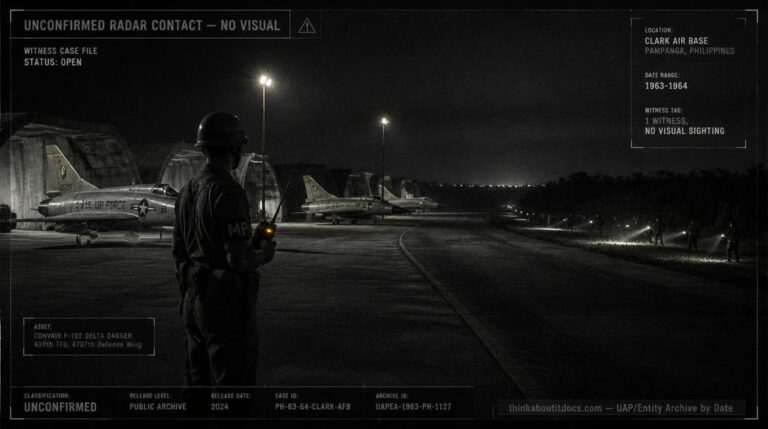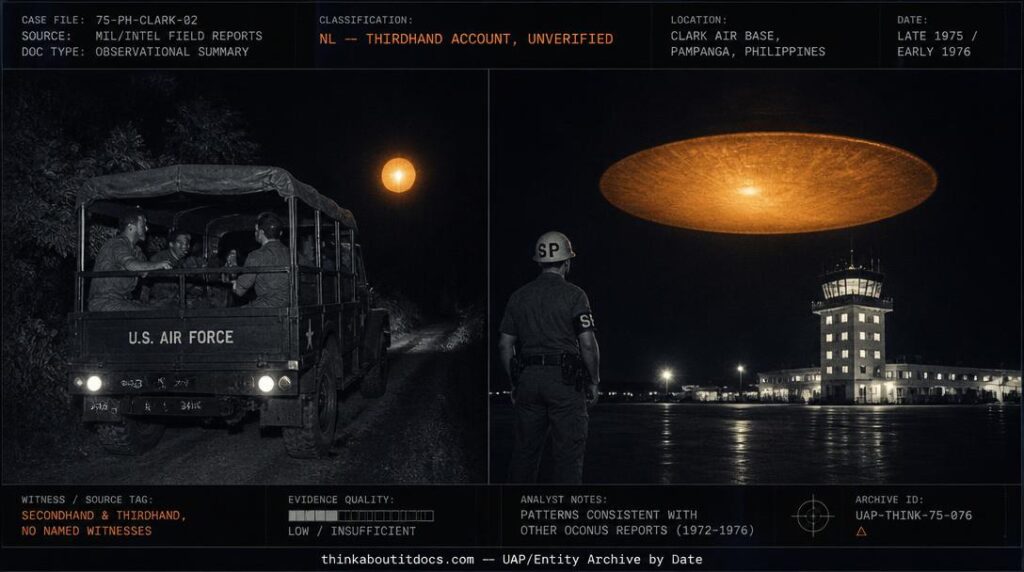
Recreation of the 1975-76 Clark Air Base incidents, in which a glowing orange orb reportedly trailed a fuel truck and a 75-100 foot orange disk reportedly hovered over a Security Policeman on the flight line the same night.
THINK ABOUTIT UFO|UAP SIGHTINGS REPORT
1975-76: The Orange Ball and Orange Disk of Clark Air Base, Philippines
On a single night in late 1975 or early 1976 at Clark Air Base, Philippines, a fuel truck crew returned from the remote “Hill Area” visibly shaken after a glowing orange ball, about 3 feet across, trailed them for half the drive, rising and dropping beside the canvas truck top before vanishing — and that same night, according to a story the reporting witness only heard years later, a Security Policeman on the flight line watched a 75-to-100-foot orange disk hover directly over him before shooting straight up and disappearing, an incident he was reportedly told by his commander to never log.
Date: A single specific night in late 1975 or early 1976, during the witness’s broader tour at Clark AB from 1973-1976 (and again 1984-1988)
Sighting Time: Between approximately 11:30 PM and midnight
Day/Night: Night — corrected from the original field, which listed “Day.” Both incidents described in this report occurred late at night.
Location: Clark Air Base, Angeles City, Pampanga, Philippines — two locations specifically: the road between the base’s main area and the “Hill Area” fuel storage point about 10 miles out, and the “J” ramp directly in front of the Clark AB control tower
Urban or Rural: Military installation — corrected/filled from the original field’s bare “-AFB”
No. of Entity(‘s): Undocumented
Entity Type: Not Applicable — no entity described
Entity Description: Not Applicable
Hynek Classification: Corrected from the original DD (Daylight Disc) to NL (Nocturnal Light), consistent with the corrected nighttime timing. The larger disk, described as solid and structured, sitting motionless before departing vertically, pushes toward a more resolved nocturnal object than a typical ambiguous NL case, similar to a caveat noted on other pages in this archive.
Duration: The orange ball trailed the truck for roughly half of its return route from the Hill Area (undocumented total time). The orange disk reportedly sat in place “a few seconds” before departing.
No. of Object(s): 2 separate objects reported the same night — a small glowing orange ball and a much larger orange disk, at two different locations on base. It is not established whether these were related or coincidental.
Description of the Object(s): (1) A glowing orange ball approximately 3 feet in diameter that trailed a fuel truck along the road from the Hill Area, repeatedly rising above and dropping to just below the top of the truck’s canvas cover, visible to all aboard, before rising and disappearing at the halfway point of the drive. (2) A much larger orange disk, approximately 75-100 feet in diameter, that hovered directly over a Security Policeman’s position on the “J” ramp in front of the control tower, remained in place briefly, then shot straight upward and vanished almost immediately.
Shape of Object(s): Ball (ball/sphere) and Disk, respectively
Size of Object(s): Approximately 3 feet in diameter (orange ball); approximately 75-100 feet in diameter (orange disk)
Color of Object(s): Orange, for both objects
Distance to Object(s): The orange ball was close enough to be level with or just below the truck’s canvas top — an arm’s reach or so above the vehicle. The orange disk was described as directly over the Security Policeman’s position, implying very close overhead proximity, though no measured distance is given for either.
Height & Speed: The orange ball moved at a pace matching the truck, rising and falling repeatedly along the way. The orange disk was stationary for a few seconds, then departed vertically at a speed described only as sudden, “almost immediately” out of sight.
Number of Witnesses: For the orange ball: an unspecified number of fuel-handling personnel riding in the truck (described only as “individuals,” count not given), relayed secondhand to the reporting witness (who was not present) upon their return. For the orange disk: one named-to-the-reporting-witness-but-unidentified-to-readers Security Policeman, whose account was relayed to the reporting witness thirdhand, years later, via a mutual acquaintance (a training manager who had himself only heard the original radio call as a desk sergeant that night).
Special Features/Characteristics: According to the thirdhand account, the Security Policeman who saw the orange disk called his commander to report the incident, who reportedly instructed him not to make an entry in the police blotter and to “forget that the incident ever happened” — an unverifiable but notable detail if accurate. The reporting witness himself witnessed neither object directly and learned of the orange disk incident only years later, by coincidence, in an unrelated conversation.
Case Status: Insufficient Data — a secondhand and thirdhand account with no named witnesses identifiable to outside readers, no independent corroboration located, and a claimed institutional suppression detail that cannot be verified
Source: Reported to Think AboutIt
Summary/Description: I was stationed at Clark AB in the Philippines (now closed) from 1973 to 1976 and again from 1984 to 1988. During the first period I mentioned, I worked in the Base Fuels Distribution Office, and one night between 1130 and 1200 we had an incident happen. We were responsible for refueling all aircraft at Clark on a 24/7 operation. As such, we would send out a truck between shifts and relieve those individuals who were refueling aircraft or receiving fuel into bulk storage for refueling at a later date. One of our storage points was known as the Hill Area, and it was about 10 miles from our main location. We received fuel there via a pipeline from Subic Naval Base (Olongapo City).
During one particular night in late 1975 or early 1976, we sent a truck up to relieve the personnel who were receiving fuel at the Hill Area and bring them back down so they could go off shift. The type of truck we used for this purpose was a 2.5-ton general utility vehicle with a canvas top over the cargo area. As assistant shift leader, I was dispatching trucks that night. When the truck arrived with the individuals going off shift, they were all visibly shaken by something. I asked what was wrong, and was told that they had been followed about halfway from the Hill Area by a glowing orange ball about 3 feet in diameter. This ball trailed the truck and would rise up above, then drop to just below the top of the canvas so that all in the truck could see it. At the halfway point, it rose up above the canvas once again and disappeared.
You would think the story ended there, but it didn’t. When I returned to Clark the second time, I changed jobs and was responsible for training at the airlift wing stationed at Clark at the time. In each unit we had training managers responsible for that squadron’s training programs. It happens that one of the squadron training managers and I were talking one day, and I found out that he had been a security policeman also stationed at Clark during 1973-1976. We started talking about old times and he asked me if I had heard of the UFO encounter at Clark. I thought he was talking about the incident I related above, but found out he was aware of that one and was talking about another incident that happened the same night. It seems he was sitting on the desk when one of the security policemen on the flight line called in a report. That policeman was in an area known as the “J” ramp, directly in front of the Clark AB control tower. His sighting involved an orange disk directly over his position, approximately 75-100 feet in diameter. According to the individual relating the story to me, the disk sat there for a few seconds, then shot straight up, disappearing almost immediately. Since this was a highly peculiar incident, he then called the Security Police commander, who asked if he had made an entry on the police blotter yet. He replied no, and the commander said not to, and to forget that the incident ever happened. I heard nothing from any of our drivers that night, because they were all occupied refueling aircraft at the far end of the parking area.
Over the years I have thought about this incident a lot, and I sure would like to talk to some other people who saw either craft. I imagine that especially those individuals working in the control tower or sitting at the ground control radar that night would have quite a story to tell.
I would like to ask that any service men or women who were working at Clark AB Philippines at the dates given in the story, who have information about this incident, please contact me. Not only would I like to know, but the gentleman relating this story would like to hear from you as well.
Related Cases: 1963-1964: Clark AFB Philippines Air Police Large Object Picked Up On Radar — an earlier unconfirmed radar contact at the same base, though involving entirely different circumstances and evidence
Detailed Report
This report is really two separate stories, joined only by occurring on the same night at the same base, and both reaching the reporting witness at one remove or more. As assistant shift leader in the Base Fuels Distribution Office, he personally witnessed neither object. The first incident — a small, glowing orange ball, about 3 feet across, pacing a fuel truck for roughly half its return route from the remote Hill Area storage point, rising and falling beside the canvas cargo cover in full view of the crew inside — reached him directly and immediately: the truck’s crew arrived visibly shaken and relayed the story to him that same night. The second and far larger incident reached him only years later, by pure coincidence, in an unrelated conversation with a squadron training manager who mentioned, almost in passing, that he had once been a Security Policeman at Clark during the same years. That individual described taking a radio call the same night from a fellow policeman on the “J” ramp, who reported a 75-to-100-foot orange disk hovering directly overhead before it sat briefly and then shot straight up out of sight — and who was reportedly told by his commander afterward not to log the incident and to forget it had happened. Neither the ball nor the disk was independently seen by the reporting witness, and no name is attached to either the truck crew or the flight-line policeman in what has been passed down. The witness’s own closing request — inviting others who served at Clark during this period to come forward — suggests he was aware of exactly how thin the corroboration was, and was actively trying to strengthen it.
RESEARCHER’S NOTES
Two Stories, One Night — Clark AB 1975-76 and the Weight of Secondhand Testimony
- Classification Assessment: The original DD (Daylight Disc) classification was a clear error — both incidents occurred at night, between roughly 11:30 PM and midnight, not during the day. Corrected to NL (Nocturnal Light), though the disk’s described behavior (a solid, briefly stationary object with a sudden vertical departure) is more structured than a typical ambiguous nocturnal light.
- Source Chain Assessment: This is one of the more layered hearsay chains in the archive. The orange ball reaches readers secondhand: witnessed by unnamed truck crew, relayed same-night to the reporting witness, then relayed by him to this site. The orange disk reaches readers thirdhand: witnessed by an unnamed flight-line policeman, relayed to a training manager (himself a former security policeman) who took the original call, relayed by him to the reporting witness years later, then relayed by the reporting witness to this site. Neither primary witness is named or independently reachable.
- Evidentiary Weight: No photograph, radar log, or police blotter entry exists for either incident — notably, the account explicitly states the disk sighting was deliberately kept out of the blotter on a commander’s instruction, meaning even the ordinary paper trail a military base would generate was allegedly suppressed. This detail cannot be verified from outside the story itself, but if true, it would explain the total absence of any official record.
- Pattern and Comparative Context: The claimed timeframe — late 1975 into early 1976 — coincides with a genuinely well-documented historical wave of UFO incursion reports at multiple US military installations, most notably the Loring AFB (Maine) incidents and similar reports at Malmstrom, Cannon, Eglin, and Fort Ritchie, all occurring within this same several-month window and later investigated in Fawcett and Greenwood’s book Clear Intent, drawing on declassified Department of Defense and CIA documents obtained via FOIA. This Clark AB account is not corroborated by any of that documented record, but it sits within the same real, historically verified period of heightened military UFO reporting, which lends the timeframe itself credibility even though this specific incident remains unverified.
- Geographic and Historical Context: Clark Air Base, near Angeles City, Pampanga, served as a major logistical hub through the Vietnam War until 1975, meaning this incident falls right at the base’s transition into its post-Vietnam era. The base closed permanently in 1991 following the Mount Pinatubo eruption.
Two objects, one night, and a reporting witness who saw neither one himself — this account is only as strong as the chain of people relaying it, and that chain runs three deep for the more dramatic of the two stories. It arrives during a documented real wave of similar reports at military bases worldwide, which lends the setting plausibility without confirming the specifics. With no names, no photographs, and an alleged order to keep it off the books, the case stands as Insufficient Data.
“The commander said not to, and to forget that the incident ever happened.”