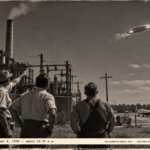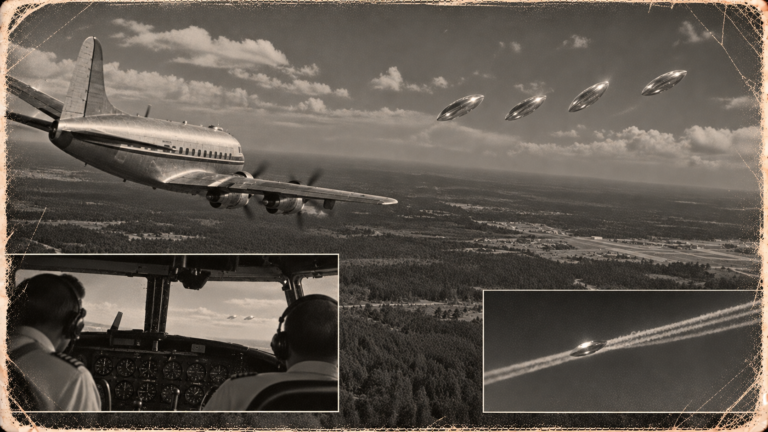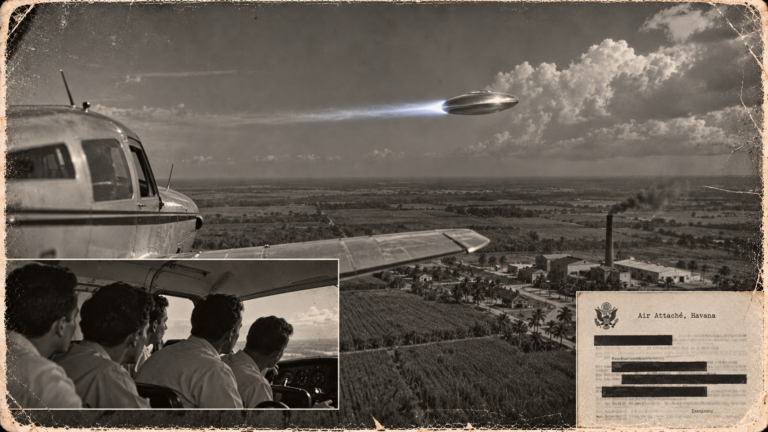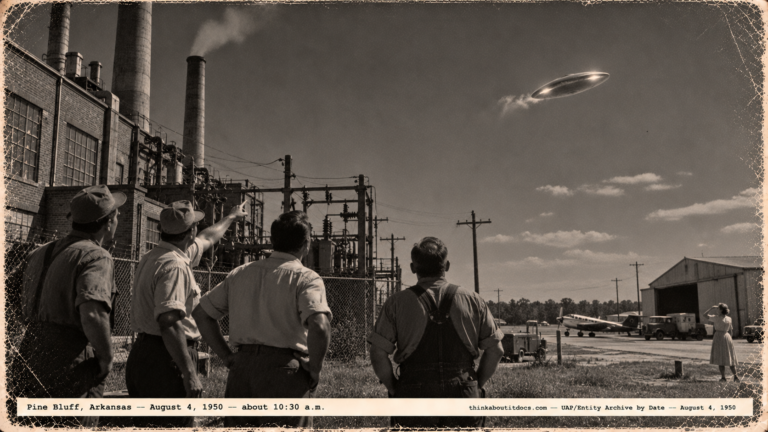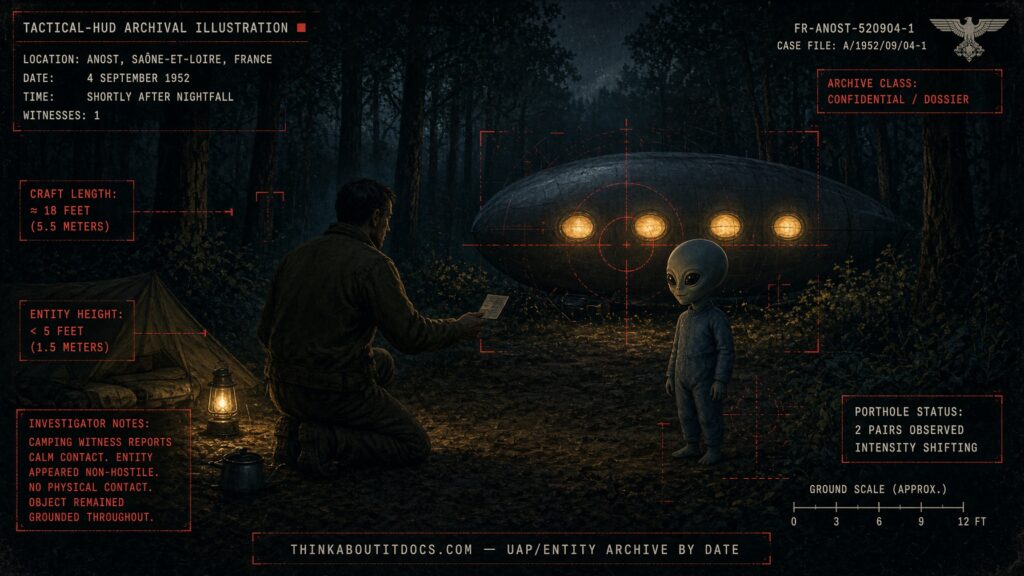
Near Anost, Saône-et-Loire, France, September 4, 1952 — Jean Sibranoseian's encounter in the Morvan forest.
THINK ABOUTIT UFO|UAP & ENTITY ENCOUNTER REPORT
1952: Anost, France — Jean Sibranoseian‘s Visiting Card Encounter
Camping alone in France’s Morvan forest, Jean Sibranoseian watched what looked like a falling star resolve into a dirigible-shaped craft barely 130 feet away — and moments later found himself face to face with a smiling, large-eyed humanoid who accepted his offered business card with genuine curiosity before hopping away into the dark.
It’s one of the more oddly charming entries in this archive’s 1952 record — no fear-driven confrontation, no message about humanity’s fate, just two strangers, one from very far away, exchanging an almost absurdly ordinary gesture of greeting. But the case’s documentation trail is worth knowing before taking it at face value: it never reached the written record in Sibranoseian’s own lifetime. What survives comes from a 1981 letter written by his widow to American UFO researcher Lucius Farish — nearly three decades after the night in the Saône-et-Loire woods it describes.
Date: September 4, 1952
Sighting Time: Shortly after nightfall
Day/Night: Night
Location: Near Anost, in the Morvan region, Saône-et-Loire, France
Urban or Rural: Rural
No. of Entity(‘s): 1
Entity Type: Humanoid
Entity Description: Barely 5 feet tall once off an elevated stump he’d been standing on (initially appeared taller); otherwise human in form, with a somewhat large head, dark hair, and large “pupil-less” eyes set in a handsome, entirely unlined, smiling face; wore a well-fitted blue-gray garment
Hynek Classification: CE-III (Close Encounter of the Third Kind) — close observation with an animate being associated with the object
Duration: Not precisely recorded; the entire encounter, from the falling-star sighting through the entity’s final departure, appears to have unfolded over a few minutes
No. of Object(s): 1
Size of Object(s): About 18 feet long and 6 feet high
Distance to Object(s): Less than 130 feet at first sighting; the entity itself approached to within 6 feet of the witness
Shape of Object(s): Dirigible-shaped, with two pairs of lighted portholes along its side
Color of Object(s): Not specified beyond the light from its portholes, which varied “curiously” in intensity or hue
Number of Witnesses: 1 (Jean Sibranoseian)
Special Features/Characteristics: The entity first appeared to be standing on a low stump, making it seem taller than Jean; once it stepped down, its true height (under 5 ft) became apparent. It approached with hands extended, palms upward; when Jean mirrored the gesture, it retreated nimbly, hopping from one leg to the other, before returning within ten seconds to stand six feet from the witness, arms now lowered. Jean offered one of his own visiting cards, which the entity accepted with a smile and slipped into what appeared to be an invisible pocket. It then backed away, raised its lower arms to a horizontal position, and departed with the same hopping gait, vanishing into the dark.
Case Status: Insufficient Data — a single witness account that reached the written UFO literature only through a 1981 letter written by Sibranoseian’s widow to American researcher Lucius Farish, nearly 30 years after the event and evidently after the witness’s own death; the case has been characterized in at least one independent French-language case catalog as “a contactee tale only reported secondhand” decades after the fact.
Source: Henri Convert; letter from the witness’s widow to Lucius Farish, 1981, reproduced in UFO Newsclipping Service #140; cited in Bord, “Life Beyond Planet Earth?” (1988), p. 144
Summary/Description: On the evening of September 4, 1952, Jean Sibranoseian was camping alone in the Morvan forest near Anost, France, when he saw what looked like a falling star. Standing to investigate, he found a dirigible-shaped craft, about 18 feet long and 6 feet high, less than 130 feet away, its side lined with two pairs of lighted portholes whose glow shifted curiously. As he stared at it, he heard a faint sound and noticed a humanoid figure roughly 15 feet away, initially appearing taller than himself because it stood atop a low stump. Once it stepped down, it proved to be barely 5 feet tall — human in form but with a large head, dark hair, and large, pupil-less eyes set in a smiling, unlined face, dressed in a fitted blue-gray garment. The being approached with palms raised; when Jean mirrored the gesture, it retreated in a hopping motion before returning within ten seconds to stand six feet away. Jean, feeling self-conscious, offered one of his visiting cards, which the being accepted and tucked into an apparently invisible pocket. It then backed off, raised its arms, and hopped away into the darkness. Sibranoseian remained convinced for the rest of his life that he had met a visitor from another world; the account itself did not reach researchers until his widow wrote to Lucius Farish in 1981.
Related Cases: Not Applicable
Detailed Report
The Anost case is best understood in two parts: the encounter itself, which is oddly specific and gentle by the standards of 1950s contactee literature, and the documentation trail behind it, which is considerably thinner than the vivid narrative might suggest on first read.
On the narrative’s own terms, the case is unusually well-observed. The stump detail — explaining why the entity first appeared taller than Jean before “proving” to be under five feet once it stepped down — is a small, physically logical touch that a purely invented account might not bother including. The exchange itself, too, reads as understated rather than dramatic: no warning, no message, no urgency, just a mirrored gesture, a retreat, a return, and an ordinary human impulse — offering a visiting card — met with what Jean interpreted as genuine curiosity.
The documentation chain, however, is where this case needs to be handled carefully. It did not reach the UFO literature during Sibranoseian’s own lifetime. The earliest confirmed source is a 1981 letter from his widow to American UFO researcher Lucius Farish, reproduced in the UFO Newsclipping Service and later cited in Janet and Colin Bord’s 1988 book “Life Beyond Planet Earth?” That means the account survives only as a secondhand relaying of Jean’s own story, recorded by someone else, nearly thirty years after the described event and evidently after Jean himself had died. An independent case-catalog evaluation of this sighting (INTCAT) describes it plainly as “a contactee tale only reported second hand” decades after the fact — a characterization this archive finds accurate and worth stating directly rather than softening.
RESEARCHER’S NOTES
Anost, France — 1952 and a Story Told by a Widow, Decades Later
- Secondhand by nearly three decades: This is not simply a delayed report — it’s a widow’s 1981 letter relaying her late husband’s account of a 1952 event, meaning the case reaches researchers at two removes: through memory, and through another person’s retelling of that memory.
- A physically logical detail (the stump) argues for genuine memory: The height discrepancy explained by the entity standing on a stump is the kind of small, non-dramatic detail that tends to survive in genuine recollection rather than invented narrative, though this observation doesn’t resolve the case’s larger documentation problem.
- An existing independent evaluation exists and is unambiguous: The INTCAT catalog’s own assessment — “a contactee tale only reported second hand” — was not generated by this archive; it’s an external researcher’s judgment this archive is simply relaying and agrees is a fair characterization of the case’s evidentiary weight.
- Gentleness as a genre marker: The case’s lack of any warning, message, or confrontation places it closer to the era’s more benign “curious visitor” contactee accounts than to either the frightening entity encounters or the message-bearing “Space Brothers” narratives more common in 1952’s American record.
What’s left of that September evening near Anost is a widow’s letter, written decades after her husband’s death, describing a night he apparently never stopped believing in — a visiting card handed to someone from very far away, and a small hopping figure who kept it.
“He accepted it, still smiling, and slipped it into an invisible pocket.”
— Jean Sibranoseian’s account, as relayed by his widow to Lucius Farish, 1981