Fort Smith, June 12, 1952.
THINK ABOUTIT UFO|UAP SIGHTINGS REPORT
Fort Smith, Arkansas:
Two Army Officers Watch a Glowing-Headed Object With a Long Tail for 15 Minutes
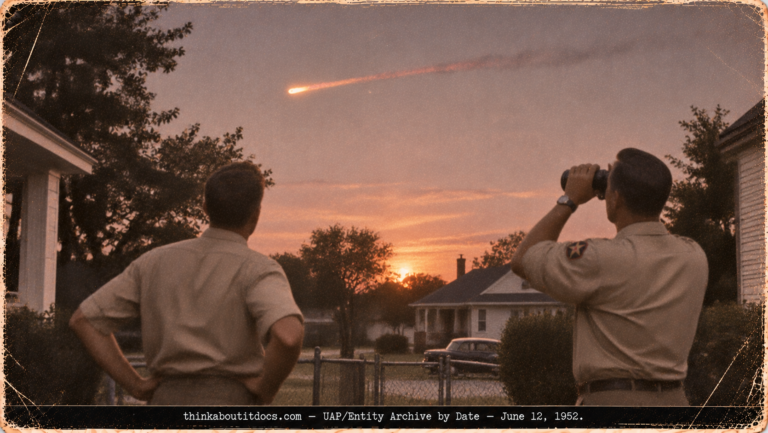
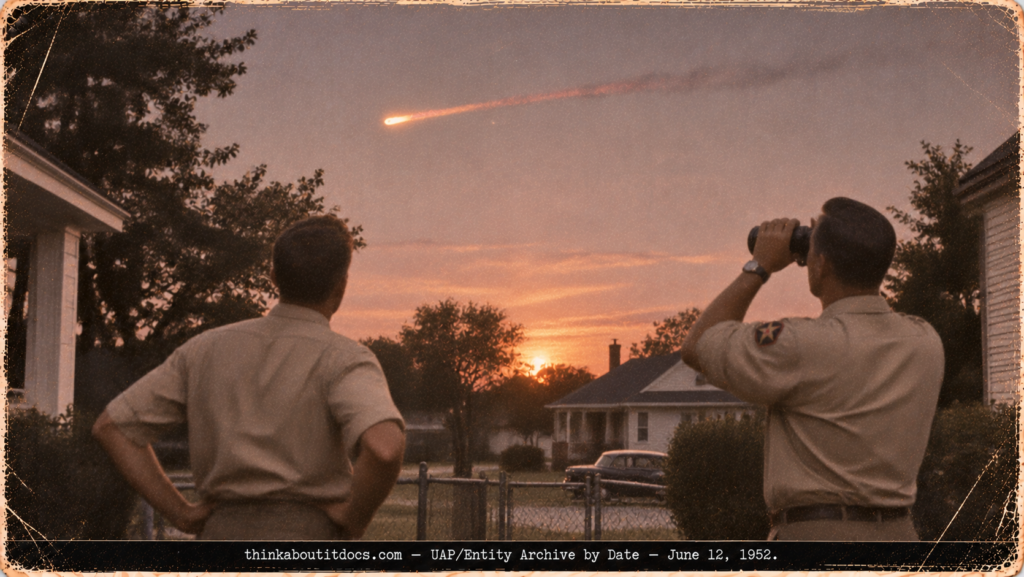
At about 7:30 on the evening of June 12, 1952, with the sun setting but still broad daylight, an Army officer getting ready to leave his Fort Smith, Arkansas home saw an object in the northern sky. It had a glowing, fiery head and a long, well-defined tail of smoke or vapor, and it held a constant altitude as it drifted west. A neighbor, the post’s Assistant Chief of Staff for personnel, joined him with binoculars, and the two watched it for 10 to 15 minutes until it disappeared in the western sky.
The Fort Smith, Arkansas UFO sighting of June 12, 1952 was reported by two Army officers who ruled out a meteor because it lasted far too long, and the Air Force later reviewed the file and kept the Unidentified evaluation.
Date: June 12, 1952
Sighting Time: About 7:30 p.m. CST (1930 hours)
Day/Night: Day (sun setting, still broad daylight)
Location: Fort Smith, Arkansas, north-northwest sky, from two neighboring homes
Urban or Rural: Suburban
No. of Entity(‘s): Not Applicable
Entity Type: Not Applicable
Entity Description: Not Applicable
Hynek Classification: Daylight Disc (DD)
Duration: 10 to 15 minutes (about 1 minute naked eye, then 2–3 minutes and 10–15 minutes with binoculars)
No. of Object(s): 1
Description of the Object(s): A glowing or fiery head with a long, well-defined tail of smoke or vapor with a choppy, broken rear end; pale orange head and rosy-orange tail, steady altitude
Shape/Size/Color of Object(s): Slender head and tail / about a quarter mile long per the second witness / pale orange head, rosy or candle-colored tail
Distance to Object(s): First estimated 15–25 miles, then 100–200 miles; the second witness said 20–30 miles
Height & Speed: About 30–40° above the horizon at first, constant altitude; moved west slowly in apparent motion but at high speed given the distance
Number of Witnesses: 2 (two Army officers who were neighbors), with wives and children nearby
Special Features/Characteristics: Seen through 6×30 and 7×50 binoculars; tail did not dissipate; the observers thought it unlikely to be a meteor given the duration; Blue Book kept it Unidentified in a later review
Case Status: Unidentified (Project Blue Book)
Source: AIIR and statements from Division Artillery headquarters, Fort Smith; Blue Book later review memo; BBU 1269 (NICAP/Berliner)
Summary/Description: Two Army officers watched a fiery-headed object with a long tail travel west for 10 to 15 minutes, too long and too steady for a meteor.
Related Cases: Chicago, Illinois, June 11, 1952
Detailed Report
In a written statement, the first officer said he first saw the object about 30° above the horizon, almost due north, traveling generally west. It resembled a meteor in that it had a glowing head and a long tail of smoke or vapor. It was clear, with unlimited visibility, no clouds and no aircraft. He watched it with the naked eye for about a minute, then with binoculars for two or three minutes, then with his neighbor for another 10 to 15 minutes until it disappeared. Motion was not apparent to the naked eye but could be seen through binoculars against a telephone wire.
He estimated the object at 15 to 25 miles when first seen and much farther, perhaps 100 to 200 miles, later. The head was a pale orange, brighter than the rest, and the tail rosy or orange and paler toward the rear, with a choppy and broken rear end as if made of a light substance. He wrote that it was unlikely to be a meteorite because of the time it stayed in the air and its deliberate course, and that the tail was not a contrail. He had never seen anything resembling it, though he noted some experimental aircraft used thermite for reconnaissance lighting.
The second officer said he saw a slender object with a head and a long tail that rose slightly from the head, light orange and glowing but with no glare, about a quarter mile long and 20 to 30 miles away. He watched it through 7×50 German field glasses for 10 to 15 minutes until it dropped below the western horizon, and it seemed to be moving very rapidly. A later Blue Book review of the file suggested very high-flying jets reflecting sunset light, but pointed out that a lieutenant colonel and a major watching with binoculars for 10 to 15 minutes would likely have identified a jet.
RESEARCHER’S NOTES
Two Officers, Two Pairs of Binoculars, Ten Minutes
- Witnesses: A lieutenant colonel and a major, both in Division Artillery headquarters, neighbors who watched together; their wives and neighborhood children also saw it but gave no useful detail.
- Alternative: The 1968 reviewer’s high-flying jet idea requires a jet at sunset for 15 minutes, which the witnesses, experienced with aircraft, rejected.
- Size: A quarter mile long at 20–30 miles is the second witness’s estimate; the first witness’s distance estimates differ widely.
- Evaluation: Blue Book’s later review reports agreement with the existing “Unidentified” evaluation.
A long observation in daylight, two officers with binoculars and a description of a head and a tail that does not match a meteor: the Fort Smith report is one of the more credible early-June unknowns.
“I have never seen any man-made craft which in any way resembled this particular object.”
— Army officer’s statement, Fort Smith, Arkansas, June 12, 1952