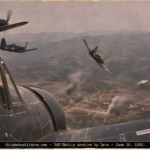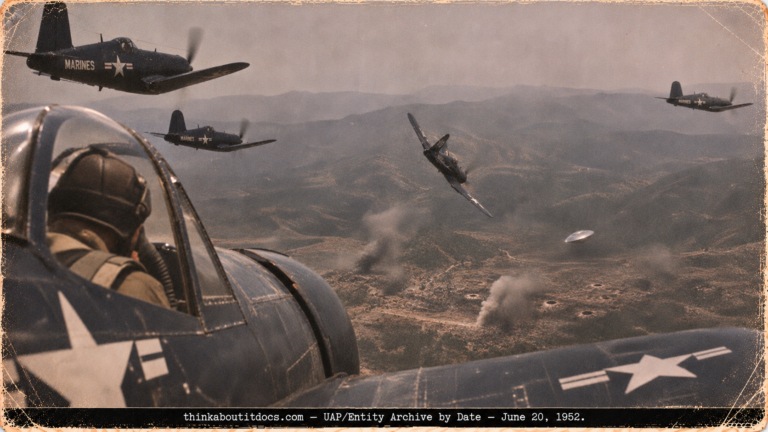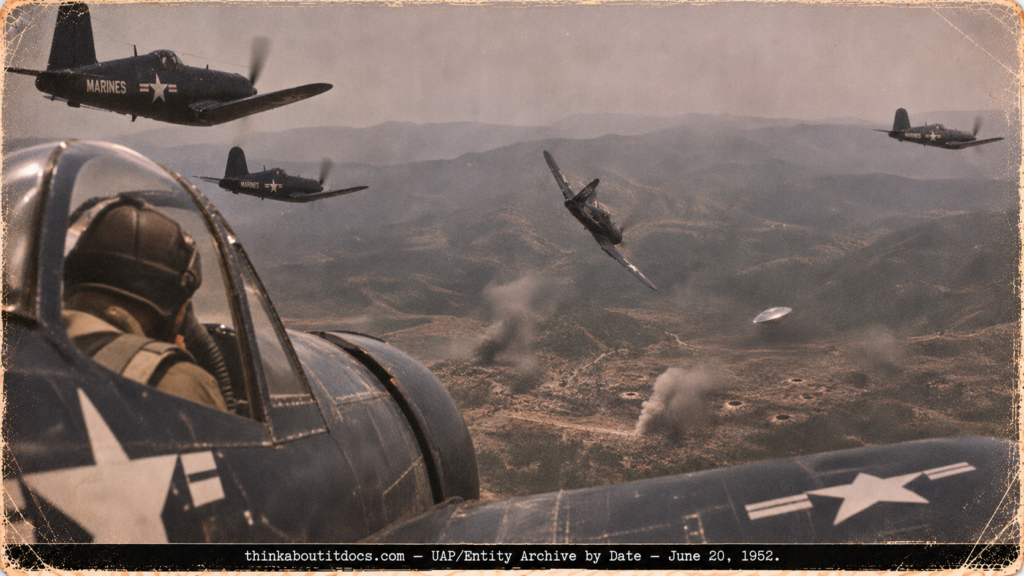
Korea, June 20, 1952: an oval object circles the target.
THINK ABOUTIT UFO|UAP SIGHTINGS REPORT
West-Central Korea:
Four Marine Pilots Watch an Oval Object Circle Their Target
On the afternoon of June 20, 1952, five Marine Corsairs were orbiting a target over west-central Korea when the flight leader saw something below him that was not a shell: a white or silver oval object, ten to twenty feet across, in a left-hand turn. It circled the target area in a 630-degree turn, then left to the east, and when one pilot rolled in to chase it at 250 knots it simply outdistanced him.
The Korea Marine Corsair UFO sighting of June 20, 1952 was reported by four experienced combat pilots and rated A-1 for reliability by the intelligence officer who forwarded it to Washington. He added that most reports from the neighboring grid had been traced to enemy balloons, but that several from this grid were still unexplained.
Date: June 20, 1952
Sighting Time: About 3:03 p.m. Korean local time (1503 “I”)
Day/Night: Day
Location: Over the CT 0911/29 target grid, west-central sector of Korea, during a Close Air Support mission for the 1st Marine Division
Urban or Rural: Rural (combat zone)
No. of Entity(‘s): Not Applicable
Entity Type: Not Applicable
Entity Description: Not Applicable
Hynek Classification: Daylight Disc (DD)
Duration: Roughly a minute or more (a 630° orbit, then lost to sight to the east)
No. of Object(s): 1
Description of the Object(s): A single oval object, white or silver, with no vapor or gas trail of any kind
Shape/Size/Color of Object(s): Oval / 10 to 20 feet in diameter / white or silver
Distance to Object(s): About two miles from the flight, roughly 1,000 feet below it
Height & Speed: Estimated altitude about 1,000 feet; Capt. Foster estimated about 1,000 mph. One pilot dived at 250 knots indicated and could not close
Number of Witnesses: Four of the five pilots in the flight
Special Features/Characteristics: Completed a 630-degree left orbit of the target area, then headed east toward friendly lines; seen by trained combat pilots; reliability rated A-1; the longest-observing pilot was reported killed in action the next day
Case Status: Unexplained in the report; the preparing officer listed the CT-grid reports as still unexplained
Source: Air Intelligence Information Report (ATIL Office, D/I FEAF) with statements of Capts. Bobbie Foster, Richard Francisco, Teddy L. Pittman and McDonald, 1st Marine Air Wing; Project Blue Book unknown BBU 1313 (NICAP/Berliner)
Summary/Description: Five Marine Corsairs working a target near the front saw a silver oval object arrive from the south, circle the target and leave to the east at a speed no one in the flight could match.
Related Cases: Nagoya, Japan, June 28, 1952
Detailed Report
At 1415 “I” Capt. Bobbie Foster led five Marine F4U-4B Corsairs from the K-6 field (written “X-6” in the typescript) on a pre-briefed Close Air Support mission with the 1st Marine Division. After checking in with their controllers, the flight was directed to its target and went into a left orbit over grid CT 091129. At 1503 Foster saw a white or silver object below him on a northerly course. At first he thought it was an artillery shell, but it was in a left turn and not shaped like a shell.
In his words, the object made a 630-degree turn, stayed in sight the whole time and described a wide circle over the target before retiring east toward friendly lines. He called it out to his flight, and four of the five pilots saw it. He estimated it at 10 to 20 feet across. When he started a dive at an indicated 250 knots at 1,000 feet, the object went out of sight, still low, at an estimated 1,000 mph, about four times his own speed.
Capt. Richard Francisco, flying number two, confirmed an object at his nine o’clock, below the flight and traveling very fast, white or silver, and put its size at six to twelve feet. The report places the flight at about 5,500 feet, the observers near the CT 0909 area and visibility at 15 to 20 miles. No photographs or physical evidence exist. The preparing officer added that Capt. Foster, who had watched the object the longest, was declared killed in action on June 21, 1952.
RESEARCHER’S NOTES
A Combat Flight, an A-1 Report and a Lost Witness
- Reliability: The forwarding officer rated the report A-1, and the four pilots were described as well trained and combat experienced.
- Object size: Foster and Francisco disagree on size (10–20 ft versus 6–12 ft), a normal spread for a fast object seen from a moving aircraft.
- Balloons: The preparing officer noted that the neighboring DT-grid reports had been traced to enemy balloons, but that several CT-grid reports were still unexplained.
- Evaluation: The report pages I read carry no Blue Book conclusion; the June 23–30 table has a “South Korea, Military, Other (FUEL TANK)” row that may or may not be this case.
Four trained Marine pilots, one flight leader who did not live to see the report filed, and an object that circled a target and left faster than a Corsair could follow: the file is short, plain and unresolved.
“The object was too fast and pulled away very rapidly.”
— Capt. Bobbie Foster, USMCR, statement, June 20, 1952