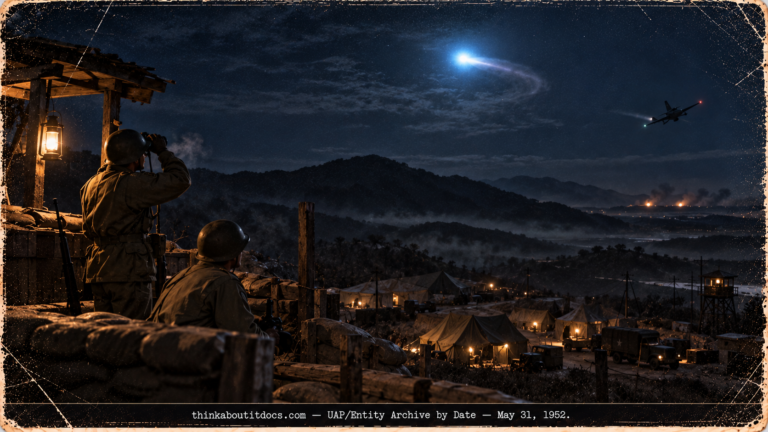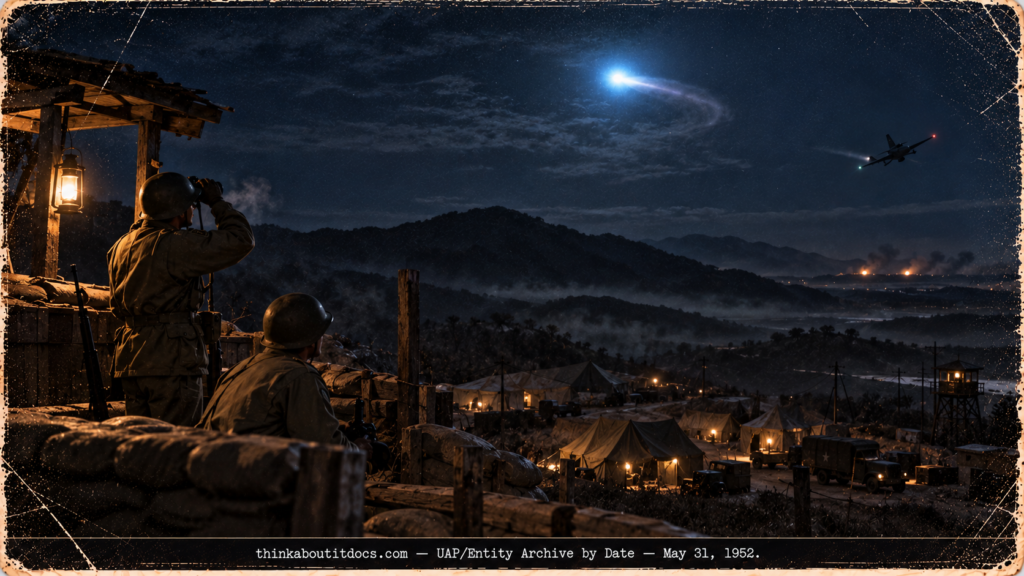
Chorwon, Korea, May 31, 1952: guards and an F-94 track a light.
THINK ABOUTIT UFO|UAP SIGHTINGS REPORT
Chorwon, Korea: Guards and an F-94 Track a Light That Will Not Fall
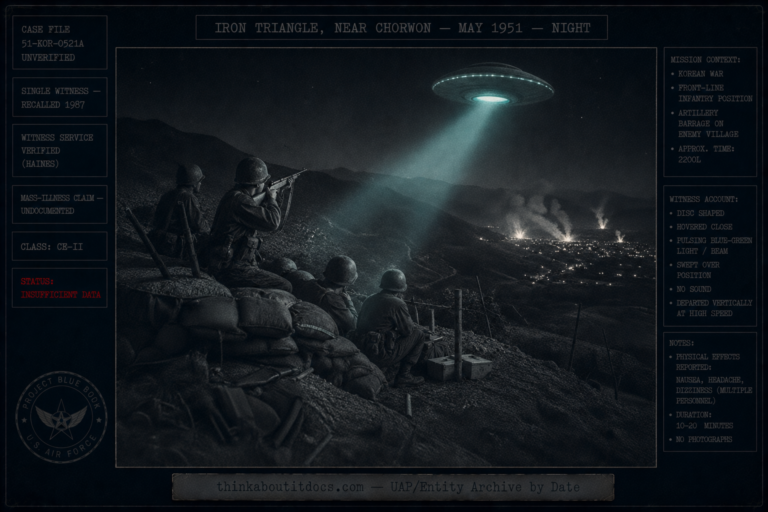
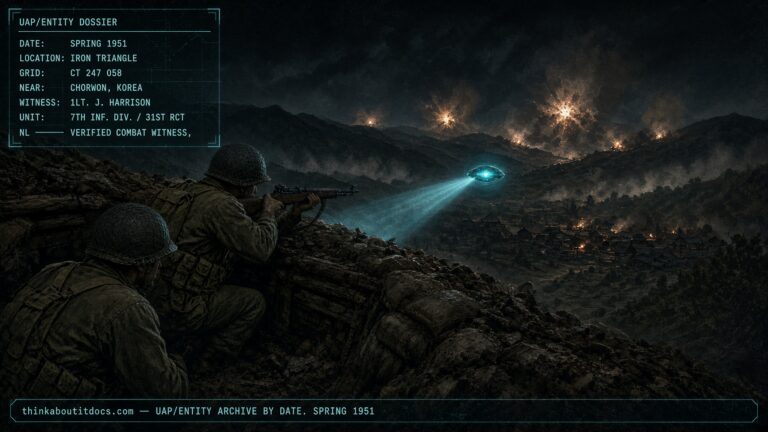
At about 3:45 on the morning of May 31, 1952, a guard on post number six at a camp near Chorwon, South Korea, called out that something like a falling star was dropping toward the mountain. It stopped, went straight back up, moved half a mile to the east with jerking motions, stopped again, reversed, reversed again and climbed away at a steep angle. A second guard at another post saw the same thing and heard a pulsating sound.
Minutes later an F-94 night fighter of the 319th Fighter Interceptor Squadron held a white-bluish object on its radar for nine minutes as it maneuvered between 1,000 and 28,000 feet. This Chorwon, Korea UFO sighting was a radar-visual case near the front, and Blue Book, after weighing enemy light balloons, left it Unknown.
Date: May 31, 1952
Sighting Time: 3:45 a.m. to 3:55 a.m. (zone time)
Day/Night: Night
Location: South of Chorwon, South Korea (near the 38th parallel, 607th Aircraft Control and Warning Squadron site)
Urban or Rural: Rural mountain camp
No. of Entity(‘s): Not Applicable
Entity Type: Not Applicable
Entity Description: Not Applicable
Hynek Classification: Radar-Visual (RV)
Duration: About 2 to 4 minutes visually; 9 minutes on airborne radar
No. of Object(s): 1
Description of the Object(s): A glowing object the color of a star with a blue tint, dull mercury-colored in the center with a white-phosphorous-like outer ring; it fell, stopped, climbed, moved jerkily east and back, then climbed away at about 45°
Shape/Size/Color of Object(s): Round, disc-like / about the size of a fighter / blue-tinged white
Distance to Object(s): About one mile from the second observer, 2,800–3,600 feet altitude
Height & Speed: 2,000–4,000 feet visually; on radar 500 mph between 1,000 and 28,000 feet
Number of Witnesses: Two ground guards and an F-94 crew of two; a separate report by two radio men
Special Features/Characteristics: Pulsating sound heard by the second guard, with the light seeming to brighten and dim in unison; the F-94 held it on airborne radar for nine minutes and it began a port climb away from the fighter
Case Status: Unidentified; Blue Book noted a “faint possibility of balloon” with no balloon-release data
Source: Project Blue Book record card; Air Intelligence Information Reports (FEAF IR 23-52); Hynek UFO Report
Summary/Description: Two guards and an F-94 crew tracked a bright object that fell, rose, reversed and accelerated away over the Korean front.
Related Cases: Korea (radio men), May 31, 1952; North Korea, May 15 and 26, 1952
Detailed Report
The first Air Intelligence Information Report records that the object was first seen falling from about 3,600 feet “like a falling star.” It stopped at about 2,000 feet, “went straight back up to about 3000 to 4000 feet,” and began to head east for about half a mile, then stopped and reversed its course, and reversed once more in an eastward direction, picking up speed in a jerking motion and fading from sight. The guard, who was on post about 100 feet above the camp, which sits at about 2,000 feet above sea level, was a mechanic with 31 months of service.
A second observer, on guard duty about 400 feet below the mountain and about a mile away, a 20-year-old with 14 months of service, described the object as about the size of a fighter, with a color duller than mercury in the center and an outer ring glowing like white phosphorus. He saw it for three to four minutes, moving with jerky movements, stopping, reversing and then going into a steep 45-degree climb. He heard a sound that came in pulses, and the light seemed to increase and decrease in intensity in unison with the sound.
The F-94 report states that the object was observed for about nine minutes by a pilot and a radar operator, with brilliant light blinding at close range. It was “extremely capable of maneuvers,” and “began a port climb at the same time to … away from the F-94.” The Air Force note on file concerned enemy light-balloons used near the front: a three- to six-foot balloon with a steady burning light which a friendly F-94 chased and shot down. Blue Book commented that, from the maneuvers, it felt there was a faint possibility of a balloon but had no information on balloon releases, and evaluated the case Unknown.
RESEARCHER’S NOTES
Front-Line Eyes and an Airborne Radar
- Enemy balloons: The same file describes enemy light-balloons in the area, which Blue Book used to explain other Korea reports as “balloon with flare.” The Chorwon case was kept Unknown because of the speed and maneuvering recorded on airborne radar.
- Two views: A separate May 31 Korea report by two radio men (balloon with flare, possible jet with a spotlight) may describe the same event from another position.
- Witnesses: The guards were young, were on duty at night, and had a poor sense of direction in one case; the F-94 radar record is independent of them.
- Date check: The records give times 0345 and 0350 zone time on the morning of May 31.
The Chorwon sighting shows a ground and airborne match: two guards saw something that fell, rose, reversed and climbed, and a fighter crew held a maneuvering target on radar for nine minutes. Blue Book, with a possible balloon in mind but no balloon data, did not close it.
“…it looked like a falling star at first.”
— Guard on post number 6, Chorwon, Korea, May 31, 1952