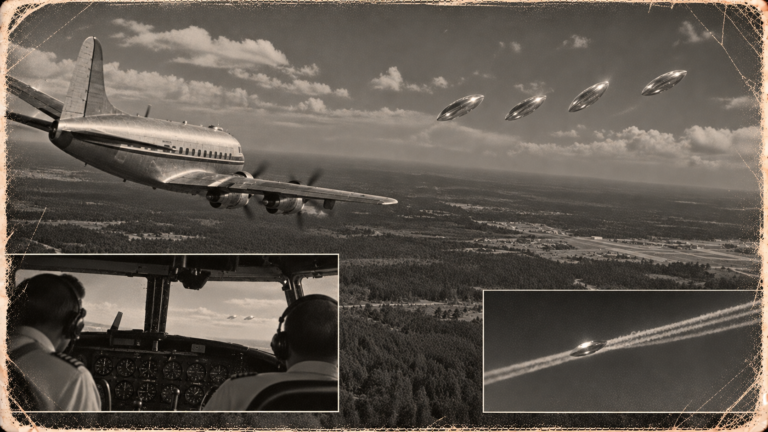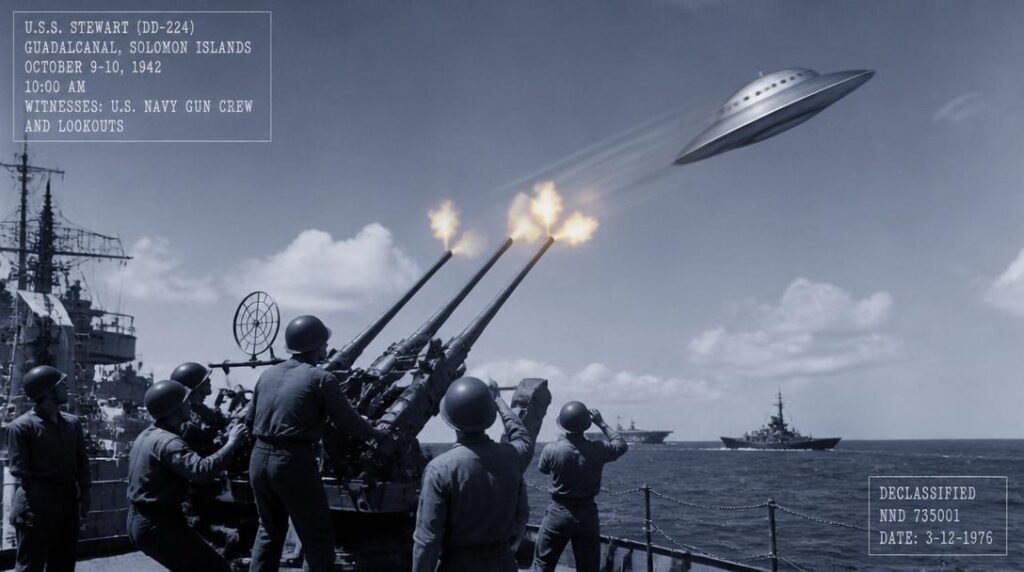
October 9-10, 1942 — Guadalcanal, Solomon Islands. A U.S. Navy witness described a silvery, domed disc that closed to 3,000 yards, banked sharply under anti-aircraft fire, and circled the fleet twice before departing.
THINK ABOUTIT UFO SIGHTINGS REPORT
1942: Guadalcanal Fleet Disc
In October 1942, in the middle of the fight to hold Guadalcanal, a U.S. Navy sailor watched fleet radar lock onto an incoming contact that a lookout then confirmed through binoculars: a silvery disc with a domed top and a ring of portholes. When gun crews opened fire at 3,000 yards, the object didn’t flee — it turned, accelerated, and circled the entire fleet twice before departing. The account survives only as a tape-recorded interview conducted more than four decades later, and a later documentary check against the deck log of the ship the witness named does not confirm the date and location as told. This report presents both the sighting and that discrepancy plainly.
Date: October 9–10, 1942
Sighting Time: 10:00 AM
Day/Night: Day
Location: Guadalcanal, Solomon Islands — fleet waters during the Guadalcanal campaign; the witness named the destroyer USS Helm (DD-388) as his vessel
Urban or Rural: Not applicable — open ocean, active naval combat theater
No. of Entity(s): Not Applicable
Entity Type: Not Applicable
Entity Description: Not Applicable
Hynek Classification: RV — Radar-Visual. The object was independently tracked on fleet radar and confirmed visually through 7×50 binoculars, meeting the standard definition of a radar/visual corroborated case. No landing, physical trace, or close-range environmental interaction is reported, so a Close Encounter tier is not applicable.
Duration: Not precisely recorded; the object’s full engagement — approach to 3,000 yards, evasive turn under fire, and two complete circuits of the fleet at high speed — implies an encounter lasting at least several minutes
No. of Object(s): 1
Description of the Object(s): A structured, silvery disc-shaped craft with a raised dome on its upper surface and a ring of what witnesses described as portholes encircling the dome. First detected on fleet radar as an incoming contact, then confirmed visually. Reacted to anti-aircraft fire with a deliberate sharp turn and acceleration rather than a simple flight path, then completed two full circuits of the fleet before departing.
Shape of Object(s): Disc with a raised central dome
Size of Object(s): Not recorded in the surviving account
Color of Object(s): Silvery
Distance to Object(s): Closed to within 3,000 yards of the fleet before gun crews opened fire
Height & Speed: Held an altitude of approximately 3,000 to 4,000 feet while circling the fleet twice at very high speed following the evasive turn
Number of Witnesses: One named interview subject in the surviving published account (the witness’s name was not published); additional radar operators, lookouts, and gun crew aboard the vessel are implied but not individually documented
Special Features/Characteristics: Independent radar and visual corroboration of a single event; the object’s response to gunfire was a controlled evasive maneuver rather than simple retreat; the account exists only as a decades-later tape-recorded oral history, with no contemporaneous 1942 report on file; a later documentary check of the named vessel’s deck log does not corroborate the reported date and location
Case Status: Unexplained
Source: UFOCAT; tape-recorded witness interview conducted by researcher Paul C. Cerny, published in MUFON UFO Journal, No. 185, July 1983, pp. 14–15; Project 1947 Updated Draft Catalogue of UFOs/USOs Reported by Seagoing Services (“NavCat 2.0”), which independently checked the USS Helm’s deck log and flagged the date/location discrepancy
Summary/Description: A U.S. Navy witness recalled that during the Guadalcanal campaign, fleet radar detected an incoming unidentified object, also observed visually through binoculars as a silvery disc with a dome and portholes. When it closed to 3,000 yards, gun crews fired on it; the object turned sharply, accelerated, and circled the fleet twice at 3,000–4,000 feet before departing. The account was recorded as an oral-history interview in the early 1980s, decades after the reported event, and a later check of the named vessel’s own deck log does not corroborate the date and location as told.
Related Cases: 1942 — Battle of Los Angeles | 1942 UFO|UAP & Alien Sightings Archive
Detailed Report
Two months into the Guadalcanal campaign — the first major Allied ground offensive of the Pacific War, and still a desperately close-run fight in October 1942 — a sailor aboard a U.S. Navy vessel watched something approach his fleet that no one aboard could identify. Fleet radar picked up an incoming contact; a lookout confirmed it visually through 7×50 binoculars as a silvery, disc-shaped object with a raised dome on top, ringed with what looked like portholes.
As the object closed to within 3,000 yards of the ships, gun crews opened fire. Rather than fleeing outright or continuing its approach, the object banked sharply, accelerated, and circled the entire fleet twice at high speed, holding an altitude of roughly 3,000 to 4,000 feet, before departing. No hits were confirmed. No wreckage was recovered. The witness gave no indication that the object was ever positively identified by anyone aboard, then or later.
The account does not survive as a contemporaneous 1942 report. It survives as a tape-recorded interview, conducted by researcher Paul C. Cerny and published in the July 1983 issue of the MUFON UFO Journal (#185, pp. 14–15) — more than forty years after the events described. This is a common evidentiary pattern for WWII-theatre military sightings: no wartime report was filed, understandably, given wartime secrecy, censorship, and a military culture with no formal channel for such an account in 1942, and the record exists only because a researcher decades later sought out and interviewed a veteran willing to go on record.
That gap matters here specifically, because this is one of the few WWII-theatre cases where a specific ship was named — the destroyer USS Helm (DD-388) — making independent verification possible. Researchers compiling the Project 1947 “NavCat” catalogue of Navy and Coast Guard UFO/USO reports checked the Helm’s deck log against the account. The Helm’s documented movements for the period do not support the account as told: naval records place the ship on escort duty between Australia and New Guinea beginning September 8, 1942, and continuing for several months — roughly 1,500 kilometers from Guadalcanal on the reported date. The only notable log entry researchers found in the surrounding period, dated July 6, 1942, records an unidentified steady white light sighted roughly ten miles distant — a different date, description, and location from the October 9–10 fleet-encirclement account. Project 1947’s own annotation suggests the witness may simply have misremembered the date across four decades, a common and unsurprising failure mode for oral testimony recorded that long after the fact.
RESEARCHER’S NOTES
The Guadalcanal Disc — A Fleet Engagement and a Vanishing Paper Trail
- On why the account reads as credible on its face: The description is specific and mechanically coherent — a structured object that reacts to gunfire with a deliberate evasive maneuver rather than simple flight, holds a stated altitude band, and completes a defined, countable maneuver (two full circuits of the fleet) rather than a vague “it moved fast and vanished.” Radar corroboration of a visual sighting, from a fleet actively engaged in combat operations and primed to correctly identify enemy aircraft, is not nothing. This is the kind of detail that separates a considered account from an embellished one.
- On why the ship’s log discrepancy is a serious problem, not a minor one: This is not a case of missing documentation — it’s documentation that exists and actively conflicts with the account. If the USS Helm’s deck log places the ship roughly 1,500 kilometers away on the date in question, then either the vessel has been misidentified, the date has been misremembered, or the location has been misremembered. Any of those is plausible for a 40-year-old recollection; none of them can currently be ruled in or out with the evidence available. This is the honest state of the case, and it is why this report carries Case Status: Unexplained rather than the Verified tag under which this sighting was previously filed on this site.
- On the broader pattern this case exemplifies: A large share of the WWII military UFO record — including several other entries in this year’s archive — exists only because researchers decades later tracked down veterans and recorded their recollections. That process is valuable and often produces genuinely important testimony, but it also means that ordinary memory drift — wrong dates, wrong ship names, conflated incidents — is baked into the record in a way that is very hard to fully audit, because the contemporaneous paper trail that would normally catch such errors was either never filed for an unidentified, non-hostile contact, or has not survived. The Guadalcanal case is unusual only in that a specific ship was named, which made it possible to check — and the check came back negative.
- On what “Unexplained” means here, specifically: This designation is not a judgment that the witness invented or embellished the account. It reflects that the object described — if a disc-shaped craft that maneuvers deliberately under fire and circles a fleet did appear over some U.S. Navy formation in the Pacific in 1942 — remains genuinely unidentified, while the specific ship, date, and location as published cannot currently be corroborated against the one documentary record that should confirm them. Both things can be true at once, and the honest approach is to hold them separately rather than force a false resolution in either direction.
The Guadalcanal fleet disc stands as one of 1942’s strongest-sounding military encounters — and one of its clearest lessons in why “strong-sounding” and “verified” are not the same thing. The object itself remains unidentified. The specific circumstances under which it was reported no longer check out against the one record that should confirm them.
“…circled the entire fleet twice at very high speed at about 3,000 to 4,000 feet altitude.”
Tape-recorded witness interview, MUFON UFO Journal, No. 185, July 1983, describing the October 9–10, 1942 Guadalcanal fleet engagement.