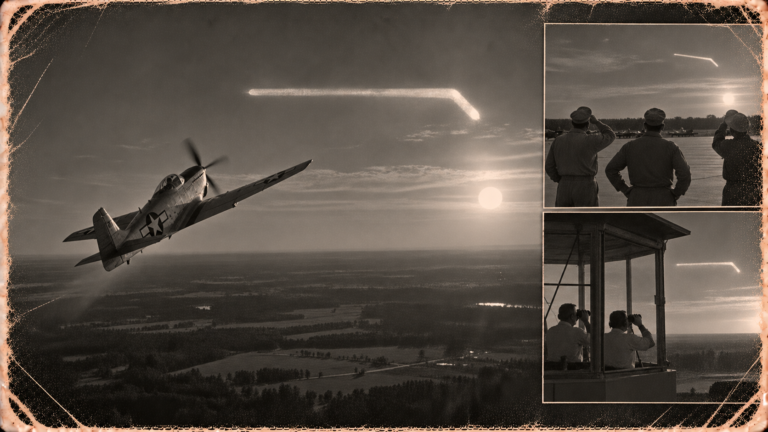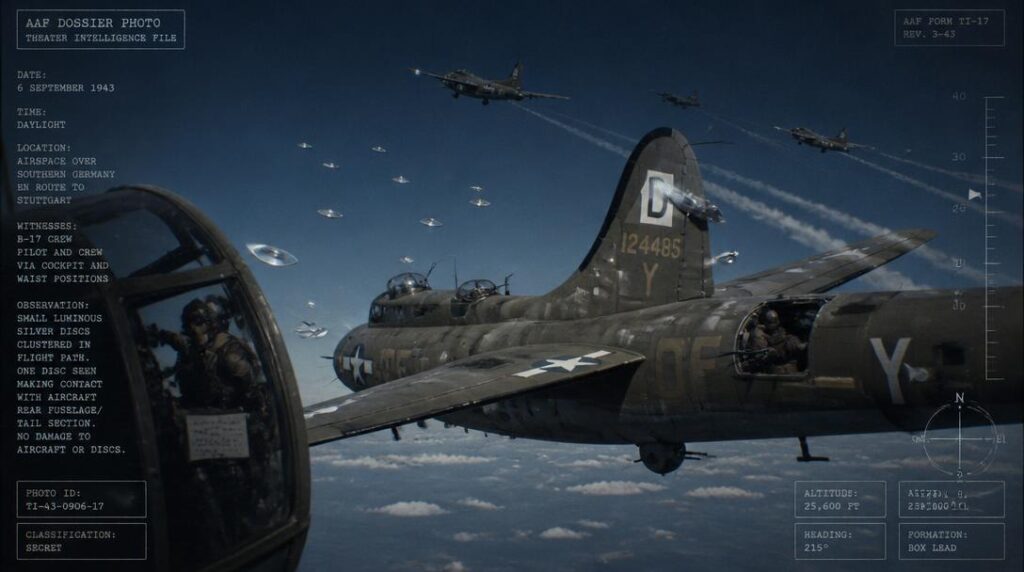
September 6, 1943 — airspace over southern Germany. During the 8th Air Force's first major daylight strike on the Reich since Schweinfurt/Regensburg, a B-17 crew reported small luminous discs passing directly through their formation, one reportedly striking the tail with no resulting damage.
THINK ABOUTIT UFO ENCOUNTER REPORT
1943: The Stuttgart Disc Collision
On September 6, 1943, the 8th United States Army Air Force flew its first major daylight strike deep into Germany since the costly Regensburg-Schweinfurt raids three weeks earlier — 338 B-17s bound for Stuttgart. Somewhere over that formation, according to a surviving confidential intelligence memo, a bomber crew watched small luminous discs pass directly through their own aircraft. One pilot’s wing reportedly passed through the discs with no effect. One disc reportedly struck the tail section of a B-17. Neither the aircraft nor, apparently, the object was damaged. This report lays out what the surviving documentary chain actually says — and what it doesn’t.
Date: September 6, 1943
Sighting Time: Daytime, during the outbound or return leg of the Stuttgart mission
Day/Night: Day
Location: Airspace over southern Germany, en route to or from Stuttgart; precise coordinates not preserved in the surviving secondary citation
Urban or Rural: Not applicable — high-altitude airborne encounter during an active bombing mission
No. of Entity(s): Not Applicable
Entity Type: Not Applicable
Entity Description: Not Applicable
Hynek Classification: CE-II — Close Encounter, Physical Effect. The reported physical contact between one disc and the aircraft’s tail section — with no resulting damage to either — constitutes a documented physical interaction, placing this above a simple sighting or near-approach despite the absence of ground trace or landing.
Duration: Not recorded; described as brief, consistent with the closing speed of a B-17 formation passing through a stationary or slow-moving cluster of small objects
No. of Object(s): A cluster/group of small discs, count not specified
Description of the Object(s): Small luminous discs, encountered in a group directly on the bomber formation’s flight path. One pilot maneuvered to avoid a head-on pass through the group; his wing is reported to have passed through the discs with no apparent effect on the aircraft. Separately, one disc reportedly made contact with the rear of a B-17 fuselage, with no resulting damage recorded to either the aircraft or the object.
Shape of Object(s): Disc/round, small individual size within a loose cluster formation
Size of Object(s): Not specified in the surviving citation for this case (compare the October 14, 1943 Schweinfurt discs, separately documented in this archive, described as roughly 3 inches wide by 1 inch thick — plausibly the same general class of object, though the two cases are not confirmed to be connected)
Color of Object(s): Silvery / luminous
Distance to Object(s): Direct physical proximity — one aircraft flew through the object cluster; one object made contact with an aircraft
Height & Speed: Bomber formation altitude for the Stuttgart mission (typically in the 20,000–25,000 foot range for 8th Air Force B-17 operations of this period); object speed/altitude not separately recorded
Number of Witnesses: At least one B-17 crew (pilot and presumably other crew aboard); broader formation exposure not specified
Special Features/Characteristics: Reported direct physical contact between an unidentified object and a U.S. military aircraft with no damage to either party; occurred during one of the largest and most closely documented USAAF daylight operations of the war, providing strong contextual dating; the case survives only via a secondary compilation citing a confidential A-2 (intelligence) duty desk memo, which this archive has not independently examined
Case Status: Unexplained
Source: U.S. confidential memo, A-2 duty desk, subject line reading (as cited) “Observation of silvery discs on mission to Stuttgart on 6 Sept. 1943”; Keith Chester, Strange Company: Military Encounters with UFOs in World War II (Anomalist Books, 2007); digitized secondary compilation, Richard F. Haines Papers / “The Foofighters Files,” American Heritage Center, University of Wyoming
Related Cases: 1943 UFO|UAP & Entity Sightings Archive (see also the October 14, 1943 Schweinfurt disc encounter, same archive)
Detailed Report
September 6, 1943 was, by conventional military history, a hard day for the 8th Air Force before anything unusual entered the picture. It was the first attempt at a major daylight strike deep into Reich territory since the costly double raid on Regensburg and Schweinfurt three weeks earlier. Roughly 338 B-17s of the 1st and 3rd Bomb Divisions were dispatched to hit industrial targets in the Stuttgart area. Nearly total cloud cover over the target prevented a clean bomb run, and most bombs were ultimately scattered onto targets of opportunity between Stuttgart and Strasbourg. German records confirm the scale of the engagement: contemporaneous Luftwaffe staff reports describe 200 to 300 attacking “flying fortresses” in the Metz–Karlsruhe–Ulm–Épinal area, with 16 to 33 bombers claimed shot down by roughly 440 defending fighters.
Somewhere within that large, chaotic formation, according to the surviving account, a bomber crew encountered something that had nothing to do with German fighters or flak. A cluster of small, luminous discs appeared directly in the aircraft’s path. One pilot, moving to avoid what looked like an imminent collision, flew his wing through the group; the discs reportedly passed through or alongside the wing with no apparent effect on either the metal or the objects. Separately — whether the same encounter or a related one in the same formation is not entirely clear from the surviving citation — one disc is reported to have made physical contact with the rear section of a B-17, again with no resulting damage recorded on either side.
The documentary trail for this case is short but specific. It survives via a digitized WWII UFO-document compilation held at the American Heritage Center, University of Wyoming (part of the Richard F. Haines Papers collection), which cites two sources: a U.S. confidential memo originating from an A-2 (military intelligence) duty desk, with a subject line referencing “silvery discs” observed on the Stuttgart mission, and Keith Chester’s 2007 book Strange Company, a research-grade history built substantially from period U.S. and British military documents obtained through archival research. This archive has not independently examined either the original A-2 memo or Chester’s full sourcing for this specific case, and that limitation is stated plainly rather than smoothed over.
RESEARCHER’S NOTES
A Collision With No Damage — What the Stuttgart Case Actually Claims
- On why the dating is unusually solid for a WWII Foo Fighter case: Unlike many wartime UFO accounts recovered decades later from memory alone, this case is anchored to a specific, extensively documented military operation. The September 6, 1943 Stuttgart raid is independently confirmed in Luftwaffe daily staff reports and unit histories, down to the approximate number of attacking bombers and the scattered bombing pattern caused by cloud cover. That external corroboration doesn’t verify the disc encounter itself, but it does rule out the kind of date confusion that undermines cases like the Guadalcanal fleet disc elsewhere in this archive.
- On why the “no damage” detail is the most analytically interesting part of the case: A conventional midair collision between a B-17 and any solid object of appreciable mass, at bomber cruising speed, would be expected to produce visible damage — a dent, a scrape, a change in engine or control response — even from a small object. The claim that a disc struck the aircraft’s tail section and left no mark at all is either an exaggeration introduced somewhere in the retelling, a case of mistaken perception (something that looked like contact but wasn’t), or a genuinely anomalous physical event. The current documentary record does not allow this to be resolved either way.
- On the source chain, honestly assessed: Keith Chester’s Strange Company is widely regarded within WWII UFO research as a serious, document-driven history rather than a speculative or sensationalized account, and an A-2 duty desk memo — if genuine and accurately characterized — would represent real-time military intelligence interest in the sighting, which matters. But this archive is relying on a secondary digitized compilation’s citation of that memo, not the memo itself. Until the original document is directly examined, the case should be treated as well-sourced but not independently verified by this archive.
- On its relationship to the Schweinfurt case five weeks later: This archive separately documents an October 14, 1943 encounter during the Schweinfurt raid, in which the 384th Bomb Group reportedly encountered a cluster of small discs (roughly 3 inches by 1 inch) while German fighter attacks mysteriously stood down. The physical description — small, silver, disc-shaped, encountered in a cluster near a B-17 formation — is similar enough between the two cases that they plausibly reflect the same category of phenomenon appearing twice within roughly five weeks of the same air campaign. The two cases are documented separately here because the sourcing for each is distinct and neither confirms the other.
The Stuttgart disc collision is one of the more physically direct WWII Foo Fighter claims in the archive — an object making contact with a combat aircraft and leaving no mark on either. Whether that reflects something genuinely unidentified interacting with a B-17 at 20,000 feet, or a story that gained a detail or two somewhere between the cockpit and the page, the object itself remains unexplained.