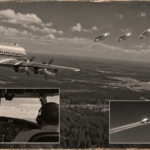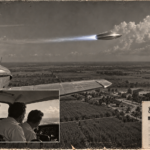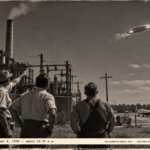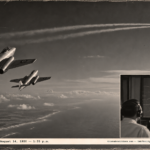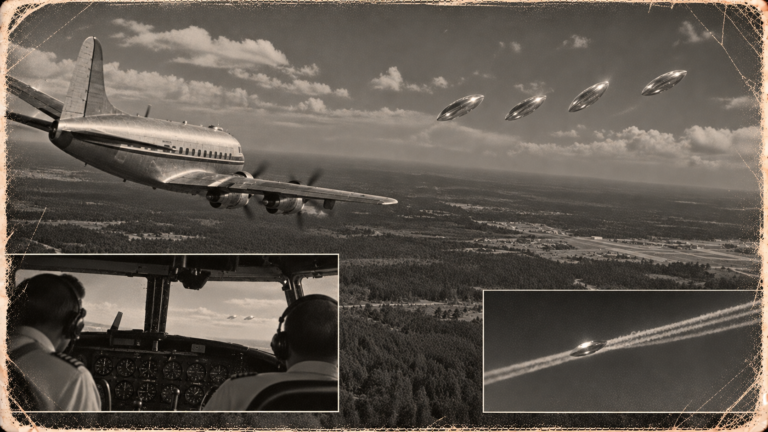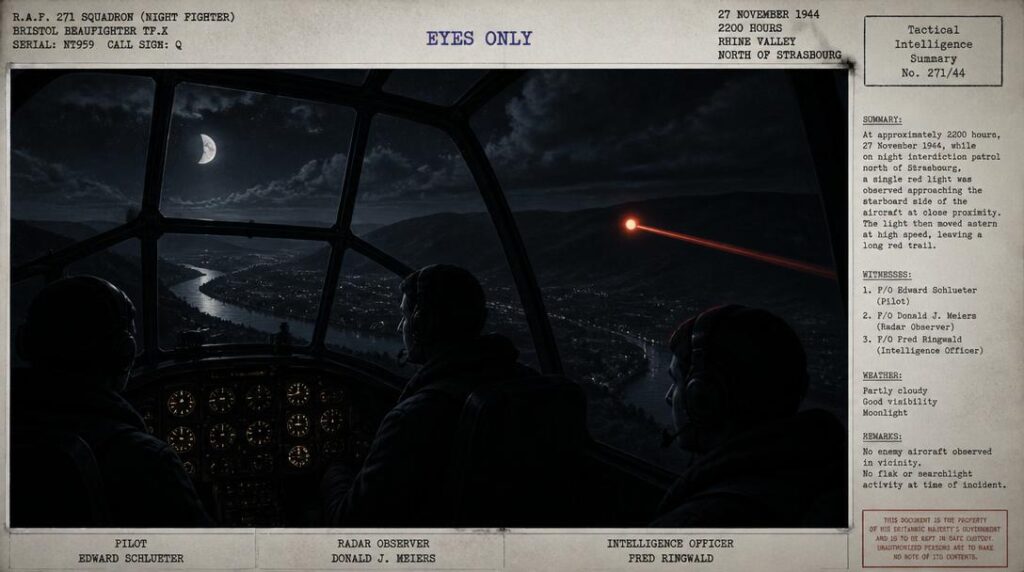
November 27, 1944 — Rhine Valley, north of Strasbourg. Lt. Edward Schlueter's own squadron report describes a single red light that closed to about 2,000 feet before disappearing in a long red streak — the case that gave the entire "Foo Fighter" phenomenon its name.
THINK ABOUTIT UFO SIGHTINGS REPORT
1944: The First Foo Fighter — Strasbourg, November 27
Every account of the Foo Fighter phenomenon traces back to one night: a U.S. night-fighter crew over the Rhine Valley, a light that wouldn’t behave like anything they knew, and a radar operator angry enough to slam a comic strip down on a desk and give the whole mystery its name. The story has been retold hundreds of times since — in Time, in the American Legion Magazine, in every history of WWII UFOs written afterward — and the retelling has grown in the years since 1944, usually to “eight to ten bright orange lights.” The squadron’s own contemporaneous paperwork tells a smaller story. This report lays out both versions side by side.
Date: November 27, 1944
Sighting Time: Night, approximately 10:00 p.m.
Day/Night: Night
Location: Rhine Valley, north of Strasbourg, on the France-Germany border; the squadron flew out of Dijon, France
Urban or Rural: Not applicable — airborne night-fighter patrol over contested front-line territory
No. of Entity(s): Not Applicable
Entity Type: Not Applicable
Entity Description: Not Applicable
Hynek Classification: NL — Nocturnal Light. Per the primary squadron account, a single light observed at night with no structural detail resolved; the widely circulated multi-light version, if accurate, would still fall within NL, as no landing, physical trace, or close-range structural detail is claimed in any version of the account.
Duration: Not precisely stated; the encounter is described as brief, on the order of a few minutes, ending when the light “disappeared in a long red streak”
No. of Object(s): Per the primary squadron document: 1. Per the popularized secondary retelling: 8 to 10, described as a row of orange lights (see Researcher’s Notes)
Description of the Object(s): Per Lt. Edward Schlueter’s own contemporaneous account: a red light, observed roughly 35 miles ENE of a reference point, closing to about 2,000 feet off starboard before departing in “a long red streak.” Per the standard secondary account built up in postwar retellings: eight to ten bright orange lights in a row, first spotted off the left wing by intelligence officer Fred Ringwald, then also seen by pilot Schlueter off the right wing, exhibiting high-speed maneuvers that appeared to track the aircraft.
Shape of Object(s): Point-source light(s); no structure resolved in either version of the account
Size of Object(s): Not specified in either version
Color of Object(s): Red (primary squadron account) or orange (popularized secondary account)
Distance to Object(s): Approximately 2,000 feet off the aircraft’s starboard side at closest approach, per Schlueter’s own account
Height & Speed: Not precisely recorded; the object(s) closed to close proximity of the aircraft and, in the secondary account, matched the aircraft’s high-speed maneuvers before departing
Number of Witnesses: 3 — pilot Lt. Edward Schlueter, radar observer Lt. Donald J. Meiers, intelligence officer Lt. Fred Ringwald, all of the U.S. 415th Night Fighter Squadron, flying together in a single Bristol Beaufighter
Special Features/Characteristics: Neither airborne radar aboard the Beaufighter nor Allied ground-control radar registered any contact corresponding to the light(s) observed visually; this is the case that produced the name “Foo Fighter,” coined by Meiers from the “Smokey Stover” comic strip catchphrase immediately after the flight; the crew’s reluctance to report the sighting, and the ridicule that followed once they did, mirrors patterns seen in later UFO testimony generally
Case Status: Unexplained
Source: 415th Night Fighter Squadron historical data entry, November 27, 1944 (U.S. Army — primary, containing Schlueter’s own account); Jo Chamberlain, “The Foo-Fighter Mystery,” American Legion Magazine, December 1945; Jeffery A. Lindell, interviews with Harold Augspurger (415th Squadron Commander) and Fred Ringwald, 1991; Keith Chester, Strange Company: Military Encounters with UFOs in World War II (2007)
Related Cases: 1944 UFO|UAP & Entity Sightings Archive (see also the December 22, 1944 Hagenau, Germany entry, same squadron, same archive) | 1943 UFO|UAP & Entity Sightings Archive (Stuttgart and Schweinfurt disc encounters, precursor cases to the named Foo Fighter phenomenon)
Detailed Report
By late November 1944, the U.S. 415th Night Fighter Squadron had been flying interception patrols out of Dijon, France for months, hunting German aircraft over the Rhine Valley in the dark. It was dangerous, exacting work, flown by experienced crews who had every reason not to want a reputation for seeing things. On the night of November 27, a Bristol Beaufighter crewed by pilot Lt. Edward Schlueter, radar observer Lt. Donald J. Meiers, and intelligence officer Lt. Fred Ringwald was on a routine patrol north of Strasbourg, working the stretch of sky between the Vosges Mountains and the Rhine.
The squadron’s own historical data entry for that night — the closest thing to a primary document this case has — records the encounter in Schlueter’s own words: “Upon returning to base saw a red light through area about 35 miles ENE of point A. Came in to about 2000 feet off starboard and then it disappeared in a long red streak.” That is the entire contemporaneous record. No formation of lights, no extended chase, no radar contact from either the aircraft or the ground — just a single red light that closed to fairly close range and then departed.
The story that became famous, and that has been repeated in nearly every subsequent account of this case — including Smithsonian Magazine, History.com, and most popular WWII UFO histories — is considerably more elaborate: eight to ten bright orange lights in a row, first noticed by Ringwald off the left wing, then also spotted by Schlueter off the right, appearing to track the aircraft’s high-speed evasive maneuvers before vanishing. Neither version disputes the core fact that something unidentified, showing no radar signature, was observed close to the aircraft at night over enemy territory. What differs is the scale and behavior of the phenomenon — a single light making one pass, versus a coordinated formation actively pursuing the plane.
Whatever the crew saw that night, it shook them enough that Meiers named it on the spot. According to intelligence officer Ringwald’s own later account, Meiers came off the flight extremely agitated, pulled a copy of the “Smokey Stover” comic strip from his pocket, slammed it on Ringwald’s desk, and declared it “another one of those foo fighters” — borrowing the strip’s firefighter catchphrase, “where there’s foo, there’s fire.” The profane original version of the phrase was cleaned up once the story reached the press roughly five weeks later, when Associated Press correspondent Robert C. Wilson spent New Year’s Eve with the squadron and filed the story that ran nationally on January 2, 1945.
RESEARCHER’S NOTES
One Red Light, or Ten Orange Ones — What the Founding Foo Fighter Case Actually Says
- On the gap between the primary document and the popular story: This is one of the clearest instances in the entire WWII UFO record of a case’s popularized version outrunning its own founding document. The squadron’s historical-data entry — written essentially contemporaneously, in Schlueter’s own words — describes a single light. The now-standard “8 to 10 lights” version does not appear to originate from that document; it appears to derive from later interviews, retellings, and possibly a conflation with other nights’ sightings by the same squadron (the squadron logged repeated encounters throughout December 1944 and January 1945, several of which do describe multiple lights or formations). None of this means the crew didn’t see something extraordinary — but it does mean the version most people know is not the version the squadron itself wrote down that night.
- On why this matters beyond pedantry: The Foo Fighter phenomenon is frequently cited as one of the best-attested UFO waves in history precisely because it involves military aircrews, contemporaneous unit records, and named, identifiable witnesses — a stronger evidentiary foundation than most UFO cases. That reputation is deserved for the phenomenon as a whole, given the volume of independent squadron reports across multiple months and theatres. But the specific “origin story” version told about this particular night has drifted from its own primary source, which is worth knowing before treating any single retelling as definitive.
- On the absence of radar corroboration: Neither the Beaufighter’s onboard radar (operated by Meiers, an experienced radar observer) nor Allied ground control registered the object in either version of the account. For a squadron whose entire mission depended on radar-guided interception, a visual contact with no radar signature was itself notable — it ruled out the most obvious mundane explanation (a conventional aircraft) for the crew, even before the object’s behavior became part of the story.
- On the case’s place in the broader pattern: This sighting did not occur in isolation. The squadron’s own war diary records further encounters through December 1944 and into 1945, including the December 22 Hagenau case (also in this archive) and numerous others compiled by researcher Jeffery Lindell and historian Keith Chester. Whatever the precise details of the November 27 night, it was the first of a documented cluster, not a single anomalous event — which is itself relevant to weighing how much any one retelling should be trusted over the underlying pattern.
The name survived the war by decades, attached itself to a rock band forty years later, and became one of the most recognizable phrases in UFO history — all traceable to a few minutes over the Rhine Valley on a November night in 1944. What exactly Schlueter’s crew saw that night remains unidentified. What they called it, and why, is not in dispute.
“Upon returning to base saw a red light through area about 35 miles ENE of point A. Came in to about 2000 feet off starboard and then it disappeared in a long red streak.”
Lt. Edward Schlueter, 415th Night Fighter Squadron historical data entry, November 27, 1944 — the account that gave the Foo Fighter phenomenon its name.