Zelyenyi Island, River Don, Russia, end of April 1941 — NKVD forces cordoned the island and recovered wreckage from a downed globe-shaped craft; nearly all personnel involved later died of radiation exposure.
THINK ABOUTIT UFO CRASH RETRIEVAL REPORT
1941: Zelyenyi Island, River Don, Russia
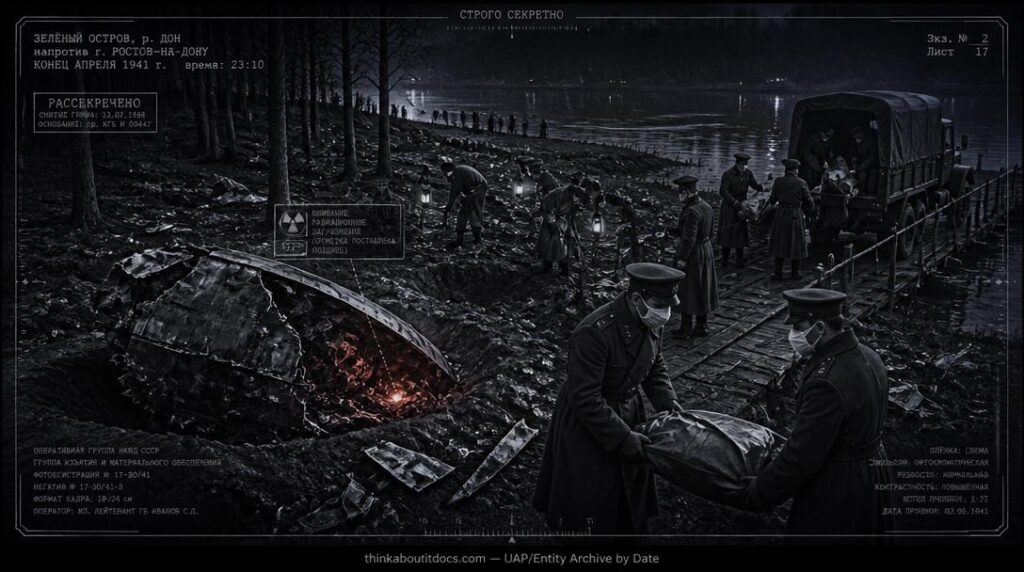
At eleven at night at the end of April 1941, a female student named N.A. Shirokova watched red and black globes engaged in what looked like aerial combat over the forests near Rostov-on-Don. One was struck and fell southeast; civilians heard a loud boom and found wreckage scattered across dozens of square meters on Zelyenyi Island in the River Don — silver metal, some sections driven deep into the ground, and what appeared to be biological remnants of alien bodies among the debris. The NKVD moved fast, cordoning the island and running recovery operations by covered truck across a pontoon bridge under cover of night. Nearly everyone involved in that recovery died of radiation exposure they had no framework to understand. Forty years later, in the 1980s, construction of a children’s Pioneer republic park on the same island was abruptly halted when soil surveys turned up rare chemical elements with no industrial explanation, and cherry trees on the island were found growing four to six times normal size — a signature consistent with radiation-induced gigantism. This is one of the most extensively cross-referenced Soviet UFO crash claims in the pre-modern record, corroborated across independent research decades apart by different investigators.
Date: End of April 1941
Sighting Time: 11:00 PM
Day/Night: Night
Location: Zelyenyi Island, River Don, near Rostov-on-Don, Russia, USSR
Urban or Rural: Rural — forested riverine island near a regional city
No. of Entity(‘s): Unspecified — “biological remnants of apparent alien bodies” found in the wreckage; no living entities encountered
Entity Type: Non-human, remains only — no morphological description survives in the available sources
Entity Description: Not described beyond “biological remnants” in the recovered material; no living occupants were encountered by any witness
Hynek Classification: Crash retrieval case — outside the standard Hynek CE scale, which describes witnessed encounters rather than post-crash recovery operations. Closest categorical equivalent in this archive’s extended framework is CE-VI (entity death associated with a UAP event), though the death here belongs to human investigators from radiation exposure, not to the entities themselves.
Duration: Initial aerial observation and crash — minutes; NKVD recovery operation — an extended period of unspecified length, likely days to weeks; radiation deaths among investigators — occurring over the following months and years
No. of Object(s): 2 (red and black globes observed in apparent aerial combat; one struck and downed)
Description of the Object(s): Two globes, one red and one black, observed maneuvering against each other in what witnesses interpreted as combat. The downed object’s wreckage consisted of silver metal scattered over dozens of square meters, with some sections driven deeply into the ground — consistent with a high-velocity or high-force impact
Shape of Object(s): Spherical/globe-shaped
Size of Object(s): Not specified; wreckage field spanned dozens of square meters
Color of Object(s): One red, one black, in flight; silver metal in the recovered wreckage
Distance to Object(s): Aerial observation at a distance sufficient to perceive combat maneuvering; wreckage subsequently accessible on the ground at Zelyenyi Island
Height & Speed: Not specified for the aerial engagement; the downed object fell southeast following being struck
Number of Witnesses: N.A. Shirokova (named primary aerial witness); unspecified civilians who heard the impact and located the wreckage; NKVD recovery personnel (numbers unspecified, largely deceased following the operation)
Special Features/Characteristics: Apparent UFO-vs-UFO aerial combat preceding the crash; wreckage embedded deeply in the ground consistent with high-impact velocity; biological remnants recovered alongside metallic debris; NKVD cordon and covert nighttime truck transport via pontoon bridge; radiation exposure fatal to nearly all personnel involved in the recovery; remaining fragments reportedly buried in Siberia, possibly near Novosibirsk; a 1980s halt to Pioneer park construction on the same island after rare, industrially-unexplained chemical elements were found in soil surveys; cherry trees on the island measured at four to six times normal size, a pattern consistent with radiation-induced gigantism
Case Status: Unexplained. Independently corroborated across multiple decades and multiple Russian researchers, though no primary Soviet military or NKVD documentation has been made public.
Source: Vadim A. Chernobrov, Chronicles of UFO Visits (Moscow, 2003); Alexey K. Priyma, XX Century: Chronicle of the Unexplained (Moscow, 1999) and UFOs: Witnesses to the Unknown (Moscow, 1997); Oleg Gayvoronskiy and Ruslan Melnikov, Megapolis Express (December 1999); Anton Anfalov. ⚠ SOURCE CAVEAT: per this archive’s standing policy, Anton Anfalov is flagged as a problematic source on Soviet/CIS-territory cases. This entry’s retention rests primarily on the independent, decades-apart corroboration across Chernobrov, Priyma, and the Megapolis Express investigative journalism — including the 1980s construction-halt and soil-anomaly evidence, which is not attributable to Anfalov’s involvement — rather than on his citation alone.
Summary/Description: At the end of April 1941, student N.A. Shirokova witnessed two globes — one red, one black — in apparent aerial combat over forests near Rostov-on-Don. One was struck and fell southeast; civilians heard the impact and located wreckage on Zelyenyi Island in the River Don, including silver metal debris embedded deeply in the ground and biological remnants of apparent alien bodies. NKVD forces cordoned the island and conducted covert nighttime recovery operations by truck across a pontoon bridge. Nearly all personnel involved in the recovery subsequently died from radiation exposure. Remaining wreckage fragments were reportedly buried in Siberia. In the 1980s, construction of a children’s park on the same island was halted after soil surveys detected rare chemical elements with no industrial source, and cherry trees on the island were found growing four to six times their normal size, a pattern consistent with radiation-related biological effects.
Related Cases: 1941: UFO|UAP & Alien Sightings Archive | 1941 Orsha, Vitebsk, Belarus — Terekhov disc rescue | June 1941 Belorussia (Goszevo/Dubrovnik) — separate Soviet crash claim, wreckage moved to Omsk then Zhitkur
Detailed Report
The Zelyenyi Island case is distinguished within the pre-modern Soviet UFO record by the breadth of its corroboration chain. Rather than resting on a single compiler’s account, it is documented across at least three independent sources spanning more than a decade of Russian investigative work: Vadim Chernobrov’s 2003 Chronicles of UFO Visits, Alexey Priyma’s two separate books (1997 and 1999), and investigative journalism published in Megapolis Express in December 1999 by Oleg Gayvoronskiy and Ruslan Melnikov. That three separate Russian researchers, working across different publications and different years, converged on largely consistent details — the aerial combat, the crash location, the NKVD cordon, the radiation deaths, the 1980s construction halt — is a meaningfully stronger evidentiary pattern than the single-compiler sourcing typical of most Soviet-territory pre-modern cases in this archive.
The case’s most distinctive feature is the apparent UFO-vs-UFO combat preceding the crash. This is a rare motif in the broader UFO literature — most crash-retrieval narratives involve a single craft experiencing mechanical failure, weather difficulty, or (in later Cold War contexts) hostile human action. Two objects, differently colored, maneuvering against each other in a way witnesses interpreted as combat, with one being struck and falling, describes something closer to an internal conflict between craft than an accident. This archive does not speculate on what that combat represented, but notes its rarity as a documented pattern element worth further comparative research against other pre-modern accounts describing multiple simultaneous craft.
The NKVD’s operational response — a cordon, nighttime covert transport by covered truck across a pontoon bridge, and the eventual burial of remaining fragments in Siberia — is consistent with the broader documented pattern of Soviet secret police suppression of anomalous phenomena reports during this period, a pattern this archive has traced across multiple decades of Soviet-territory cases. What sets Zelyenyi Island apart is the human cost of that operation: nearly everyone involved in the recovery is reported to have subsequently died from radiation exposure. If accurate, this describes a 1941 Soviet radiation exposure event nearly four years before the first American nuclear weapon was detonated at Trinity, and years before any conventional Soviet radiological hazard would have existed at this specific rural riverine location. The wreckage itself, rather than any secondary industrial or military radiological source, is the implied cause.
The 1980s corroboration layer is the case’s strongest independent evidentiary element, because it does not depend on any witness testimony about the original 1941 event at all. Soviet construction authorities halting a children’s park project because soil surveys detected rare chemical elements with no industrial explanation, and the independent observation of grossly oversized cherry trees on the same island, are municipal and botanical facts that would exist and be documented regardless of whether anyone believed the 1941 crash story. That these anomalies were found specifically on Zelyenyi Island — the same location named in the earlier crash accounts — by investigators who, per the sourcing, connected the anomaly to the older story rather than the reverse, strengthens the case considerably beyond what witness testimony alone could establish.
RESEARCHER’S NOTES
Zelyenyi Island — 1941 and the Strongest Soviet Crash Retrieval Claim
- Source Chain Assessment: This case’s citation to three independent researchers across a thirteen-year publishing span (1997–2003), including investigative journalism in Megapolis Express, gives it a corroboration structure well above the typical single-compiler sourcing for pre-modern Soviet-territory cases in this archive. The Anfalov flag applies per standing policy but does not undermine the independent Chernobrov/Priyma/Megapolis Express corroboration.
- The 1980s Corroboration as Independent Evidence: The construction halt and soil anomaly findings are municipal-record-adjacent facts rather than witness testimony, and represent the strongest single piece of corroborating evidence in this case. This archive treats physical/institutional corroboration of this type — evidence that exists independent of anyone’s belief in the underlying UFO narrative — as carrying more evidentiary weight than additional witness accounts would.
- The UFO-vs-UFO Combat Motif: Two differently-colored globes engaged in apparent aerial combat, with one struck and downed, is an unusual and rarely documented pattern in the broader pre-modern UFO literature. This archive flags it as a research priority for comparative cross-referencing against any other pre-1947 accounts describing multiple craft in apparent conflict with one another.
- Radiation Timeline Significance: If the radiation deaths among NKVD recovery personnel occurred as described, this would represent a documented Soviet radiation exposure event predating the Trinity test (July 1945) by over four years, at a rural location with no conventional radiological hazard on record. This chronological detail is analytically significant regardless of the case’s ultimate resolution and merits further research into any surviving Soviet-era health or personnel records from the Rostov-on-Don NKVD district for the relevant period.
Two globes fought each other in the sky over the River Don on an April night in 1941, and one of them lost. What came down on Zelyenyi Island killed most of the men sent to clean it up, and forty years later it was still killing the island’s own soil chemistry and turning its cherry trees into giants nobody could explain through any conventional means. Three separate Russian researchers, writing years apart, all found their way to the same island. The wreckage was buried in Siberia. The story was buried under decades of Soviet silence. Neither burial held.
“Silver metal scattered over dozens of square meters, some sections deeply embedded. Biological remnants of apparent alien bodies found. NKVD cordoned the island. Recovery teams transported material by covered trucks at night via pontoon bridge. The radiation from the wreckage killed nearly all investigators.”
Case summary, describing the end-of-April 1941 crash retrieval at Zelyenyi Island, River Don, Russia, sourced via Vadim A. Chernobrov, Alexey K. Priyma, and Megapolis Express, December 1999