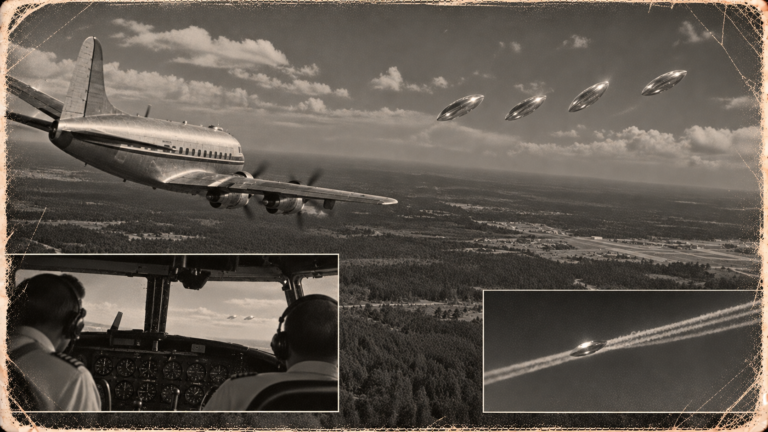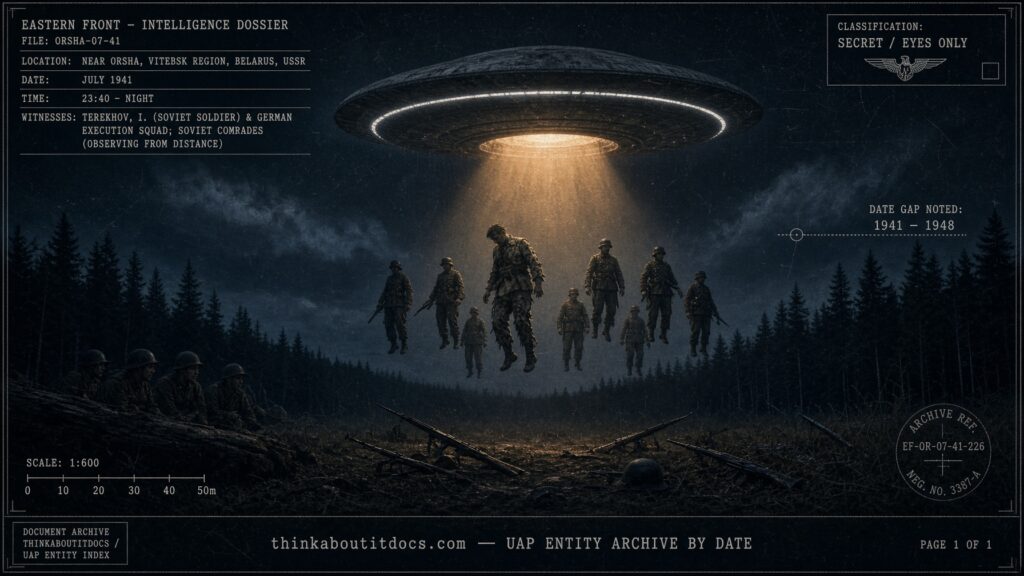
Near Orsha, Belarus, July 1941 — facing execution, Soviet soldier Terekhov was lifted into a grey disc along with his German captors; he did not return home until 1948, reportedly unaged.
THINK ABOUTIT UFO|ENTITY ENCOUNTER REPORT
1941: Orsha, Vitebsk, Belarus
The Terekhov Disc Rescue
On a night in July 1941, in the Vitebsk region of German-occupied Belarus, a Soviet soldier named Terekhov — stunned by a mine explosion and standing before a German firing squad — was pulled upward off the ground into a large grey disc ringed with circumferential lights, taking his German executioners with him. He fainted. When he woke, he was back on the ground, and the Germans lay unconscious beside him. He was taken prisoner shortly after and spent the remainder of the war and several years beyond it as a POW, not returning home until 1948 — seven years after Soviet Army records had already listed him as missing in action in 1941. His fellow soldiers, present before the incident, confirmed his account. Two of the German soldiers who had been about to execute him, later held as POWs themselves, independently corroborated what happened that night. A Minsk-based ufologist subsequently located additional witnesses who separately reported seeing a large disc hovering near Orsha that same summer. Perhaps strangest of all: when Terekhov finally came home in 1948, those who had known him before the war noted that he did not appear to have aged in the intervening years.
Date: July 1941
Sighting Time: Night
Day/Night: Night
Location: Near Orsha, Vitebsk region, Belarus, USSR (under German occupation at the time)
Urban or Rural: Rural/battlefield — active wartime combat zone, Eastern Front, weeks after Operation Barbarossa began
No. of Entity(‘s): None directly described — no occupants of the disc are described in the available account; the entities’ presence is inferred only from the craft’s apparent controlled retrieval action
Entity Type: Not described — this is a craft-interaction case without a witnessed occupant description
Entity Description: Not available in the source material; Terekhov lost consciousness before or during the retrieval and has no described memory of any occupants
Hynek Classification: CE-II bordering CE-IV (Close Encounter of the Second Kind — physical/physiological effect: the retrieval itself, the unconsciousness, the apparent multi-year age discrepancy on return — with elements suggestive of CE-IV abduction, though Terekhov has no conscious memory of any interior contact, examination, or communication)
Duration: The lifting/retrieval event itself — brief, seconds to at most a few minutes; Terekhov’s total unaccounted time before waking on the ground — unspecified, but presumably short given the immediate post-event context (Germans also unconscious nearby); the broader disappearance — seven years (1941–1948)
No. of Object(s): 1
Description of the Object(s): A large grey disc with lights arranged around its circumference. No further structural detail (size in absolute terms, hatch or door mechanism, interior description) survives in the available secondary source
Shape of Object(s): Disc
Size of Object(s): “Large” — described as sufficient to lift multiple men, but no specific dimension recorded
Color of Object(s): Grey, with circumferential lights
Distance to Object(s): Directly overhead at the moment of the lifting event — close enough to physically draw Terekhov and his German captors upward
Height & Speed: Hovering low enough to lift standing men from the ground; further flight characteristics not described, as Terekhov lost consciousness
Number of Witnesses: Terekhov (primary); his fellow Soviet soldiers present before the incident (secondary, corroborating); at least two German soldiers among the execution party (corroborating, later interviewed as POWs); additional unnamed civilian witnesses in the Orsha area who separately reported a hovering disc that summer, located via a Minsk-based ufologist’s later investigation
Special Features/Characteristics: Simultaneous lifting of both the intended victim and his executioners — the craft did not selectively retrieve only Terekhov; apparent loss of consciousness for both parties during the event; Germans found unconscious beside Terekhov upon his return to the ground, effectively halting the execution; a seven-year absence during which Soviet Army records listed Terekhov as missing in action from 1941; corroboration from both sides of the conflict — Soviet comrades and German POWs; independent local witness reports of a hovering disc near Orsha that summer, located by later investigation; reported lack of visible aging in Terekhov upon his 1948 return, despite the seven-year gap
Case Status: Unexplained.
Source: planeta.moy.su blog, citing Vadim A. Chernobrov and Alexey K. Priyma.
Summary/Description: In July 1941, near Orsha in German-occupied Belarus, Soviet soldier Terekhov — stunned by a mine and facing imminent execution by German soldiers — was pulled upward into a large grey disc ringed with lights, along with his German captors. He lost consciousness and awoke on the ground with the Germans unconscious beside him. He was subsequently taken prisoner and did not return home until 1948, seven years after Soviet Army records listed him as missing in action. His account was corroborated by fellow Soviet soldiers present before the incident and, later, by two of the German POWs involved. A Minsk ufologist located additional local witnesses who independently reported a hovering disc near Orsha that summer. On his return, Terekhov reportedly did not appear to have aged during his absence.
Related Cases: 1941: UFO|UAP & Alien Sightings Archive | 1941 Zelyenyi Island, River Don, Russia — NKVD crash retrieval
Detailed Report
The Terekhov case is one of the more operationally unusual entries in this archive’s Soviet wartime record, and its significance rests less on physical trace evidence — there is none described — than on the structure of its corroboration and the strangeness of its temporal outcome. The source is a Russian-language blog citing the work of Vadim Chernobrov and Alexey Priyma, both of whom this archive’s Zelyenyi Island report also identifies as credentialed Russian UFO researchers with decades of published field work. This is a secondary compilation rather than a primary interview record, but it draws on named researchers with an established body of independently corroborated work elsewhere in the Soviet-territory record.
The corroboration structure is genuinely unusual for a pre-modern wartime case: witnesses on both sides of an active combat engagement independently confirmed the same event. Terekhov’s Soviet comrades, present in the moments before the retrieval, corroborated the setup — the mine, the stunning, the German capture, the imminent execution. Separately, German soldiers who had been part of the execution party — later themselves prisoners of war and presumably with no continuing loyalty to protect a Soviet narrative, nor any career or propaganda incentive to invent a story crediting an unexplained craft with saving an enemy soldier’s life — reportedly confirmed the same sequence of events from their own side of the encounter. Cross-national, cross-conflict corroboration of this type, where neither party’s account serves that party’s wartime interest, is a meaningfully strong evidentiary structure regardless of how strange the underlying claim is.
The craft’s behavior is the case’s most analytically interesting element. Rather than selectively retrieving Terekhov — the ostensible “target” if one assumes any purposive intent behind the retrieval — the disc lifted both the intended execution victim and his executioners simultaneously. This is not consistent with a rescue narrative built around protecting a specific individual; it reads more like an indiscriminate response to the immediate physical situation (multiple humans clustered together at that location and moment) than a targeted intervention on Terekhov’s behalf. The Germans’ subsequent unconsciousness, and the abandonment of the execution once they and Terekhov were returned to the ground, produced a rescue-like outcome without necessarily implying rescue-like intent.
The seven-year disappearance and the reported absence of visible aging are the case’s most extraordinary claims and the ones most resistant to independent verification. Soviet Army administrative records listing Terekhov as missing in action from 1941 is a plausible and mundane wartime record-keeping outcome regardless of what actually happened to him — millions of Soviet soldiers were listed as missing during this period, many having simply been captured, killed without identification, or lost to chaotic front-line record-keeping. That Terekhov specifically returned in 1948, three years after the war’s end, is consistent with a POW held under difficult postwar repatriation conditions and does not by itself require an unexplained mechanism. The claim of unchanged appearance after seven years is subjective, secondhand, and impossible to verify from available sources — but it is presented as an observation made by people who had known him before the war, not as Terekhov’s own claim about himself, which is a marginally stronger form of testimony than self-report would be.
RESEARCHER’S NOTES
Orsha 1941 — The Terekhov Rescue and Cross-Conflict Corroboration
- Source Chain Assessment: The case reaches this archive through a secondary blog citation of Chernobrov and Priyma rather than through direct access to their original published work. This archive has not independently verified the primary Chernobrov/Priyma text for this specific case, and flags that as a research priority — locating the original Russian-language source material would meaningfully strengthen or weaken this entry’s evidentiary standing.
- Classification Rationale: The case sits uncomfortably between CE-II and CE-IV. There is a clear physical/physiological effect (the lifting, the unconsciousness) consistent with CE-II, but no witnessed interior contact, examination, or communication that would definitively establish CE-IV — Terekhov has no conscious memory of anything beyond being lifted and later waking on the ground. This archive classifies it as CE-II with CE-IV-adjacent elements rather than forcing a single clean designation.
- Cross-Conflict Corroboration as a Credibility Marker: Independent confirmation from soldiers on opposing sides of an active war, neither of whom had any evident motive to support the other’s account, is a rare and analytically valuable corroboration structure in this archive’s broader record. Most pre-modern multi-witness cases involve witnesses who already knew and trusted each other; corroboration across enemy lines, obtained separately, is a stronger pattern.
- The Indiscriminate Retrieval Pattern: The craft’s apparent lifting of both Terekhov and his German captors together, rather than selectively extracting only the ostensible rescue target, is worth flagging as a pattern distinct from typical rescue-narrative UFO accounts, where occupants are usually depicted as specifically choosing and protecting an individual. This entry’s behavior reads as reactive to the immediate physical cluster of people rather than as an intentional, individually-targeted intervention.
A Soviet soldier stunned by a mine, standing before a German firing squad in the summer of 1941, was pulled off the ground into a grey disc along with the men about to kill him, and came back down to find them unconscious and the execution over. He disappeared from the war entirely — not dead, not fighting, simply gone from the record — until 1948, when he came home to people who swore he looked exactly as he had the day he left. His own side confirmed the setup. The enemy soldiers who had raised their rifles confirmed the outcome. Neither had any reason to agree with the other. Case Status: Unexplained.
“Soviet soldier Terekhov, stunned by a mine and about to be shot by Germans, was pulled upward into a large grey disc with circumferential lights along with his German escorts. He fainted and woke back on the ground with the Germans unconscious beside him.”
Case summary describing the July 1941 Orsha, Vitebsk, Belarus encounter, sourced via planeta.moy.su, citing Vadim A. Chernobrov and Alexey K. Priyma