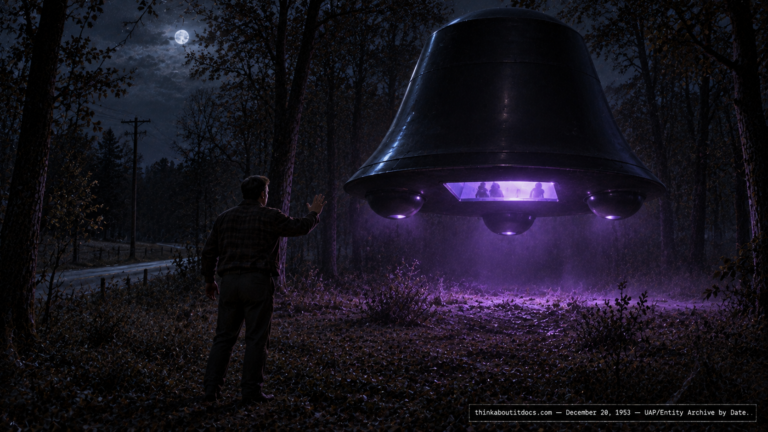
The alleged Camp Polk, Louisiana crash-retrieval claim — an unsubstantiated but widely circulated 1953 case.
THINK ABOUTIT CRASH REPORT
1953: The Camp Polk, Louisiana Crash-Retrieval Claim
Army personnel near Camp Polk, Louisiana allegedly watched an egg-shaped craft come down hard into soft sand, its hull glowing hot enough to bake the ground beneath it into powder. Three small, helmeted figures reportedly climbed out on their own; a fourth had to be carried on a stretcher. It’s one of a handful of alleged 1953 crash-retrieval claims that circulate in later UFO literature with almost no contemporary documentation behind them — and this archive treats it exactly as carefully as it treated Kingman.
⚠ UNSUBSTANTIATED CRASH-RETRIEVAL CLAIM
This case rests entirely on a secondary source (LeRoy Pea’s “UFO Crash Secrets at Wright-Patterson Air Force Base”) with no named primary witness, no contemporary 1953 documentation, and no independent corroboration located. It is retained in the archive as a documented crash-retrieval claim of the kind that circulates widely in the field, not as a verified event. Per locked editorial standard, no Hynek classification is applied to unsubstantiated crash-retrieval claims.
Date: Summer 1953 (exact date not specified in the source)
Sighting Time: Unknown
Day/Night: Unknown
Location: Near Camp Polk, Louisiana (present-day Fort Johnson; historically also referenced as Fort Polk)
Urban or Rural: Rural (military installation grounds)
No. of Entity(‘s): 4 alleged — 3 reportedly walked away from the crash under their own power; 1 was carried out on a stretcher
Entity Type: Small humanoid
Entity Description: Approximately four feet tall, with large helmeted heads; legs described as stiff when walking; wearing tight-fitting, dull metallic greenish suits and a kind of mitten; spoke in an unknown language
Hynek Classification: None — per locked editorial standard, unsubstantiated crash-retrieval claims do not receive a Hynek classification
Duration: Not specified
No. of Object(s): 1
Description of the Object(s): An ovoid or egg-shaped craft with a collared structure on top and a revolving, horizontal fin-like protrusion around its equator, still rotating after the crash
Shape/Size/Color of Object(s): Ovoid/egg-shaped; approximately 9-10 meters in diameter; color not specified
Distance to Object(s): Army personnel were reportedly close enough to be posted as guards around it
Height & Speed: Not applicable — object had crash-landed into soft, sandy soil
Number of Witnesses: Unspecified number of Army personnel; none individually named in the surviving source material
Special Features/Characteristics: The ground around the crashed craft reportedly burned into a powdery substance and became extremely hot; a hatch opened, forming a ramp; personnel were ordered to guard the object until ambulances arrived; three entities walked away from the wreck under their own power, one was carried on a stretcher
Case Status: Insufficient Data — single-source secondary claim with no named witnesses and no contemporary documentation located
Source: LeRoy Pea, “UFO Crash Secrets at Wright-Patterson Air Force Base”
Summary/Description: Army personnel near Camp Polk, Louisiana allegedly witnessed an ovoid, egg-shaped craft, roughly 9-10 meters in diameter with a collared top structure and a rotating equatorial fin, crash-land into soft, sandy soil during the summer of 1953. The ground around it reportedly burned to powder and grew extremely hot. A hatch opened into a ramp. Three four-foot-tall entities in helmeted heads and dull greenish metallic suits reportedly walked away from the wreck under their own power; a fourth was carried out on a stretcher. Personnel were ordered to guard the site until ambulances arrived.
Related Cases: 1953: Kingman, Arizona — Alleged UFO Crash Retrieval (a similarly single-source, unsubstantiated 1953 crash-retrieval claim)
Detailed Report
The Camp Polk claim, as it survives in the UFO-literature record, describes Army personnel near the Louisiana installation — historically referenced under both the names Camp Polk and Fort Polk, and known today as Fort Johnson — witnessing the crash of an unusual craft during the summer of 1953. No more specific date is preserved in the available source.
The object itself is described as ovoid or egg-shaped, roughly nine to ten meters across, distinguished by a collared structure on its upper surface and a horizontal, fin-like protrusion running around its equator — a feature reportedly still rotating after the craft had come to rest in soft, sandy ground. The heat generated by the crash, or by the craft itself, was said to be substantial: the surrounding earth reportedly burned into a fine, powdery substance and remained extremely hot to the touch.
A door or hatch on the craft opened, forming a ramp. According to the account, three entities — each about four feet tall, wearing tight-fitting, dull greenish metallic suits with large helmeted heads and a kind of mitten on their hands, their legs stiff as they walked — emerged and moved away from the wreckage under their own power. A fourth was reportedly injured badly enough to require a stretcher. The beings were said to have spoken in a language unrecognized by the personnel present. Those personnel were ordered to guard the crash site until ambulances arrived to remove the occupants.
No named witness, contemporary press account, or military document has been located to corroborate any part of this narrative. It survives in the record primarily through LeRoy Pea’s later compilation of alleged crash-retrieval claims associated with Wright-Patterson Air Force Base — a pattern of documentation (single secondary source, decades removed from the alleged event, no named primary witness) shared by several of the era’s most circulated crash claims.
RESEARCHER’S NOTES
Camp Polk — 1953 and the Single-Source Problem, Again
- The same evidentiary shape as Kingman: Like the Kingman, Arizona claim from earlier that same year, Camp Polk rests on a single, much later secondary compilation, with no named primary witness and no surviving 1953-era documentation. This archive applies the identical standard to both: preserved as a documented claim, not elevated to a verified event.
- No named witnesses at all: Unlike Kingman, where at least one witness (Arthur Stansel) is named and signed an affidavit, the Camp Polk account doesn’t name a single individual — a meaningfully weaker evidentiary position even within the already-thin category of crash-retrieval claims.
- Consistent physical-effect details: The scorched, powdered ground and extreme heat are physical claims that would, in principle, have been checkable at the time — but no indication survives that any independent investigation or soil analysis was ever conducted or reported.
- A recurring entity archetype: Four-foot-tall, helmeted, metallic-suited beings with stiff-legged gaits recur across several unverified 1950s crash-retrieval narratives — worth noting as a pattern in the folklore of the genre without treating the recurrence as corroboration.
- Geographic and institutional plausibility, nothing more: Camp Polk was, and Fort Johnson remains, an active U.S. Army installation, which lends the setting a surface plausibility — but an active military base is also exactly the kind of setting a fabricated or exaggerated claim would plausibly choose.
This claim is retained in the archive because it circulates prominently in crash-retrieval literature and deserves an honest record — not because it meets any independent evidentiary bar. With no named witness, no contemporary documentation, and a single secondary source compiled decades after the fact, it sits alongside Kingman as a historically significant claim rather than a demonstrated event.
“The ground around the crashed craft burnt into a powdery substance and became extremely hot.”
— LeRoy Pea, “UFO Crash Secrets at Wright-Patterson Air Force Base”