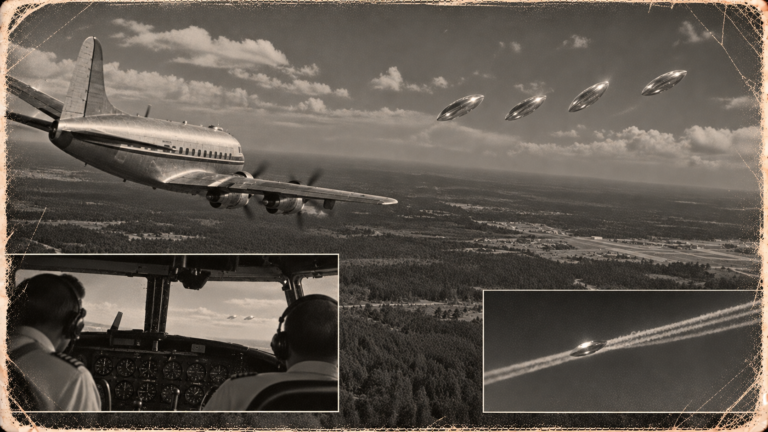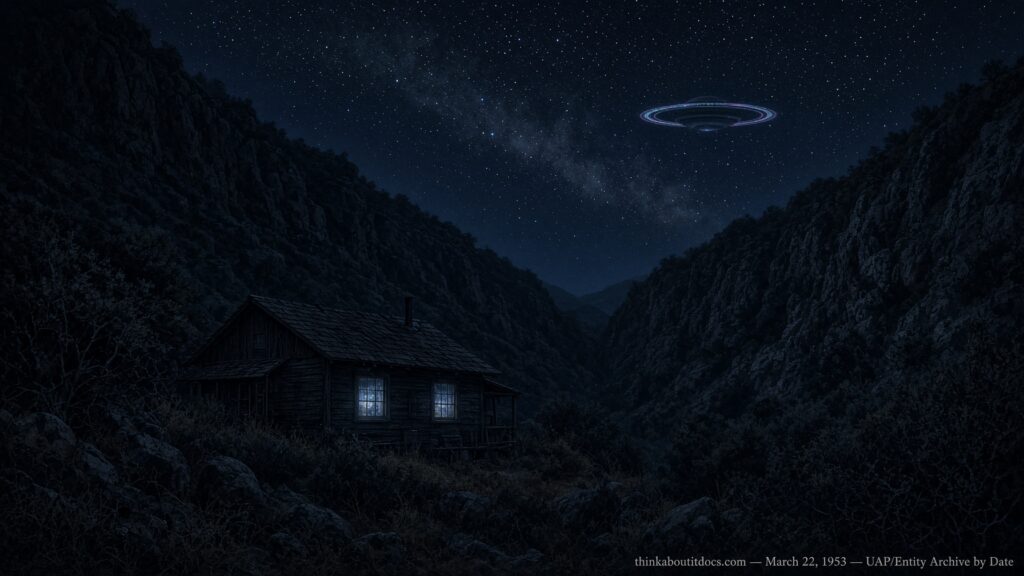
The Tujunga Canyon cabin where Sarah Shaw and Jan Whitley lost over two hours of memory, March 22, 1953.
THINK ABOUTIT UFO|UAP & ENTITY ENCOUNTER REPORT
1953: The Tujunga Canyon Contacts — Sarah Shaw & Jan Whitley
Sarah Shaw and Jan Whitley remembered a blue-white light outside their remote cabin window, a sudden silence, and then nothing — until they came to almost two and a half hours later with no memory in between. It took hypnosis, years afterward, to surface what Sarah recalled: eight shadowy figures passing through a closed window and a locked door, and a Saturn-shaped craft waiting outside. The case would go on to become the subject of an entire book, one of the most closely examined abduction accounts of the era.
Date: March 22, 1953
Sighting Time: 02:00 (missing time resumes at 04:20)
Day/Night: Night
Location: A remote cabin, Tujunga Canyon, California
Urban or Rural: Rural
No. of Entity(‘s): 8 (2 described as apparent leaders)
Entity Type: Humanoid
Entity Description: Slender-built humanoids, roughly 5 feet tall, with narrow shoulders and long arms; oval, hairless, largely featureless faces apart from narrow, long eyes appearing covered by a membrane, giving the impression of a ski mask with eye holes; dry, cold-feeling skin; black skintight coveralls, mittens, and boots. Some had heads wider at the bottom, apparently female. Two taller beings appeared to lead the group; one, directing the later examination from a balcony, wore a light-colored suit with black stripes and had bare, gray-fleshed hands.
Hynek Classification: CE-IV (Close Encounter, Fourth Kind — abduction)
Duration: Approximately 2 hours 20 minutes of missing time (0200-0420)
No. of Object(s): 1
Description of the Object(s): A Saturn-shaped craft with a rim or platform encircling it, hovering, glowing in various colors, emitting a whining sound
Shape/Size/Color of Object(s): Saturn/ringed shape; multicolored glow; precise size not given
Distance to Object(s): The witnesses reported being taken aboard; the craft was described as hovering directly outside the cabin
Height & Speed: Not applicable — object described as stationary/hovering during the encounter
Number of Witnesses: 2 (Sarah Shaw and Jan Whitley)
Special Features/Characteristics: Total external silence preceding the sighting; a headache and sensation of cold reported by Jan before the missing-time period began; Sarah described floating toward the craft on a beam of light and feeling calm and unafraid, while Jan resisted and was reportedly rendered unconscious by an injection before being carried aboard; both women were examined in a large domed room; recall of the missing-time period was recovered only later, under hypnosis
Case Status: Unresolved — an extensively documented and independently investigated hypnotic-regression case, later the subject of a full published book; the recovered material’s evidentiary status as hypnotically-refreshed memory is a significant, openly acknowledged limitation
Source: Ann Druffel, Idabel Epperson, and D. Scott Rogo; later published in full as “The Tujunga Canyon Contacts”
Summary/Description: Sarah Shaw and Jan Whitley, staying in a remote Tujunga Canyon cabin, awoke around 2:00 a.m. to total external silence and a blue-white light casting moving shadows through the windows. Jan developed a headache and a sense of cold; both women then experienced a period of giddiness and confusion, with conscious memory not resuming until 4:20 a.m. Under later hypnosis, Sarah recalled eight humanoid beings entering the cabin through a closed window and a shut door, taking both women aboard a hovering, Saturn-shaped craft, and conducting an extensive physical examination in a domed interior room before returning them.
Related Cases: None known
Detailed Report
The night of March 22, 1953 began, by the witnesses’ waking recollection, ordinarily enough. Sarah Shaw and Jan Whitley were staying at a remote cabin in Tujunga Canyon, California, when at around 2:00 a.m. all outside sound abruptly stopped. A blue-white light began moving outside, casting shifting shadows across the cabin walls. Jan got out of bed and was almost immediately overcome by a headache and a creeping sense of coldness. A wave of giddiness and confusion followed for both women — and then their conscious memory simply stops. It does not resume until 4:20 a.m., roughly two hours and twenty minutes later.
What filled that gap did not surface at the time. It emerged only later, through hypnotic regression, and it was Sarah’s recollection that formed the fuller account. She described several beings approaching the cabin and passing directly through a closed window and the shut kitchen door — eight in total, entering the room and placing their hands on the two women, apparently taking control of them as they did.
The beings themselves were described consistently: slender, narrow-shouldered, long-armed humanoids, most around five feet tall, with oval, hairless, largely featureless faces apart from narrow, elongated eyes that appeared covered by a membrane — an effect the witnesses compared to a ski mask with eye holes cut into it. Their skin felt dry and cold to the touch. They wore black, skintight coveralls, mittens, and boots. Some had heads that widened toward the bottom rather than the top, and these were taken to be female. Two taller individuals among the group appeared to lead the others.
Both women were reportedly taken toward a hovering, Saturn-shaped craft encircled by a rim or platform, glowing in shifting colors and emitting a low whining sound. Sarah described the sensation of floating toward it on a beam of light, and — notably, given how differently the two women’s experiences diverged at this point — recalled feeling tranquil, unafraid, and even something like enjoyment. Jan’s account was markedly different: she resisted the beings and was, by her account, rendered unconscious with an injection before being carried inside.
Once aboard, the two were brought to a large, domed interior room and extensively examined and scanned. Throughout, a tall being directed the process from a balcony-like extension along the wall, dressed in a light-colored suit marked with black stripes, his bare hands showing gray-toned flesh.
The case did not stay confined to a single retelling. It was investigated by Ann Druffel and Idabel Epperson and later co-written up in full by Druffel and D. Scott Rogo as the book “The Tujunga Canyon Contacts” — giving this account a depth of independent documentation and scrutiny that few 1953-era cases received.
RESEARCHER’S NOTES
Tujunga Canyon — 1953 and the Limits of Hypnotically Recovered Memory
- Two witnesses, two very different emotional accounts: Sarah’s described calm and even pleasure sits in direct contrast to Jan’s resistance and forced unconsciousness — a divergence investigators and researchers have long noted, and one this archive preserves rather than smooths into a single unified narrative.
- Missing time as the anchor, not the hypnotic narrative: The one piece of this account not dependent on hypnosis is the roughly two-hour-twenty-minute gap in the women’s own waking memory, bookended by a genuinely unusual shared sensory experience (the sudden silence, the light, the headache and cold).
- Hypnotic regression’s evidentiary limits: Recovered-memory testimony under hypnosis is widely understood, including by the case’s own investigators, to be susceptible to confabulation and suggestion. That the case became the subject of extended, book-length investigation reflects how seriously it was taken — not a verdict on the underlying facts.
- Consistency of entity description: The described beings — slender build, membrane-covered eyes, cold dry skin, black coveralls — align closely with a “Grey”-adjacent archetype that would become far more culturally dominant in later decades, making this a comparatively early example of the pattern.
- A rare book-length treatment: Few individual cases in this archive have an entire published book built around them. That level of dedicated investigation is itself part of the case’s historical significance, independent of what conclusion one draws about it.
This is one of the most extensively documented entity cases from 1953, and also one of the most methodologically complicated — its core narrative rests on hypnotic regression conducted after the fact, a technique with real, well-documented limitations. The women’s shared, waking experience of the missing-time gap itself is harder to dismiss than the recovered narrative that later filled it. Both halves are presented here as reported, without resolving the tension between them.
“Sarah felt herself floating into the craft on a beam of light. She felt tranquil, unafraid and even enjoyed the experience. But Jan resisted the beings and was rendered unconscious by an injection.”
— Ann Druffel, Idabel Epperson & D. Scott Rogo