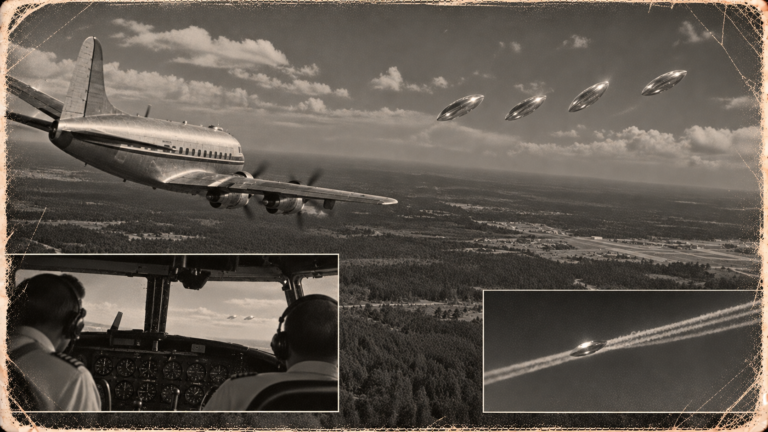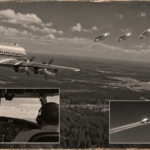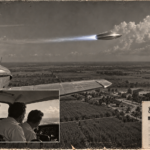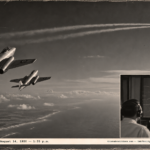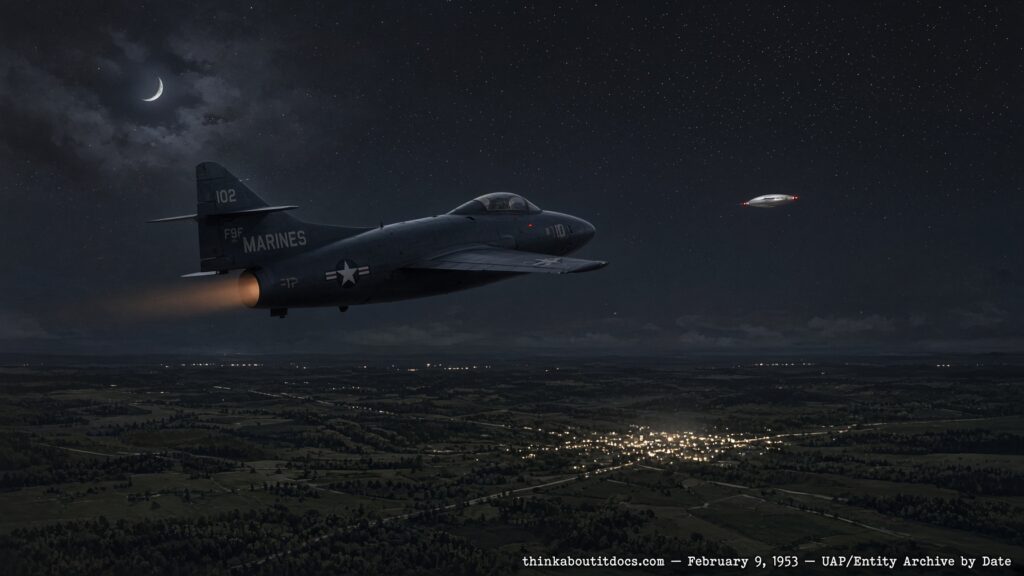
1st Lt. Ed Balocco's F9F Panther chases an unidentified object at over 500 mph without closing the distance, February 9, 1953.
THINK ABOUTIT UFO|UAP SIGHTINGS REPORT
1953: The Balocco Panther Jet Intercept — Near Washington, D.C.
Ground observers near the Virginia-North Carolina border had already reported a silver, maneuvering object when a Norfolk-based Marine Corps F9F Panther was scrambled to investigate on the evening of February 9, 1953. Pilot 1st Lt. Ed Balocco was already headed back to base, having seen nothing, when something below him closed 10,000 feet vertically in a matter of seconds — and the chase that followed pushed his jet past 500 mph for four minutes without ever closing the distance.
Date: February 9, 1953
Sighting Time: Evening (exact clock time not recorded)
Day/Night: Night
Location: Near the Virginia-North Carolina border, in the vicinity of Washington, D.C.
Urban or Rural: Rural/regional airspace
No. of Entity(‘s): 0
Entity Type: Not Applicable
Entity Description: Not Applicable
Hynek Classification: RV (Radar-Visual)
Duration: Pursuit lasted 3-4 minutes at high speed
No. of Object(s): 1
Description of the Object(s): A silver, maneuvering object initially reported by ground witnesses; later described by the pilot as resembling an airplane with red lights
Shape/Size/Color of Object(s): Silver in color; carrying red lights; precise shape and size not established
Distance to Object(s): Closed to below the pilot’s altitude before climbing away; exact distance not given
Height & Speed: Object climbed approximately 10,000 feet vertically in a matter of seconds; pursuing F9F Panther exceeded 500 mph without closing the gap
Number of Witnesses: Multiple — original ground witnesses near the VA-NC border, plus 1st Lt. Ed Balocco in the air
Special Features/Characteristics: Extreme vertical acceleration (10,000 ft in seconds); sustained pursuit at over 500 mph with no closure; military jet unable to match the object’s performance
Case Status: Unresolved — a named military pilot’s direct account of an unsuccessful intercept, prompted by an independent ground sighting
Source: Contemporary press/military account; witness identified as 1st Lt. Ed Balocco, USMC
Summary/Description: On the evening of February 9, 1953, a Marine Corps F9F Panther pilot, alerted by a Norfolk naval facility after ground witnesses near the Virginia-North Carolina border reported a silver, maneuvering object, searched the area and initially saw nothing. While returning to base, 1st Lt. Ed Balocco spotted what looked like an airplane with red lights below him — until it moved 10,000 feet vertically in a matter of seconds. He turned to pursue, chasing the object at speeds exceeding 500 mph for three to four minutes, but could never close the distance.
Related Cases: None known
Detailed Report
The case begins on the ground, not in the air. Sometime on the evening of February 9, 1953, witnesses near the Virginia-North Carolina border reported a silver, maneuvering object in the sky — enough of a report to reach a Navy facility in Norfolk, which in turn alerted the Marine Corps for an intercept.
1st Lt. Ed Balocco, flying an F9F Panther, was sent to investigate. His initial search turned up nothing, and he had turned back toward base when the case took its strange turn. Below him, he saw something that at first looked unremarkable — “what looked like an airplane with red lights,” in his own words. What made him look twice was what it did next.
“What caused me to look back at the object,” Balocco later said, “was the fact that it moved from below me 10,000 feet vertically in a matter of seconds.” That kind of climb rate had no ordinary explanation, and Balocco turned to give chase. What followed was a straightforward, unglamorous pursuit: the Panther pushed past 500 mph and held that speed for three to four minutes, but never gained an inch on the object. Eventually the chase ended without an intercept, and the object was lost.
Unlike many Blue Book-era cases built from secondhand summaries or terse radar logs, this one preserves a direct quote from the pilot describing the moment that changed his assessment of what he was looking at — a rare and valuable detail for a military intercept case from this period.
RESEARCHER’S NOTES
The Balocco Intercept — 1953 and the Limits of Contemporary Aircraft
- Ground-to-air corroboration: This case didn’t start with the pilot — it started with independent ground witnesses whose report is what got a jet scrambled in the first place, giving the case two separate observation points rather than one.
- A rare direct quote: Balocco’s own words about the 10,000-foot vertical climb are preserved verbatim, which is unusual for a period when most military sighting reports survive only as terse after-action summaries.
- Performance mismatch as the core claim: The evidentiary weight of this case rests entirely on one specific, checkable claim: that a contemporary Marine Corps jet, at full pursuit speed for several minutes, could not close on the object. That’s a concrete operational fact, not an impression.
- No radar confirmation in the surviving account: Despite the Norfolk naval facility’s involvement, no radar track of the object itself is described in this record — the case rests on visual testimony from the ground and the air.
- Sits inside the broader Robertson Panel window: Coming just five days before the Robertson Panel convened, this is exactly the kind of military radar-adjacent, high-performance case the panel was specifically tasked with reviewing.
This case is well-anchored by military rank, a named pilot, and a direct quotation — stronger sourcing than a great deal of what survives from this period. What it lacks is any independent radar confirmation of the object itself, leaving the performance claims resting on visual testimony alone, however credible the witness.
“What caused me to look back at the object was the fact that it moved from below me 10,000 feet vertically in a matter of seconds.”
— 1st Lt. Ed Balocco, USMC, February 9, 1953