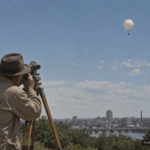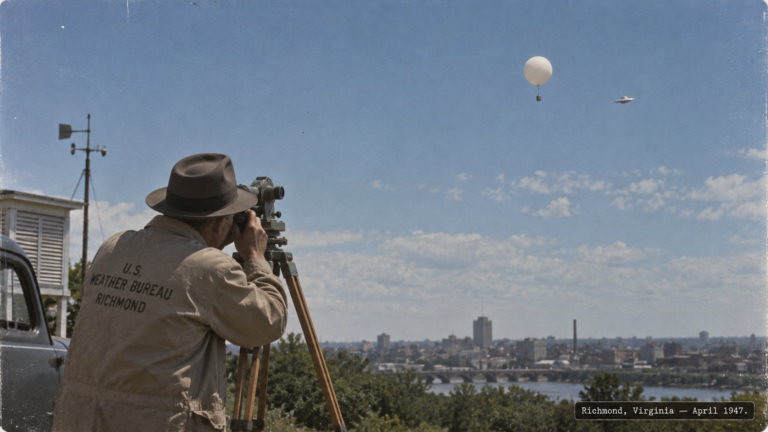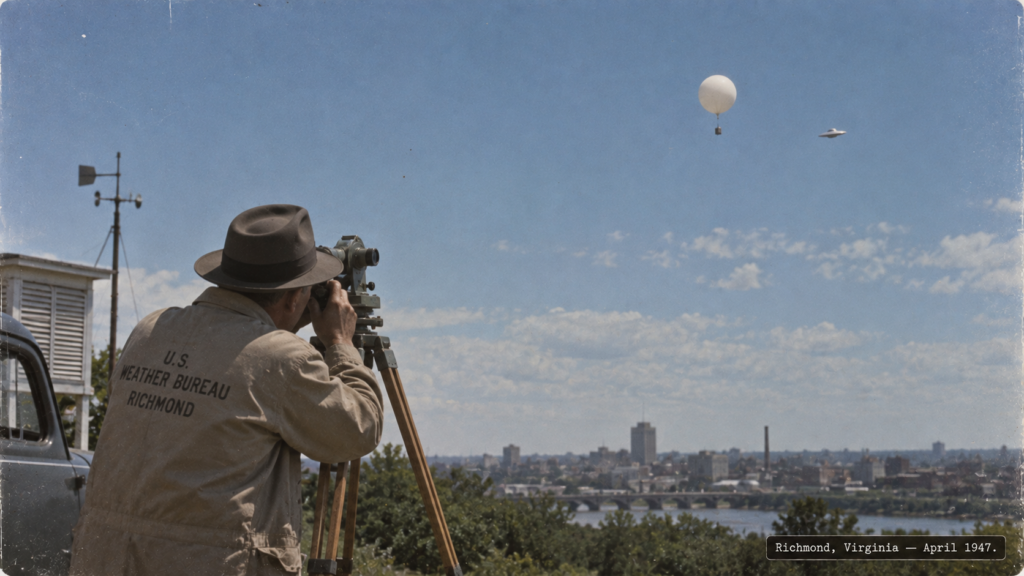
April 1947 — Weather Bureau meteorologist Walter A. Minczewski tracked a silvery disc through his theodolite while measuring winds via a routine pilot balloon. thinkaboutitdocs.com.
THINK ABOUTIT UFO|UAP SIGHTINGS REPORT
1947: Richmond, Virginia: A Weather Bureau Meteorologist’s Theodolite Sighting
In April 1947, two months before Kenneth Arnold’s sighting would coin the term “flying saucer,” a U.S. Weather Bureau meteorologist in Richmond, Virginia was doing his ordinary job — tracking a pilot balloon through a theodolite to measure upper-air winds — when a second object entered his instrument’s field of view. Walter A. Minczewski watched a silvery disc keep pace roughly alongside the balloon he was tracking, distinctly larger than it, traveling east to west below 15,000 feet. Two decades later, physicist James E. McDonald tracked Minczewski down and interviewed him directly, and the case has since become one of the more frequently cited pre-Arnold American sightings — not because of any dramatic maneuver, but because of who was watching and what he was using to watch with.
Date: April 1947
Sighting Time: Approximately 11:00
Day/Night: Day
Location: Richmond, Virginia
Urban or Rural: Urban
No. of Entity(‘s): Not Applicable
Entity Type: Not Applicable
Entity Description: Not Applicable
Hynek Classification: DD (Daylight Disc)
Duration: Not specified in available sourcing
No. of Object(s): One (in addition to the weather balloon Minczewski was routinely tracking, which was not itself the UFO)
Description of the Object(s): A silvery disc, observed through a theodolite, traveling east to west
Shape/Size/Color of Object(s): Disc-shaped, silvery, distinctly larger in the instrument’s field of view than the pilot balloon it appeared alongside
Distance to Object(s): Not specified in available sourcing
Height & Speed: Altitude below 15,000 feet; speed not specified
Number of Witnesses: One (Walter A. Minczewski)
Special Features/Characteristics: Observed through a theodolite, a precision surveying instrument used for tracking pilot balloons — an unusually objective viewing method for a 1947 sighting, since the witness was using calibrated optics for an unrelated professional task at the moment of the sighting, not scanning the sky by eye
Case Status: Unexplained
Source: Dr. James E. McDonald, 1968 direct interview with Minczewski; FOIA; FUFOR Index
Source Status: VERIFIED — a named, credentialed federal government witness performing a routine professional task, later personally interviewed by a physicist investigating the broader 1947 wave; widely cited as one of the stronger pre-Arnold American cases.
Summary/Description: Weather Bureau meteorologist Walter A. Minczewski saw a silvery disc through a theodolite while tracking a “pibal” (pilot balloon) weather balloon. The object, traveling east to west at an altitude of less than 15,000 feet, appeared distinctly larger than the balloon being tracked.
Related Cases: No directly connected case has been identified. It sits within this archive’s broader April 1947 record of pre-Arnold American and European sightings traceable to named or institutional sources — see this archive’s April 1947 monthly index.
Detailed Report
On a morning in April 1947, Walter A. Minczewski was performing routine duties as a meteorologist with the U.S. Weather Bureau in Richmond, Virginia. His task that day was ordinary and specific: tracking a pilot balloon, or “pibal,” through a theodolite — a surveying instrument that measures precise horizontal and vertical angles — to calculate upper-atmosphere wind speed and direction, a standard weather-observation procedure of the period.
While the balloon was in view, Minczewski observed a second object in the same field: a silvery, disc-shaped object, distinctly larger than the balloon he was tracking, moving on a steady east-to-west course at an altitude below 15,000 feet. Because he was viewing the sky through calibrated optics at the moment of the sighting rather than scanning by unaided eye, his account carries a degree of instrumental precision unusual for sightings of this era — though the surviving record does not preserve a duration, distance estimate, or eventual disposition of the object.
The case remained essentially undocumented in public UFO literature for over twenty years. In 1968, physicist James E. McDonald — a University of Arizona atmospheric physicist who conducted independent investigations into numerous UFO cases during that period — located and directly interviewed Minczewski about the sighting. McDonald’s interview, along with FOIA and FUFOR Index records, is the basis for what is known about the case today.
RESEARCHER’S NOTES
Why This Case Is Taken Seriously
- A credentialed, on-duty federal witness: Minczewski was a working government meteorologist performing his actual job at the moment of the sighting, not a bystander who happened to look up — a witness profile that carries more institutional weight than an unrelated passerby account.
- Instrumental, not naked-eye, observation: The theodolite is a calibrated precision instrument. Viewing the object through it, rather than by eye, reduces (without eliminating) certain categories of misidentification common to casual sky-watching.
- A serious, independent later investigator: James McDonald’s involvement matters. He was a credentialed physicist who tracked down and personally interviewed the original witness two decades after the fact, rather than relying on a secondhand retelling.
- What the record does not include: No second witness, no photograph, no measured duration, and no resolution are preserved in the sourcing located for this report. The case’s strength rests on witness credibility and instrumentation, not corroborating evidence.
- Twenty-year documentation gap: The sighting went unrecorded in public UFO literature until McDonald’s 1968 interview, meaning the account as it exists today rests on a witness’s two-decade-old memory rather than a contemporaneous written report.
Taken together, the Richmond case is neither a dramatic close encounter nor a dismissible vague light in the sky. It sits in the narrower, harder-to-categorize space of a single credible witness, using precise equipment, whose account was preserved only because a serious independent investigator went looking for it decades later. This archive lists it as Unexplained on that basis, while noting plainly what corroborating evidence it lacks.
The object, traveling east to west, appeared distinctly larger than the balloon being tracked.
This archive’s case summary, based on Dr. James E. McDonald’s 1968 interview with witness Walter A. Minczewski.