Semyen Okulov's winter 1951 encounter with a hovering craft and its skull-headed occupants in the Arkhangelsk taiga, Russia.
THINK ABOUTIT UFO|ENTITY ENCOUNTER REPORT
1951: The Okulov Taiga Encounter — Arkhangelsk Region, Russia
Deep in the taiga of Russia’s far north, a week into a solitary marten-trapping expedition, 50-year-old hunter Semyen Stepanovich Okulov built his fire for the night beneath a spruce tree and heard something in the darkness that no experienced woodsman could place: a strange, buzzing sound, like a giant beetle, rising over the crackle of his own fire. What followed — a shining cloud, a floating, cast-iron-colored craft, a column of misty light, and a row of portholes framing pale, skull-shaped heads — became, twenty years later, one of the most detailed and carefully documented Soviet-era close encounters on record, recovered through the patient fieldwork of Russian ethnographer and folklorist Georgiy Naumenko.
Date: Winter 1951 (exact date not recorded)
Sighting Time: Evening, after nightfall
Day/Night: Night
Location: A forest glade along the Pesha River, near Safonovo, Arkhangelsk region, in the taiga of northern Russia (USSR)
Urban or Rural: Remote wilderness
No. of Entity(‘s): Several (exact number not specified; multiple heads and shoulders visible through separate portholes)
Entity Type: Humanoid
Entity Description: Skull-like, hairless heads with no visible noses, wide, bumpy foreheads narrowing to a pointed chin; only the heads and part of the shoulder area were visible through the craft’s portholes
Hynek Classification: CE-II (Close Encounter of the Second Kind), given the physical ground trace and the sighting of occupants through the craft’s windows without direct interaction; borders on CE-III given how clearly the occupants were observed
Duration: Approximately 30 minutes of close hovering, within a longer overall observation
No. of Object(s): 1
Description of the Object(s): Resembling an inverted, flattened cast-iron plate — flat on the bottom with a curved, “humpbacked” top like an inverted deep bowl; a bright light flashed at its top; several round windows or portholes appeared along its upper section, glowing dimly from within; something at the top-center rotated silently before departure
Shape of Object(s): Inverted, flattened dome/plate shape
Size of Object(s): Not numerically estimated, but large enough to leave a substantial circular melted patch in the snow
Color of Object(s): Dark, cast-iron-like coloring, with a bright flashing light at the top and a dim inner glow visible through its portholes
Distance to Object(s): Descended very close to the ground in the same glade where Okulov had made camp; he observed from concealment behind nearby conifer branches
Height & Speed: Emerged from and floated out of a shining cloud, descended slowly to near ground level, hovered for about 30 minutes, then shot away suddenly, leaving a trail of sparks over the treetops before vanishing from sight
Number of Witnesses: 1 direct witness (Semyen Stepanovich Okulov); a second hunter, of Nenets background, independently reported seeing lights flying into a cloud the same night from a different vantage point
Special Features/Characteristics: A strange buzzing sound preceded the sighting; the object emerged from within a cloud that grew unusually bright before the craft appeared; a thick, misty or foggy column of light was projected from the object to the ground for the duration of its hover, only vanishing before departure; a circular patch of melted snow was found at the site the following morning — a physical trace independently corroborating the location and approximate scale of the encounter.
Case Status: Insufficient Data
Source: Georgiy Markovich Naumenko, personal investigation conducted 1971, published in Extraterrestrials and Earthlings: Testimonies of Contacts, Moscow, 2007
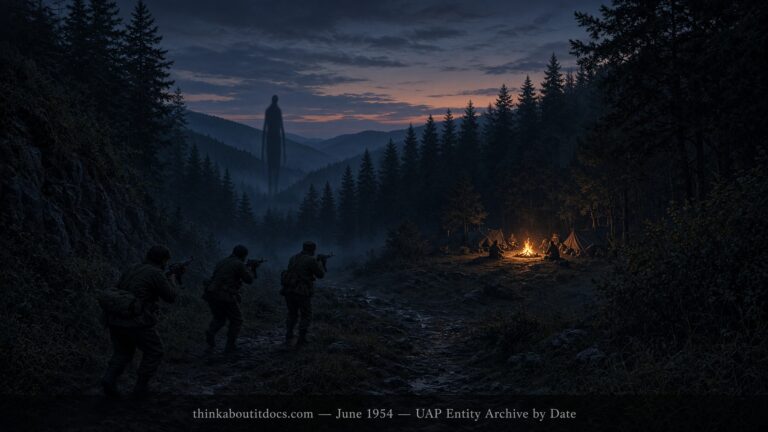
Summary/Description: In the winter of 1951, 50-year-old Semyen Stepanovich Okulov, an experienced hunter, set out alone into the dense taiga near Safonovo in Russia’s Arkhangelsk region, hunting martens along the Pesha River with supplies for a week or more. Having caught only a single marten by nightfall, he made camp beneath a large spruce, built a fire, and prepared a bed of conifer branches. As he settled in, he heard a strange, sustained buzzing sound unlike anything in his experience — audible even over the crackling fire. Looking up, he saw one cloud in the night sky growing steadily brighter and shinier than the others, until it was enveloped in an intense glow; something unusual then floated out of the cloud. The object resembled an inverted, flattened cast-iron plate, flat on the bottom with a humpbacked, dome-like top, a bright light flashing at its apex. It descended slowly over the glade, coming to hover very near the ground. Frightened despite his experience, Okulov quickly smothered his fire with snow and hid behind nearby conifer branches to watch. The object’s lights went out, replaced by a thick, misty column of light projected down to the ground; round portholes appeared along its top section, glowing faintly from within, and Okulov could make out several shadowy, skull-shaped, hairless heads with wide, bumpy foreheads narrowing to pointed chins, along with parts of their shoulders. The object hovered in place for roughly 30 minutes before the misty light vanished, its top lights resumed flashing, and something at its center began rotating silently; it then shot away abruptly, trailing sparks across the treetops before disappearing. Unable to sleep, Okulov returned to the site at first light and found a circular patch of melted snow where the object had hovered. Rushing to the cabin where other hunters had gathered, he encountered a fellow hunter of Nenets background and asked whether he had seen anything unusual that night; the man confirmed he had seen lights flying into a cloud. The account remained unrecorded until 1971, when folklorist Georgiy Naumenko conducted a personal investigation and interview, later publishing the case in 2007.
Related Cases: 1951: The Sønderborg, Denmark Encounter | 1951: The Veghenza Landing, Ferrara, Italy (same year, comparable landing-with-occupants structure and physical trace)
Detailed Report
The Okulov case’s most distinctive feature, among this archive’s Cold War-era Soviet cases, is its documentary path: not a contemporary newspaper account, not a government file, but the deliberate ethnographic fieldwork of a folklorist collecting oral testimony two decades after the fact. Georgiy Naumenko’s broader body of work focuses on Russian folk narrative and oral tradition, which means this account reaches researchers filtered through a methodology built for collecting and preserving stories as told by their tellers — a strength in that it likely preserves Okulov’s own voice and framing with real fidelity, and a limitation in that it is not the same as a contemporaneous investigative report with cross-checked details.
The witness’s own professional background lends the account unusual credibility on specific points. An experienced hunter, accustomed to the sounds of the taiga at night, explicitly recognized the buzzing sound as categorically unfamiliar — a judgment call that carries more weight coming from someone whose livelihood depended on correctly identifying wilderness sounds than it would from an urban witness with no comparable frame of reference. Similarly, Okulov’s practiced woodsman’s instinct to extinguish his fire and take concealment, rather than freeze in place or flee outright, reads as a plausible, survival-trained reaction rather than a dramatized flourish added for effect.
The entity description — skull-like, hairless, noseless heads with wide, bumpy foreheads — is distinctive within this archive’s broader entity catalogue, differing meaningfully from both the “Grey” archetype and the more human-passing beings described in many contemporaneous European contact accounts. That the witness saw only heads and partial shoulders, framed within individual portholes, is also a more restrained and structurally plausible claim than many entity accounts of the period; Okulov does not claim to have seen full bodies, faces in detail, or any behavior beyond passive presence within the craft, which is consistent with what a distant, concealed observer looking through small round windows at night could plausibly make out.
The morning-after discovery of a circular melted patch in the snow is the case’s strongest piece of independent corroboration, verifying that something occupying roughly the reported footprint had generated real, localized heat at the precise location Okulov described — a detail that exists independently of his testimony about the object’s appearance or the entities inside it. The second hunter’s unprompted, independent confirmation of “lights flying into a cloud” the same night, obtained by Okulov’s own direct question before any suggestion of what he had seen, adds a modest additional data point, though it falls short of a full corroborating witness account of the close-range details.
RESEARCHER’S NOTES
The Okulov Taiga Encounter — Arkhangelsk 1951 and the Value of Ethnographic Fieldwork
- Classification issues: CE-II is applied given the physical trace and the entities observed only passively through portholes rather than in direct interaction; the case sits close to the CE-II/CE-III boundary given how clearly the occupants were described.
- Source chain assessment: The account was recorded 20 years after the event through folklorist Georgiy Naumenko’s personal fieldwork interview, published a further 36 years later in 2007 — a long chain, but one grounded in a methodical, named researcher’s direct interview with the primary witness, rather than a secondhand or anonymous retelling.
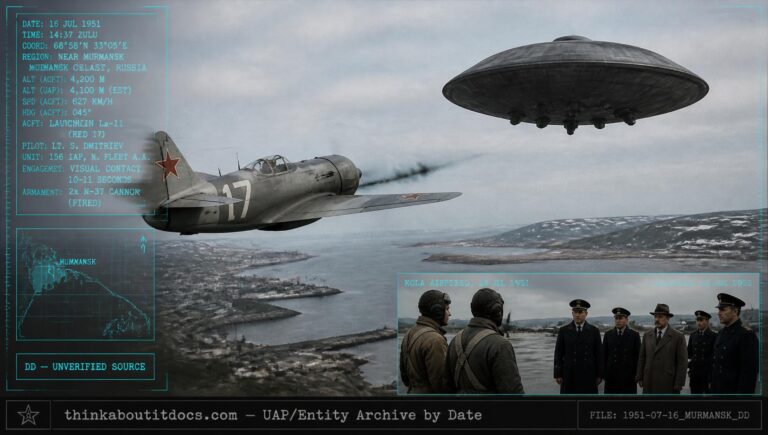
- Pattern context: The case joins a small but growing body of documented Soviet-era close encounters from this archive’s Cold War record (see also the July 1951 Vusov engagement near Murmansk), illustrating that anomalous aerial phenomena were reported within the USSR during this period despite the country’s closed information environment — though, as with Vusov, official corroboration from Soviet records remains unavailable to this archive.
- Physical evidence and evidentiary weight: A morning-after ground trace (melted snow) provides genuine, if modest, physical corroboration, independently locating and scaling the encounter. A second witness’s unprompted confirmation of related activity the same night adds limited further support. No photograph or artifact survives.
- Geographic and historical context: The Arkhangelsk region’s remote taiga wilderness, far from any military or population center, argues against a mundane military-technology explanation of the kind more plausible for sightings near known Soviet test or defense sites, while also meaning no comparable secondary witness population existed to independently confirm the sighting.
The Okulov taiga encounter stands as one of the most carefully preserved Soviet-era close encounters in this archive’s record, owing its survival to a folklorist’s patient fieldwork rather than to any contemporary official or journalistic channel. An experienced woodsman’s precise, restrained description of an unfamiliar craft and its passively observed, skull-headed occupants, corroborated by a genuine morning-after physical trace and a second witness’s independent confirmation, gives the case real substance even two decades removed from its telling. It is catalogued here as Insufficient Data: a methodically recorded account of a genuinely strange night in the northern Russian wilderness, resting on one man’s testimony and the ground it left behind.
“He then rushed towards the cabin… and asked him if he had seen anything unusual that night. His answer was indeed, that he had seen lights flying into a cloud.”
— Georgiy Naumenko, on the winter 1951 Arkhangelsk region, Russia encounter