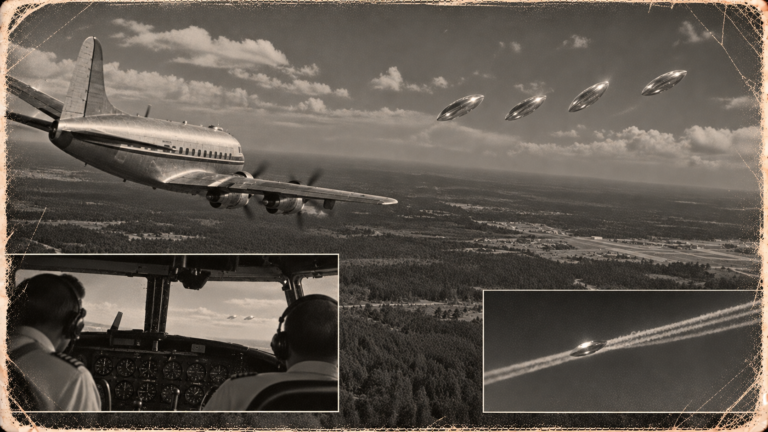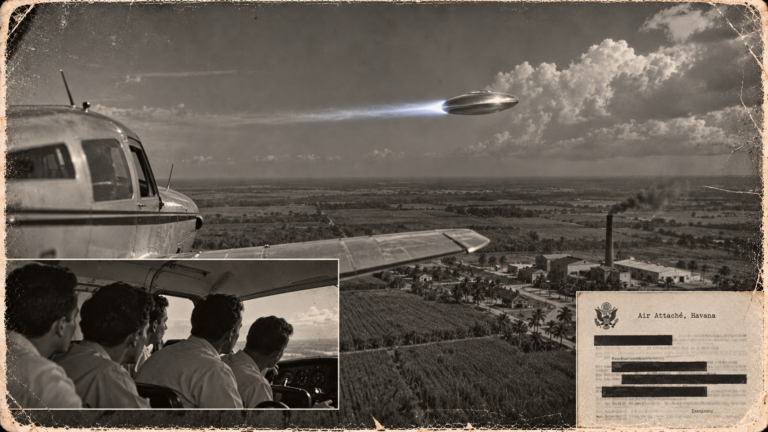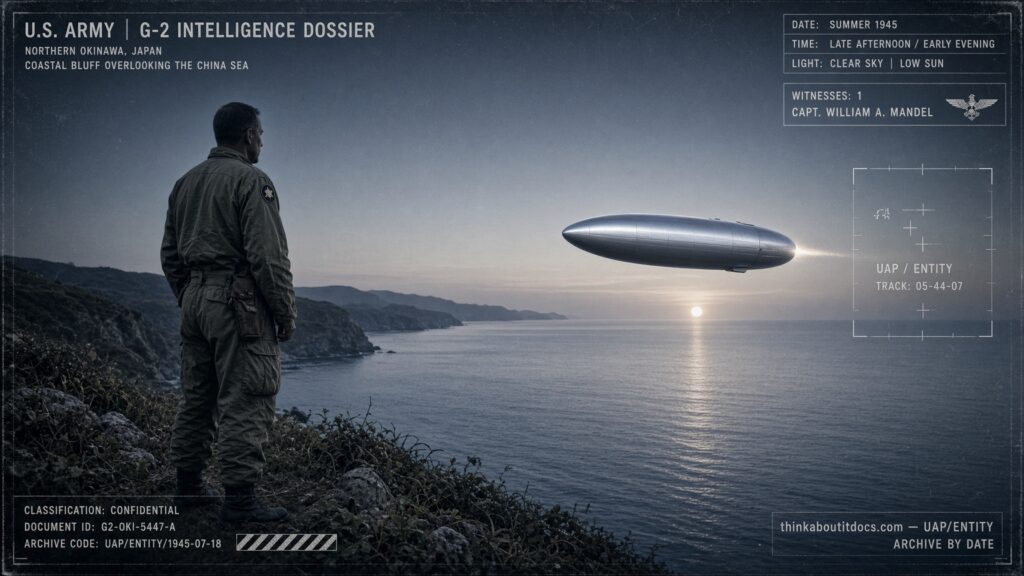
Summer 1945 — northern Okinawa. Artillery Captain William A. Mandel watched a 35-50 foot metallic cigar glide silently past him at eye level — a sighting he kept to himself for seven years before writing to Dr. J. Allen Hynek.
THINK ABOUTIT UFO SIGHTINGS REPORT
1945: The Okinawa Cigar — William A. Mandel
A trained artillery officer, standing alone on a coastal bluff in the final weeks of the Pacific War, watched a silent, metallic, cigar-shaped object glide past him at eye level, close enough to see clearly and far too controlled to mistake for anything conventional. He told no one for seven years. When he finally wrote it down, it was because a national magazine had made it safe to say what he’d actually seen.
Date: Summer 1945 — the witness could not recall the exact date, but bracketed it between roughly early July and the atomic bombing of Hiroshima (August 6, 1945)
Sighting Time: Late afternoon or early evening, in clear daylight
Day/Night: Day
Location: A high, precipitous coastal bluff overlooking the China Sea, northern Okinawa, Japan, near the witness’s military government bivouac
Urban or Rural: Rural/coastal — an isolated military encampment area
No. of Entity(s): Not Applicable
Entity Type: Not Applicable
Entity Description: Not Applicable
Hynek Classification: CE-I — Close Encounter of the First Kind. The object passed within a few hundred yards of the witness at his own eye level, close enough for detailed structural observation, but produced no landing, physical trace, or occupant sighting.
Duration: Approximately five minutes, per the witness’s own estimate
No. of Object(s): 1
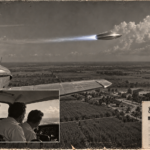
Description of the Object(s): A cigar-shaped, metallic object, entirely without wings, markings, ports, windows, or other visible openings except at the after (rear) end, from which its only visible light emanated. It produced no sound whatsoever and moved smoothly along a constant course parallel to the coastline at a constant altitude and speed.
Shape of Object(s): Cigar-shaped
Size of Object(s): Estimated 35 to 50 feet in length, 6 to 8 feet in diameter
Color of Object(s): Metallic, unpainted appearance, with light visible only from the tail end
Distance to Object(s): Passed within an estimated 500 yards of the witness, possibly closer — Mandel himself noted this distance estimate as the weakest part of his account, since he had no landmark for comparison and was too absorbed in watching to attempt measurement
Height & Speed: Altitude estimated at under 400 feet — scarcely 100 feet above the witness’s own elevated position on the bluff; speed estimated at 200 to 300 miles per hour, which Mandel — an experienced anti-aircraft and artillery observer — specifically noted was well below jet or rocket-propelled speeds of the era
Number of Witnesses: 1 — Captain William A. Mandel, alone at the time
Special Features/Characteristics: The witness explicitly credited his military training — primarily antiaircraft and artillery observation, with extensive experience distinguishing friendly from enemy aircraft — as directly relevant to his ability to assess what he was seeing was not a conventional aircraft; the object produced no engine sound of any kind despite its low altitude and close pass; Mandel delayed reporting the sighting for seven years, out of concern for his credibility, only writing it up after the widely publicized April 1952 Life magazine article “Have We Visitors from Space?” made the subject broadly discussable; he subsequently corresponded directly and at length with astronomer Dr. J. Allen Hynek, providing an expanded, more detailed account beyond his initial 1952 letter.
Case Status: Unexplained
Source: William A. Mandel, letter to Civilian Saucer Investigations of Los Angeles, 1952; subsequent detailed correspondence with Dr. J. Allen Hynek, preserved in project research archives
Related Cases: 1945: August UFO & Entity Sightings Archive
Detailed Report
In the summer of 1945, William A. Mandel was serving as an artillery captain with the U.S. military government on Okinawa, in the final weeks before Japan’s surrender. His unit’s bivouac sat on a bluff overlooking a narrow beach along the China Sea. On a clear moonlit — or, by his later, more precise recollection to Hynek, clear daylight — evening, gazing out to sea, Mandel saw a bright point of light approaching from the south, tracking parallel to the coast.
As it drew closer, the light resolved into the tail end of a cigar-shaped object, which he could see with total clarity as it passed him at a distance he estimated at not more than 500 yards, and possibly considerably closer. The object had no wings, no visible ports or windows, and no markings of any kind, its light emanating solely from the rear. It moved smoothly and silently, at an altitude he judged to be under 400 feet — probably less, since it appeared to pass him at roughly eye level and he was standing perhaps 200 feet above the sea. He estimated its speed at 200 to 300 miles per hour, a figure he was careful to note was well below jet or rocket propulsion speeds of the period, ruling out, in his own assessment, the most obvious secret-weapon explanations circulating in the final weeks of the war.
Mandel’s military background is directly relevant to how he assessed the sighting: his training and experience were primarily in artillery and antiaircraft work, which had made him proficient at recognizing both friendly and enemy aircraft types at a glance. His first instinct, in fact, was that he was watching a returning Navy Corsair — until he realized the shape and behavior didn’t match, at which point he began seriously considering that it might be a Japanese aircraft, and continued watching carefully for that reason.
He did not report the sighting to anyone at the time — not superior officers, not fellow soldiers, not even his wife until much later — and he told no one publicly for seven years. In his own later words, he “made up my mind that I would tell no one of my sighting until the news became public,” discreetly asking a number of his own officers and men whether they had witnessed anything unusual on the relevant day, always receiving negative answers without prompting suspicion about his own state of mind. It was only after Life magazine’s widely read April 1952 article “Have We Visitors from Space?” — which included an image of a cigar-shaped craft matching what he had seen — that Mandel finally wrote up his account and sent it to Civilian Saucer Investigations of Los Angeles. He subsequently entered into detailed, extended correspondence with Dr. J. Allen Hynek, then still working within the Air Force’s UFO investigation apparatus, providing a more precise and expanded account than his original 1952 letter.
RESEARCHER’S NOTES
A Seven-Year Silence, and What It Says About the Report
- On why the delay strengthens rather than weakens this case: A seven-year gap between event and report is often treated as a red flag in evaluating UFO testimony, since memory degrades and can be shaped by intervening exposure to popular UFO culture. Here, though, Mandel’s own explanation for the delay — deliberate, self-aware silence, specifically to avoid appearing to chase a trend — actually argues the opposite. He wasn’t waiting to see what UFO stories were popular before crafting his own; he made a private decision to stay quiet until the subject became publicly discussable, then reported an account whose core physical details (silent flight, tail-only illumination, 35-50 foot cigar shape, sub-jet speed) remained stable and specific across two separate written tellings, years apart, to two different investigative bodies.
- On the witness’s own credibility assessment of himself: Mandel’s letters are notably self-critical rather than self-aggrandizing — he explicitly flags his own distance estimate as unreliable, acknowledges he had no equipment to verify anything, and describes his years of doubt about whether he’d experienced “some kind of rare hallucination.” This kind of unprompted epistemic humility, especially regarding the weakest parts of one’s own account, is a pattern generally associated with more careful and reliable witnesses rather than embellishing ones.
- On the training argument, weighed honestly: Mandel’s antiaircraft and artillery background is a genuinely relevant credential — such training does build real pattern-recognition skill for aircraft silhouettes, sounds, and flight behavior. It does not, however, make him an expert on exotic or unconventional craft, and his own account acknowledges this limitation implicitly: he could rule out what the object wasn’t (a Corsair, a jet, a rocket) far more confidently than he could establish what it was.
- On the correspondence with Hynek specifically: That Mandel’s account was substantial and specific enough to sustain extended direct correspondence with J. Allen Hynek — a trained astronomer who spent decades separating credible reports from noise, first for the Air Force and later as a prominent independent researcher — is itself a data point worth noting, though not proof of any particular conclusion. Hynek’s professional interest in a case is evidence the account cleared a basic threshold of internal consistency and detail, not evidence of what actually flew past that Okinawa bluff.
A silent metal cigar, moving at eye level along a wartime coastline, watched by a man trained specifically to identify aircraft — who spent seven years deciding whether to tell anyone, and then spent years more explaining it to one of the most careful investigators in the field. Mandel died still without an answer. So, per the documentary record, does everyone else.