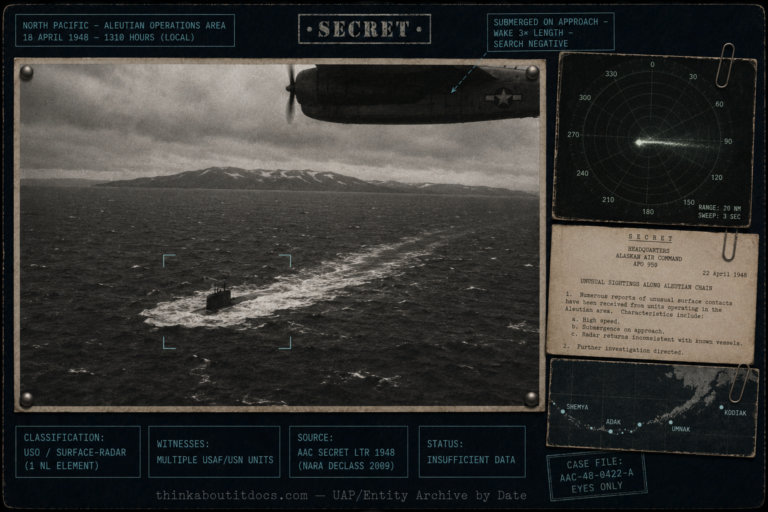
1945 — Aleutian Islands, past Adak. Fourteen crewmen of the USAT Delarof watched a 150-to-250-foot dark sphere rise from the ocean, circle their ship, and depart, in one of the best-documented sea encounters of the WWII era.
THINK ABOUTIT UFO SIGHTINGS REPORT
1945: The USAT Delarof Sphere — Aleutian Islands
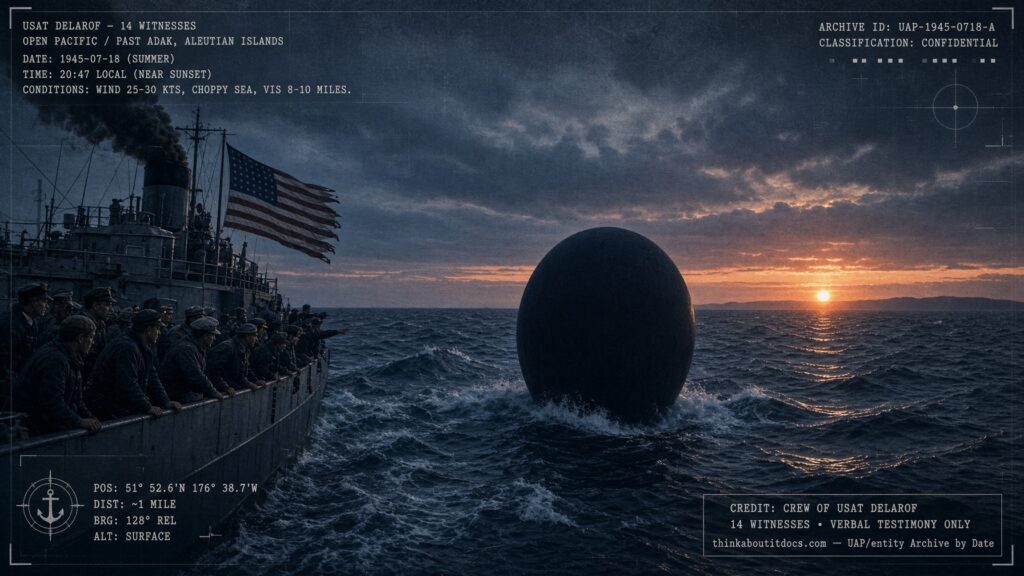
A dark, massive sphere rose out of the North Pacific a mile off a troop transport’s bow, climbed straight up, arced into level flight, and circled the ship while fourteen sailors watched and the gun crews held their fire. It’s one of the best-documented military-adjacent sea encounters of 1945 — a named witness, decades of follow-up investigation by two separate research organizations, and a consistent core account across every retelling. What isn’t consistent is the date, and this report addresses that directly rather than pretending it isn’t a problem.
Date: Uncertain — most reliably placed in summer 1945; also cited as March 1945 in some secondary compilations (see Researcher’s Notes)
Sighting Time: Near sunset
Day/Night: Dusk
Location: Open Pacific waters past Adak, Aleutian Islands, Alaska Territory — aboard the U.S. Army Transport Delarof, en route to Seattle
Urban or Rural: Not applicable — open ocean
No. of Entity(s): Not Applicable
Entity Type: Not Applicable
Entity Description: Not Applicable
Hynek Classification: CE-I — Close Encounter of the First Kind. The object approached to close range (within easy gun range of the ship, by the witness’s own account) and was observed in clear detail by multiple witnesses, but produced no landing, physical trace, or occupant sighting.
Duration: Several minutes, encompassing the object’s emergence, climb, arc into level flight, multiple circuits of the ship, and departure
No. of Object(s): 1
Description of the Object(s): A large, dark, spherical object. It was first seen emerging directly from the surface of the ocean roughly a mile from the ship, silhouetted darkly against the setting sun. It climbed almost vertically for a few moments, then arced smoothly into level flight and circled the Delarof two or three times at close range, moving with no audible sound. Witness Robert S. Crawford estimated its diameter at 150 to 250 feet, based on comparison with the width of a finger held at arm’s length. All observers believed the object to be self-propelled, reasoning that the prevailing strong winds would otherwise have visibly affected its movement, which they did not.
Shape of Object(s): Spherical
Size of Object(s): Estimated 150 to 250 feet in diameter
Color of Object(s): Dark, appearing black in silhouette against the setting sun
Distance to Object(s): Emerged roughly one mile from the ship; closed to well within range of the ship’s guns while circling
Height & Speed: Climbed nearly vertically from the ocean surface before leveling off; speed not numerically estimated, but described as smooth and controlled rather than erratic
Number of Witnesses: 14 — crew of the USAT Delarof, including radioman Robert S. Crawford, the primary reporting witness
Special Features/Characteristics: The object emerged directly from beneath the ocean surface rather than descending from the sky — a USO (unidentified submerged object) characteristic distinct from most aerial cases in this archive; despite the object coming within easy gun range, the ship’s crew held fire throughout, remaining on high alert but never engaging; three flashes of light were reported at the point on the horizon where the object finally disappeared; an official report on the incident was reportedly forwarded to Washington, though this archive has not independently located that document.
Case Status: Unexplained
Source: Robert S. Crawford, witness account, as recorded by Prof. N.N. Kohanowski (University of North Dakota, NICAP consultant) and later investigated directly by Dr. James E. McDonald (University of Arizona physicist) in 1967; published in UFO Investigator (NICAP), Vol. 4, No. 5, March 1968; Richard Hall, The UFO Evidence, NICAP, 1964; Jacques Vallée, Passport to Magonia, 1969, p. 190; Ivan T. Sanderson, Invisible Residents, 1970, pp. 35-36; Janet and Colin Bord, Unexplained Mysteries of the 20th Century, 1989, p. 169
Related Cases: 1945: January UFO & Entity Sightings Archive | 1945: March UFO & Entity Sightings Archive | 1945: June UFO & Alien Sightings (same case, dated “Summer, 1945” — see Researcher’s Notes)
Detailed Report
The USAT Delarof was a workhorse of the wartime Aleutian supply and evacuation effort, ferrying munitions, supplies, and — earlier in the war — displaced Aleut villagers between Alaska Territory ports. On the voyage central to this case, the ship was in open water past Adak, homeward bound for Seattle, when the encounter occurred near sunset.
Radioman Robert S. Crawford was near the radio room on the port side when he heard shouting from other crewmen. Turning, he saw a large, dark, round object that had just emerged directly from the ocean surface, roughly a mile from the ship. Several crewmen reported watching it actually break the surface of the water. The object climbed almost straight up for a few moments before leveling into smooth horizontal flight, then began circling the Delarof — by most accounts two or three complete circuits — at a distance close enough to bring it well within range of the ship’s deck guns.
Despite that proximity, and despite remaining on tight alert for any sign of hostile intent, the gun crews held their fire throughout the encounter. Witnesses described the object’s motion as smooth and unaffected by the strong prevailing winds of the area, leading the crew to conclude it was under its own power rather than being some form of drifting device. After several minutes, the object moved off toward the south or south-southwest and disappeared; three flashes of light were seen from the direction it had gone. Crawford, comparing the object’s apparent size to the width of a finger held at arm’s length, later estimated its diameter at 150 to 250 feet — a very large object by any standard, roughly comparable in scale to a small ocean vessel.
The case did not become widely known until Crawford, then a geology student at the University of North Dakota, related the story to Professor N.N. Kohanowski, a NICAP consultant, years after the war. NICAP subsequently investigated and published the account. In 1967, physicist Dr. James E. McDonald of the University of Arizona — a scientist who personally investigated numerous UFO reports under university grant — conducted his own interview with Crawford, by then a professional geologist, adding a second independent layer of investigation to the case decades after the original event.
RESEARCHER’S NOTES
One Case, Three Dates — Untangling the Delarof’s Place in This Archive
- On the dating problem, stated plainly: This site currently carries this same core account — 14 witnesses, dark sphere, Aleutian Islands, USAT Delarof — under three separate months: an undated “1945” entry on the January archive, a “Mar. 1945” entry on the March archive, and a “Summer, 1945” entry on the June archive. These are not three separate sightings; they are one case that has accumulated inconsistent dating across the secondary UFO literature this archive draws from. The earliest and most rigorously sourced material — Crawford’s own account as recorded by NICAP and independently investigated by Dr. James McDonald — consistently places the event during the ship’s return voyage to Seattle in the summer of 1945, which is the dating this report treats as most reliable.
- On where the March date likely came from: The March dating on this archive traces to a citation of “Magonia #54,” a secondary UFO-history compilation. Compilations of this kind sometimes carry forward transcription or indexing errors from earlier digests without independently re-verifying the original source material. Given that every account tracing back to Crawford himself — the only named, interviewed witness — places the sighting in summer, the March date appears to be exactly this kind of downstream error rather than an independent, differently-dated sighting.
- On why the case is unusually well-attested despite the date confusion: Setting the dating problem aside, this is one of the stronger sea-based cases from 1945: a named, identifiable witness who was later a credentialed professional (geologist), independent investigation by two different research bodies across roughly a 20-year span (NICAP in the 1960s, McDonald’s follow-up interview in 1967), and a consistent, physically specific core account — object emerges from water, climbs, circles, departs — that didn’t drift or embellish significantly between tellings. The uncertainty here is about when it happened, not really about whether something happened.
- On the “USO” classification: An object emerging from beneath the ocean surface before taking flight is a recurring but relatively rare category in wartime UFO reports, more commonly associated with later Cold War-era sightings near naval installations. The Delarof case is among the earliest well-documented examples of this specific pattern — object surfaces from water, then flies — in the WWII-era record this archive covers.
Whatever rose out of the Pacific that evening past Adak, it did so in full view of fourteen men, held formation around their ship for several minutes, and left without incident. Robert Crawford carried the story for over twenty years before anyone with a research organization thought to ask him about it directly — and when they did, in two separate decades, he told it the same way both times. The date this archive has attached to the case has moved around. The account itself has not.
“As it circled the Delarof, the flying object was in easy range of the ship’s guns. But the gun crews held their fire, though on tight alert for any sign of hostility.”
NICAP investigation of Robert S. Crawford’s account, UFO Investigator, Vol. 4, No. 5, March 1968.