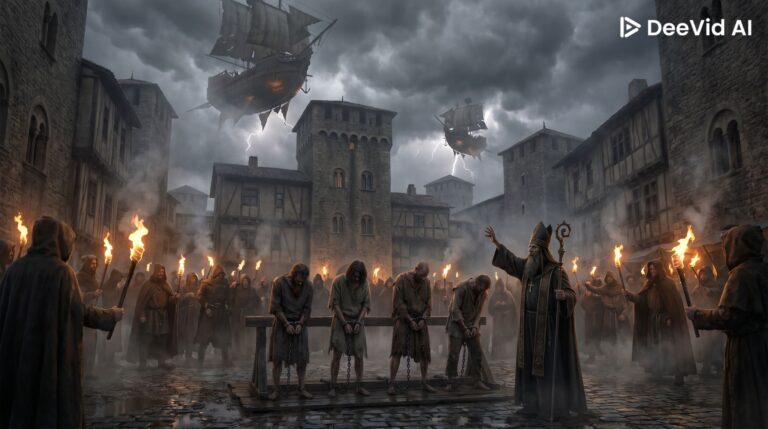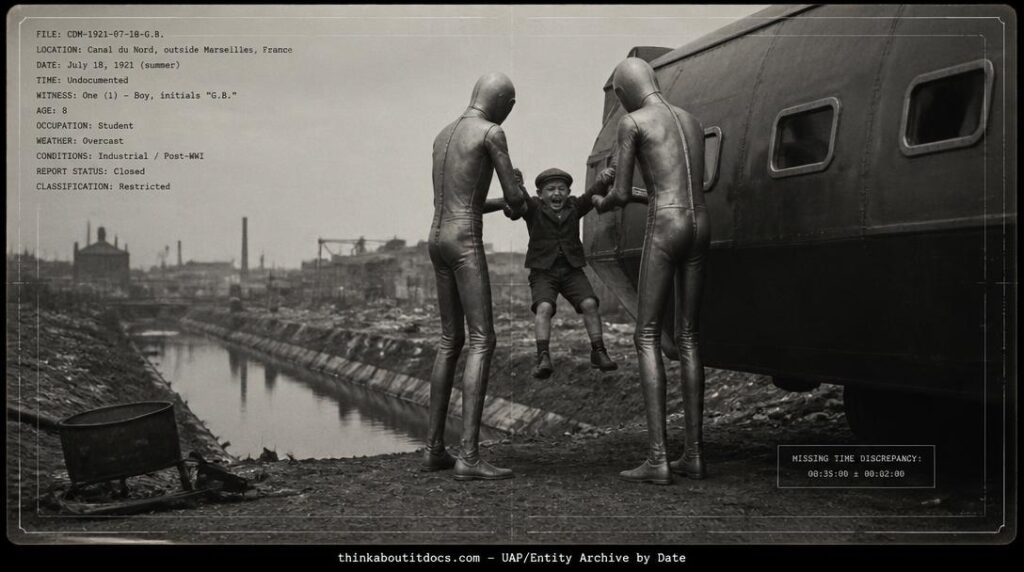
Canal du Nord, outside Marseilles, 1921 — eight-year-old "G.B." recalled being taken aboard a craft by two tall, slim, metallic-suited beings, as later described in a 1954 Paris Match letter.
THINK ABOUTIT UFO|UAP | ENTITY ENCOUNTER REPORT
Marseilles France 1921: Canal du Nord Child Abduction, CE-IV
Sometime in the summer of 1921, an eight-year-old boy wandering the slag heaps and war-waste canal country outside Marseilles was seized by two very tall, very slim beings in flexible metallic suits and hoisted into a craft he first mistook for an armored tank — and released, minutes later by his own account, only to find that an afternoon had somehow passed on the walk back to a path he remembered leaving five minutes before. The story did not surface until 1954, in a reader’s letter to Paris Match written in the vocabulary of that year’s French flying-saucer wave, and that thirty-three-year gap between event and record is the case’s central evidentiary problem — one this report addresses directly rather than obscuring behind the vivid physical detail.
Date: 1921 (specific date undocumented; retrospective account places it in a “very hot year,” consistent with summer)
Sighting Time: Undocumented (daytime)
Day/Night: Day
Location: Along the Canal du Nord, outside Marseilles, France
Urban or Rural: Rural/industrial-waste periphery — a post-WWI landscape of slag heaps and canal channels the witness describes as “quasi-lunar”
No. of Entity(‘s): 2
Entity Type: Humanoid, unidentified
Entity Description: Very tall, very slim; covered head to foot in flexible, metallic-appearing diving-suit-type coverings; no facial or anatomical detail remembered by the witness
Hynek Classification: CE-IV (Close Encounter of the Fourth Kind — abduction)
Duration: Undocumented for the abduction itself (“a few minutes” per the witness); missing time of several hours between the witness’s subjective experience and his return to the path
No. of Object(s): 1
Description of the Object(s): A craft initially mistaken by the witness for an armored war vehicle (“tank”) of unusual form; cabin fitted with rectangular portholes and a flexible couch; an opening appeared in the cabin ceiling to release the witness
Shape of Object(s): Undocumented beyond “curious form,” tank-like in first impression
Size of Object(s): Undocumented
Color of Object(s): Undocumented
Distance to Object(s): Close range — witness was physically taken aboard
Height & Speed: Undocumented
Number of Witnesses: 1 (the boy, identified only as “G.B.”)
Special Features/Characteristics: Missing time (subjective “few minutes” versus an actual afternoon’s absence); rectangular rather than round portholes; a soft/flexible cabin interior; the entities’ apparent response to the child’s distress, releasing him after he began crying
Case Status: Insufficient Data. The account is single-witness and was not recorded until 33 years after the alleged event, in language drawn from the cultural vocabulary of its recording date rather than 1921.
Source: Paris Match, October 23, 1954 — primary source, a reader’s letter submitted by Mr. G.B. of Marseilles. Subsequently catalogued by Guy Quincy in a personal typewritten archive and referenced in Magonia #43, which had previously been listed on this archive’s index page as the case’s primary citation — a source-chain error corrected here to reflect Paris Match as the actual point of origin.
Summary/Description: In the summer of 1921, eight-year-old “G.B.” was wandering the war-waste and slag-heap terrain along the Canal du Nord outside Marseilles when two very tall, very slim beings in flexible metallic diving-suit-type coverings emerged from the undergrowth and lifted him toward a craft he initially mistook for an armored tank. He was placed inside a cabin with rectangular portholes and a soft couch. After he began crying, an opening appeared in the cabin ceiling and he found himself back on the ground. He then had to walk most of the afternoon to return to the path he recalled leaving only five minutes earlier. He arrived home at nightfall and was called a liar by his parents; the account went unrecorded until his 1954 letter to Paris Match.
Related Cases: 1921: UFO|UAP & Alien Sightings Archive
Detailed Report
The case as it exists in ufological literature has circulated for decades under a misleading source citation. This archive’s index page previously listed “Magonia #43, Quincy” as the case’s origin — treating Guy Quincy’s personal typewritten archive and its brief mention in the journal Magonia as though they were the primary record. URECAT research corrects this: the actual primary document is a reader’s letter published in Paris Match on October 23, 1954, written by the adult “G.B.” recounting an experience he says occurred in 1921, when he was eight. Quincy’s archive and the Magonia notation are downstream citations of that letter, not independent sources. This is not a minor bibliographic correction — it changes how the case should be read. A thirty-three-year gap between event and first record means the account is filtered entirely through the adult witness’s memory and through the specific vocabulary available to a French magazine reader in 1954, at the height of that year’s French flying-saucer wave.
That vocabulary problem is visible in the letter itself — “saucer,” “machine,” terms that an eight-year-old in 1921 would not have had cultural access to, since the modern saucer era did not begin until Kenneth Arnold’s 1947 sighting. What the 1954 framing cannot as easily manufacture, however, are the specific behavioral and physical details that don’t map cleanly onto 1950s saucer-lore conventions: rectangular rather than the more commonly reported round portholes, a flexible rather than rigid cabin interior, missing time measured in hours rather than the “twenty minutes gone” pattern typical of later abduction narratives, and the detail of the entities appearing to respond to the child’s crying by releasing him. None of these are stock elements of 1954 saucer reporting, which argues against the entire account being freely invented from that year’s available cultural material — while not resolving the deeper problem that this is still a single uncorroborated childhood memory, recorded decades after the fact, by an adult narrator whose own vocabulary has necessarily been shaped by the intervening years.
RESEARCHER’S NOTES
The Canal du Nord Case — 1921 and the Problem of Retrospective Testimony
- Source Chain Correction: The case’s actual point of origin is a 1954 Paris Match reader’s letter, not the Quincy/Magonia #43 citation this archive previously carried as primary. Quincy and Magonia are downstream references to the same letter. This correction does not invalidate the case but substantially changes its evidentiary standing — it is a 33-year retrospective account, not a contemporaneously catalogued 1921 report.
- Classification Rationale: CE-IV is assigned because the account describes physical removal of the witness into the craft, which meets the abduction threshold of the Hynek scale’s later extensions. This is among the earliest claimed abduction dates in the pre-1947 record if the 1921 dating is accurate, predating the Betty and Barney Hill case by four decades.
- Pattern Context: The 1954 recording date places this account’s language and publication context squarely within that year’s French flying-saucer wave, one of the most intense regional UFO waves of the pre-modern era. Retrospective childhood memories surfacing during active waves are a recognized pattern in the literature, where a real or imagined earlier experience gets recontextualized and vocabulary-updated by the surrounding cultural moment at time of telling.
- Evidentiary Weight: Single witness, no contemporaneous record, no named investigator, and a 33-year gap between event and documentation place this case at the low end of evidentiary strength despite its narrative vividness. The specific physical details that resist easy explanation as 1954-vocabulary invention (rectangular portholes, hours-scale missing time, entities responding to distress) are noted as points of interest rather than proof, since an adult’s genuine but imperfect childhood memory could produce these same details without requiring an anomalous origin.
The Marseilles case stands as this archive’s clearest illustration of why source-chain work matters as much as the content of a report. Corrected to its actual origin — a 1954 letter recalling a 1921 childhood event — it remains a genuinely striking pre-contamination-era abduction account, but one whose evidentiary weight is inseparable from the three decades of memory and cultural vocabulary that separate the boy on the canal bank from the man who finally wrote it down.
“I was undoubtedly too much upset. I remember only two details: there were square or at least rectangular portholes. The cabin had a kind of flexible couch on which I had sat. The two beings were very tall and very slim.”
Mr. G.B. of Marseilles, Paris Match reader’s letter, October 23, 1954, describing his 1921 encounter