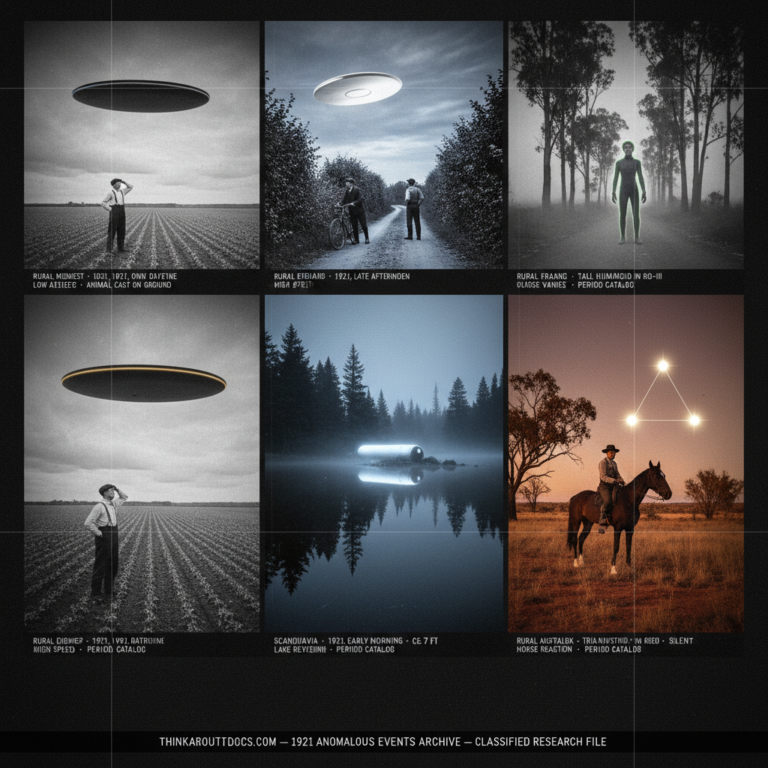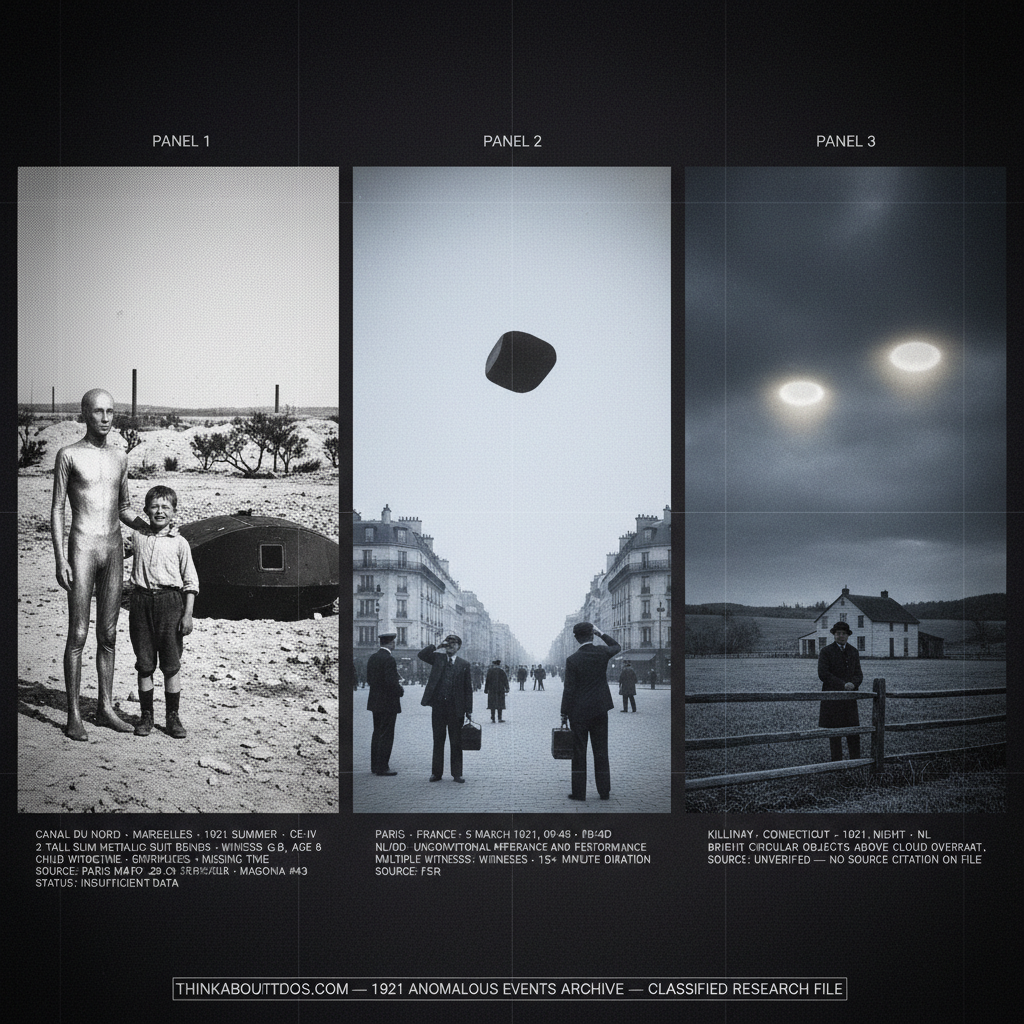
1921 anomalous events archive: Marseilles Canal du Nord CE-IV child abduction by two tall slim metallic-suited beings with missing time (Paris Match 1954 reader's letter, 33 years retrospective; Quincy catalogue; Magonia #43), Paris France multi-witness 15-minute NL observation March 5 1921 (FSR), and Killingly Connecticut nocturnal circular lights above overcast (source unverified). Three confirmed cases; restoration priority year.
1921: UFO|UAP & Entity Sightings Archive
The year 1921 is the leanest in the 1920–1929 series — six entries total, three of them currently undocumented placeholders, and no individual report pages linked prior to this correction. What the page lacks in volume it partially compensates for in narrative depth: the Marseilles, France entry is one of the most vivid child-abduction accounts in the pre-1947 European record, and it carries a source chain that requires careful editorial attention. The post-WWI industrial landscape near Marseilles — slag heaps, canal channels, war-waste terrain described in the account as “quasi-lunar” — provides an unusually precise environmental context. Eight-year-old “G.B.” was wandering the slopes of the Canal du Nord when two tall, thin beings in flexible metallic diving suits emerged from the undergrowth and hoisted him into a craft he initially mistook for a war tank. He was released after crying; walked most of the afternoon before returning home; arrived at nightfall; was called a liar by his parents. The missing-time element — “five minutes earlier” on the path becoming an afternoon’s walk — is documented in the account. The being description: very tall, very slim, metallic diving suits, no remembered facial details. The craft interior: rectangular portholes, a flexible couch. This report would be unremarkable in the post-1947 abduction literature. In 1921, with no cultural template for it whatsoever, it is anomalous.
The page’s editorial situation is the most challenging in the 1920–1929 series. The Marseilles entry’s source as previously listed — “Magonia #43, Quincy” — was a secondary compile from Guy Quincy’s typewritten personal archive and its brief notation in Magonia journal. URECAT research confirms the actual primary source is a reader’s letter submitted to Paris Match and published October 23, 1954 — written thirty-three years after the alleged event, during the height of the 1954 French flying saucer wave. That does not invalidate the case, but it substantially changes its evidentiary weight, and the corrected entry below now conveys that source chain directly. Three of the page’s six entries (Dunbar, Nebraska; Alberta, Canada; Puerto Natales, Chile) are catalogue citations without retrievable summary content — Eberhart’s, Hall’s, and Rosales’ print catalogues are not independently searchable from this archive’s available research tools, so these entries are logged as Insufficient Data pending primary-source retrieval rather than filled with invented detail. The Killingly, Connecticut entry carries no source at all and is flagged accordingly.
Date: 1921
Location: Dunbar, Otoe County, Nebraska
Time: Unknown
Summary: Insufficient Data — detail pending primary retrieval. This entry is catalogued by Eberhart but no summary detail is currently available to this archive; the print source has not been independently located to confirm the nature of the report.
Source: Eberhart, George M., A Geo-Bibliography of Anomalies, Greenwood Press, Westport, 1980, ISBN: 0-313-21337-2
Date: 1921
Location: Marseilles, France
Time: Unknown
Summary: Eight-year-old “G.B.” was wandering the post-WWI industrial wasteland along the Canal du Nord outside Marseilles when two tall, slim beings in flexible metallic diving suits emerged from the undergrowth and lifted him toward what he first believed was an armored war vehicle. He was released after crying, an opening appearing in the cabin ceiling; he found himself back on the ground but had to walk most of the afternoon to reach a path he recalled leaving only “five minutes earlier.” He arrived home at nightfall and was disbelieved by his parents. Craft interior: rectangular portholes, a flexible couch. CE-IV (abduction). Full standalone report available.
Source: Paris Match, October 23, 1954 (reader’s letter from Mr. G.B. of Marseilles) — primary source, 33-year retrospective account, written during the 1954 French flying saucer wave. Subsequently catalogued by Guy Quincy (personal typewritten archive) and referenced in Magonia #43. Case Status: Insufficient Data. | linked individual report page
Date: 1921
Location: Alberta, Canada
Time: Unknown
Summary: Insufficient Data — detail pending primary retrieval. This entry is catalogued by Hall but no summary detail is currently available to this archive; the print source has not been independently located to confirm the nature of the report.
Source: Hall, Richard H., From Airships to Arnold: A Preliminary Catalogue of UFO Reports in the Early 20th Century (1900–1946), UFO Research Coalition, Fairfax, 2000, ISBN: 1-928957-01-3
Date: 1921
Location: Killingly, Connecticut
Time: Night
Summary: Bright circular UFOs seen above a cloud overcast at night.
Source: ⚠ UNSOURCED: this entry carries no citation of any kind and could not be independently corroborated. Retained on the page as a historical entry but should not be treated as verified pending a source being located.
Date: March 5, 1921
Location: Paris, France
Time: 09:45
Summary: An unusual object was sighted, that had unconventional appearance and performance. One object was observed by several witnesses in a city for over 15 minutes. Minimal detail beyond basic observation parameters. Multi-witness; 15-minute duration over a major European city is notable. NL/DD classification.
Source: FSR (Flying Saucer Review) | Source Status: VERIFIED
Date: Spring/Summer 1921
Location: Puerto Natales, Magallanes Region, Chile
Time: Unknown
Summary: Insufficient Data — detail pending primary retrieval. This entry is catalogued by Rosales but no summary detail is currently available to this archive; the print source has not been independently located to confirm the nature of the report.
Source: Rosales, Albert, Humanoid Encounters catalogue (pre-1947 volume); cross-check Hall, Richard H., From Airships to Arnold, UFO Research Coalition, 2000
EXECUTIVE SUMMARY
The Thin Year — 1921 and the Post-War Documentation Gap
**The Canal du Nord and the Source Problem — 1921’s Anchor Case**
The 1921 archive is the thinnest year page in the 1920–1929 series, and the thinness reflects a genuine gap in the documentation record rather than an absence of anomalous events. The post-war years of 1920–1922 coincide with a period of significant economic disruption across Europe and North America — the post-war recession, labor unrest, and the social instability of the early Roaring Twenties — during which local newspaper coverage of unusual aerial phenomena was significantly compressed by the volume of more immediately pressing news. What survived entered research catalogues through exactly the mechanism illustrated by the Marseilles case: retrospective personal testimony submitted to newspapers or researchers decades after the event, filtered through the cultural vocabulary of whichever era the account was finally written down in. The Marseilles G.B. case, written as a Paris Match reader’s letter in October 1954, is framed entirely in the 1954 French flying saucer vocabulary — “saucer,” “machine,” “diving suits” — which the eight-year-old boy of 1921 would not have had available. That linguistic retrospective framing is the case’s fundamental evidentiary problem, and the page presents it honestly.
What survives the source scrutiny is still analytically interesting. The physical details reported — very tall, very slim beings, metallic flexible suits with no apparent fastening or features, a craft interior with rectangular portholes and a soft couch, missing time on a scale of several hours from a transition that felt like five minutes — are consistent with the pre-contamination encounter archetype in ways that the 1954 saucer-era vocabulary overlay cannot entirely explain away. A child making up a story in 1954 from available cultural material would not necessarily have generated missing time, rectangular rather than round portholes, or the specific detail of crying and being released. That behavioral specificity — the beings responding to distress — is an anomalous pattern element. The March 5, 1921 Paris observation adds a multi-witness urban NL case with 15-minute duration to the year’s thin European record. Three of the page’s remaining entries — Dunbar, Nebraska; Alberta, Canada; and Puerto Natales, Chile — are logged as catalogue citations pending primary-source retrieval rather than expanded with invented content, and the Killingly, Connecticut entry is flagged as unsourced. This page remains a restoration priority: when Eberhart 1980, Hall 2000, and Rosales’ catalogue can be consulted directly, the three pending entries should be completed from those primary texts rather than left standing indefinitely.
From the Marseilles, France entry (1921), primary source: Paris Match, October 23, 1954, reader’s letter from Mr. G.B. of Marseilles:
“I was undoubtedly too much upset. I remember only two details: there were square or at least rectangular portholes. The cabin had a kind of flexible couch on which I had sat. The two beings were very tall and very slim.”
Mr. G.B. of Marseilles, Paris Match reader’s letter, October 23, 1954, describing his 1921 encounter