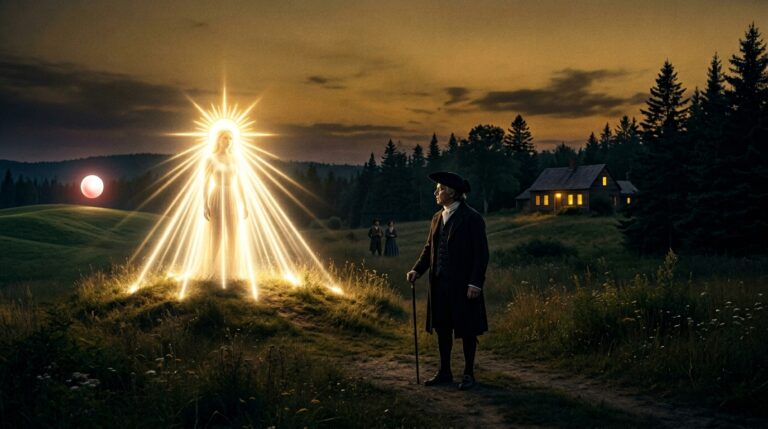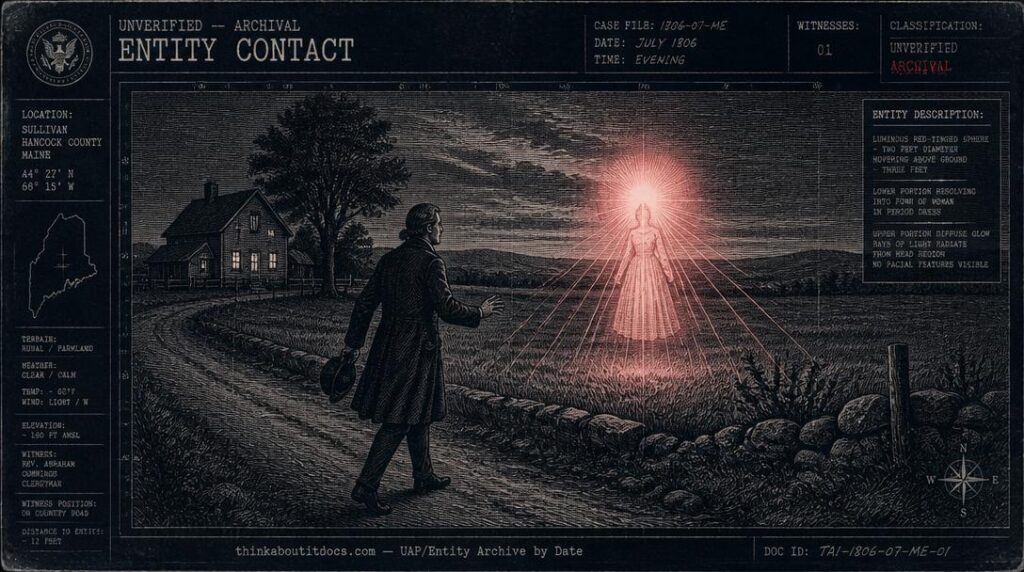
The July 1806 Sullivan, Maine encounter — Rev. Abraham Cummings watched a luminous globe rise from the ground, close distance at high speed, and transform through two size changes into a radiant female humanoid figure.
THINK ABOUTIT ENTITY ENCOUNTER REPORT
1806 Sullivan, Maine — The Nelly Butler Entity Encounter
In the winter of 1799, in the small coastal town of Sullivan, Maine, a young widower named George Butler began hearing rapping on the walls of his farmhouse cellar. Within weeks the sound had a voice, and the voice identified itself as his late wife, Eleanor “Nelly” Hooper Butler — dead three years, buried in Franklin, and now apparently unwilling to stay that way. What followed became one of the most extensively documented hauntings in early American history: thirty-one sworn eyewitness affidavits, a public meeting convened to address the “spectre,” and — in July 1806 — a face-to-face encounter with a traveling Calvinist minister who had come to the parish specifically to expose the whole affair as a hoax.
That minister was the Reverend Abraham Cummings, a Harvard-educated itinerant preacher, and his account of what happened to him on a country road outside Sullivan is the entry that anchors this case in the archive rather than in ghost-lore alone. Cummings did not merely hear a disembodied voice test his skepticism from the safety of a cellar. He watched a stationary white mass on the ground rise into the air, assume the form of a luminous red-tinged globe roughly two feet in diameter, accelerate toward him at high speed, shrink to child height, then expand to full adult stature with rectilinear rays of light streaming from its head to the ground — a transformation sequence he recorded in careful, almost clinical detail and later published under his own name.
Date: July 1806
Sighting Time: Evening
Day/Night: Night
Location: Sullivan, Hancock County, Maine, USA
Urban or Rural: Rural
No. of Entity(‘s): One
Entity Type: Humanoid — luminous female apparition
Entity Description: A globe of red-tinged light approximately two feet in diameter that transformed first into a child-sized female figure, then into a full-grown adult woman in a dress, with rectilinear rays of light emanating from the head and reaching to the ground
Hynek Classification: Not Applicable — non-craft entity contact, outside the standard Hynek close encounter scale
Duration: Not recorded — sequence described as occurring across several minutes (initial sighting, approach, and transformation)
No. of Object(s): Not Applicable
Description of the Object(s): Not Applicable
Shape of Object(s): Not Applicable
Size of Object(s): Not Applicable
Color of Object(s): Not Applicable
Distance to Object(s): Not Applicable
Height & Speed: Entity closed from approximately 12 ft to 11 ft distance from the witness at high speed before transforming
Number of Witnesses: One direct witness to this specific encounter (Rev. Abraham Cummings); part of a wider case with 31 sworn affidavits from separate incidents
Special Features/Characteristics: Progressive size-and-form transformation; rectilinear rays of light from the head reaching to the ground; entity closed distance under its own apparent volition
Case Status: Unexplained.
Source: Rev. Abraham Cummings, Immortality Proved by the Testimony of Sense (1826); Chris Aubeck, Return to Magonia; Marcus LiBrizzi & Dennis Boyd, The Nelly Butler Hauntings: A Documentary History (2010)
Summary/Description: The Reverend Abraham Cummings, having traveled to Sullivan, Maine to debunk widely circulated reports of a ghost haunting the Blaisdell family, was informed that two persons had seen what appeared to be a specter in a nearby field. Going to check ten minutes later, he first mistook a white mass on the ground for a rock. Three minutes on, he saw it had risen into the air as a red-tinged luminous globe roughly two feet across. It approached him at high speed to within eleven feet, took the form of a child-sized female figure, then expanded to adult height with rays of light streaming from its head to the ground. Others in the area independently reported a similar luminous female figure accompanied by a small glowing cloud.
Related Cases: 1800–1809: UFO|UAP & Alien Sightings Archive
Detailed Report
Nelly Hooper was born in 1774 to David and Joanna Hooper of Sullivan, Maine, one of seven children. In 1799 she married Captain George Butler and died within the year, in childbirth, along with her infant. Three days after her burial, residents in the cellar of the Blaisdell farmhouse — where Nelly had spent her final months — began hearing rapping sounds and a disembodied voice claiming to be hers. Fifteen-year-old Lydia Blaisdell heard it most often, and over the following years the voice, and eventually a visible luminous figure, appeared to dozens of townspeople, delivering messages, predictions, and instructions to family members.
The case grew contentious enough that Sullivan held a public meeting to address it, and thirty-one residents ultimately gave sworn affidavits describing what they had witnessed. Among the predictions attributed to the apparition: that Blaisdell’s wife and father would die, and that the widowed George Butler would remarry — specifically to Blaisdell’s daughter Lydia. Both reportedly came true. Nelly is said to have appeared at the wedding itself and predicted Lydia would be dead within ten months — a prediction that also came true, and which quieted local suspicion that Lydia had orchestrated the entire affair as a hoax, since the apparitions continued after her death.
The Reverend Abraham Cummings entered the story as a skeptic. Alarmed that so many of his congregation were treating the Blaisdell cellar as a shrine and the voice’s pronouncements as gospel, he traveled to Sullivan in July 1806 intending to debunk it. According to his own account, published two decades later in the pamphlet Immortality Proved by the Testimony of Sense, he was told that two people had seen what appeared to be a specter in a nearby field. Ten minutes later he went to check the field himself. At first, looking toward a rise roughly twelve feet from the house, he saw what he took to be a white rock on the ground and dismissed it. Three minutes later he glanced back — the “rock” was now hovering in the air, a complete globe with a reddish tincture, about two feet in diameter.
Curious rather than afraid, Cummings walked toward it. The globe closed the distance instead, approaching to within eleven feet of him at very high speed. It then instantly took the form of a woman’s dress, though no taller than a seven-year-old girl. Cummings later wrote that as he studied it, he thought to himself that it was not tall enough to be the woman who had so frequently appeared to others in the area — and immediately the figure grew to the height of a full-grown woman. The entity appeared, in his words, glorious, with a representation of the sun on its head from which luminous rectilinear rays extended in every direction, reaching to the ground. Through the glow he could make out the form of a woman in a dress. Others in the area reported seeing a similar figure accompanied by a small luminous cloud.
Cummings’ pamphlet is widely credited by modern researchers — most substantially Marcus LiBrizzi of the University of Maine at Machias, who tracked down the rare surviving text and, with researcher Dennis Boyd, located the Butler and Hooper family gravestones and confirmed Sullivan (not the frequently misattributed Machiasport) as the site of the haunting — as the first extensively documented ghost account in American history, predating the Fox sisters and the rise of 19th-century Spiritualism by more than four decades.
RESEARCHER’S NOTES
The Sullivan Transformation — Maine 1806 and the Anatomy of a Light-Based Entity
- Classification Issues: This case does not fit neatly onto the Hynek scale, which was built for craft-and-occupant encounters rather than light-based apparitions with no associated vehicle. It is filed here as an entity encounter rather than a UFO sighting, consistent with archive policy for entity-only cases. The transformation sequence itself — inert light, mobile globe, size distortion, humanoid stabilization, cephalic luminosity — is the more useful classification handle than any Hynek tier.
- Source Chain Assessment: Cummings’ pamphlet was not published until 1826, twenty years after his own July 1806 encounter and twenty-seven years after the haunting began. That gap does not disqualify the account — Cummings was writing as a named, credentialed clergyman defending a specific position — but it belongs in any serious assessment. The wider case is unusually well-anchored for its era: thirty-one separate sworn affidavits, a documented public meeting, and 21st-century genealogical confirmation of the family plots by LiBrizzi and Boyd.
- Pattern Context: The transformation progression Cummings describes recurs across entity literature far outside the 19th-century New England ghost tradition, and is part of why this case appears in Chris Aubeck’s Return to Magonia alongside more conventionally classified aerial and entity anomalies rather than in purely folkloric or religious-apparition collections. Notably, Cummings’ firsthand account does not use overtly religious framing — unusual for a clergyman describing a luminous humanoid figure, and decades before Marian apparition accounts (Lourdes, Fatima) became a common interpretive lens for this kind of phenomenon. Cummings’ own conclusion was that he had witnessed proof of the soul’s immortality, not a divine visitation — a distinction worth preserving rather than smoothing over.
- Geographic and Historical Context: Sullivan was a small, isolated coastal frontier settlement in 1806, recently incorporated and thinly populated. The scale of documented public involvement — a formal town meeting, dozens of named affidavit-givers — is unusual for a community of its size and period, and argues against the case being the invention of a single family, even as it leaves the underlying cause open.
The Nelly Butler haunting is generally filed under American ghost-lore, and rightly so in most of its particulars — it is fundamentally a story about grief, small-town social pressure, and a family’s need to make sense of two sudden deaths. But Abraham Cummings’ July 1806 encounter, read on its own terms, is a first-hand, named-witness account of a light-based entity performing a size-and-form transformation sequence that would not look out of place in a 20th-century close-encounter report. Whatever it was, it convinced a skeptical, educated clergyman who went to Sullivan specifically to end the story — and instead spent the rest of his life defending it.
“Immediately she grew up as large and tall as what a normal woman would be… on her head was the representation of the sun diffusing the luminous, rectilinear rays all around.”