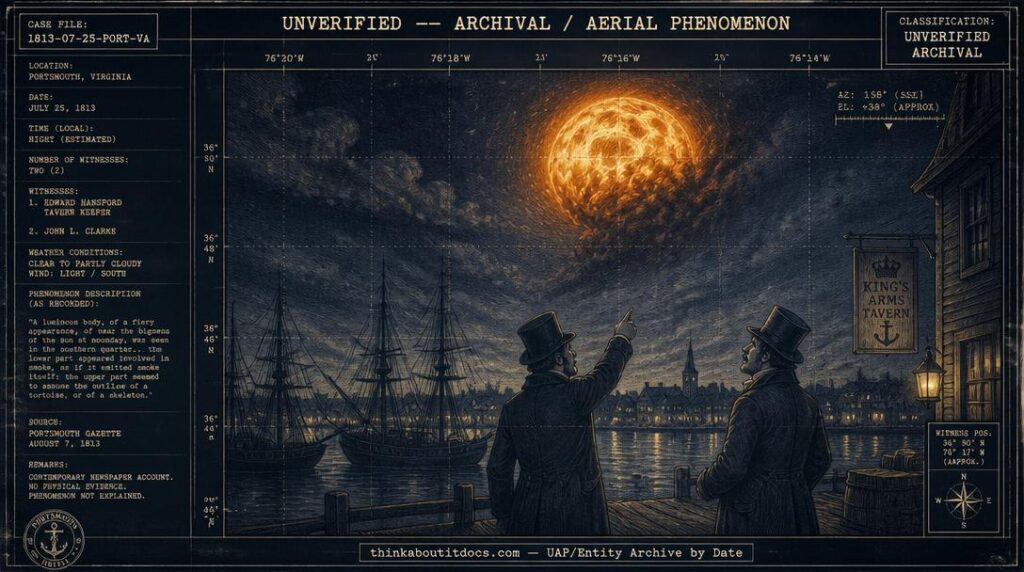
The July 25, 1813 Portsmouth, Virginia fireball — witnessed by Edward Hansford and John L. Clarke, who wrote to Thomas Jefferson describing an object that transformed into a turtle, a human skeleton, and a Scotch Highlander before vanishing.
THINK ABOUTIT UFO|UAP SIGHTINGS REPORT
July 25, 1813: Portsmouth, Virginia — The Shape-Shifting Fireball Letter to Thomas Jefferson
On the night of July 25, 1813, two men in Portsmouth, Virginia watched a ball of fire the apparent size of the noonday sun hang in the southern sky and, over some unspecified span of time, change shape four separate times — first a turtle, then a human skeleton, then a Scotch Highlander dressed for battle — each transformation punctuated by the object obscuring itself in smoke of its own making before reappearing in its new form. Unsatisfied with keeping the account to themselves, the two witnesses did something almost no one else in this archive’s 19th-century record did: they wrote a formal letter to the sitting former President of the United States asking him, as a man of science, what he thought it was.
The letter survives. It sits today in the Thomas Jefferson Papers at the Library of Congress, digitized and searchable through the National Archives’ Founders Online project — making this one of only a handful of pre-Civil War American UAP accounts with an unbroken, verifiable paper trail from a named witness’s own hand to a national archival collection. Jefferson, so far as the historical record shows, never wrote back.
Date: July 25, 1813
Sighting Time: Night (exact hour not recorded)
Day/Night: Night
Location: Portsmouth, Virginia, USA
Urban or Rural: Urban (port town)
No. of Entity(‘s): Not Applicable — no independent entity, though the object took a humanoid shape at two stages
Entity Type: Not Applicable
Entity Description: Not Applicable — see Description of the Object(s) for the humanoid-form stages
Hynek Classification: NL
Duration: Not precisely recorded — described as sustained across multiple distinct phases, with individual obscuring/smoke intervals of roughly ten minutes each
No. of Object(s): One
Description of the Object(s): A ball of fire that repeatedly obscured itself in self-emitted smoke and re-emerged in a new form each time: first retaining its original brilliant round form with visible agitation, then taking the shape of a turtle, then a human skeleton, then finally “a Scotch Highlander arrayed for battle,” before disappearing to the west in its own smoke
Shape of Object(s): Sequential — sphere, turtle, human skeleton, armed Highlander figure
Size of Object(s): Described as “full as large as the sun at Maridian [meridian]”
Color of Object(s): Fire/flame-colored, with self-generated smoke periodically obscuring it
Distance to Object(s): Not recorded — observed in the southern sky at altitude
Height & Speed: Descended obliquely to the west, then rose again perpendicular to a peak elevation of roughly 75 degrees
Number of Witnesses: Two — Edward Hansford and John L. Clarke
Special Features/Characteristics: Repeated, sequential shape transformation through four distinct forms; self-obscuring smoke emitted from the object’s own body between each transformation; oblique descent and perpendicular re-ascent to a consistent elevation
Case Status: Unexplained.
Source: Edward Hansford and John L. Clarke to Thomas Jefferson, 31 July 1813, The Thomas Jefferson Papers, Retirement Series, Founders Online, National Archives (original held at the Library of Congress)
Summary/Description: Edward Hansford, a Portsmouth tavern keeper, carpenter, and the district’s former harbormaster, and John L. Clarke of Baltimore, wrote to Thomas Jefferson six days after witnessing a ball of fire “full as large as the sun at Maridian” in the southern sky. The object was repeatedly obscured by smoke it appeared to emit from its own body, and each time it reappeared it had taken a new form: first still round but visibly agitated, then a turtle, then a human skeleton, and finally a Scotch Highlander arrayed for battle. It descended obliquely west and rose again to about 75 degrees elevation between transformations, before finally disappearing to the west in its own smoke. The two men, describing themselves as having “very high respect & esteem” for Jefferson, asked for his opinion on the phenomenon as a matter of natural philosophy. No response from Jefferson has been located in the historical record.
Related Cases: 1810–1824: UFO|UAP & ENTITY SIGHTINGS ARCHIVE
Detailed Report
Edward Hansford was a well-established figure in Portsmouth, Virginia by 1813 — a tavern keeper (proprietor of the Washington Tavern), carpenter, and joiner who had served as harbormaster for the Norfolk and Portsmouth district since roughly 1805, and who had worked on Commonwealth-built fortifications during the Revolutionary War. He was not, by any measure, a fringe or anonymous witness. His co-signatory, John L. Clarke, was a resident of Baltimore.
On July 31, 1813, the two men wrote jointly to Thomas Jefferson at Monticello, addressing him as “most honorable Sir” and “most earnestly” soliciting his opinion on what they called an “extraordinary Phenomenon.” According to their account, at an unspecified hour on the night of July 25, they saw in the south “a Ball of fire full as large as the sun at Maridian.” Within the space of about ten minutes, the fireball was repeatedly obscured by smoke that appeared to emit from its own body, though it retained its brilliancy and form throughout — described as showing “apparent agitation” during this phase.
The object then assumed the form of a turtle, itself agitated and periodically obscured by the same kind of smoke. It descended obliquely to the west, then rose again perpendicular to its original height — given as approximately 75 degrees of elevation. At this point it assumed the shape of a human skeleton, again periodically obscured and again alternately descending and ascending. Finally, the object took the form of “a Scotch Highlander arrayed for battle and extremely agitated,” before passing to the west and disappearing into its own smoke.
The original letter is held today in the manuscript collection of the Library of Congress and has been transcribed and made publicly searchable through the National Archives’ Founders Online project as part of the published Papers of Thomas Jefferson, Retirement Series. The document is endorsed in Jefferson’s own hand as received on September 14, 1813 — roughly six weeks after it was written. No reply from Jefferson to Hansford and Clarke has been located among his surviving correspondence.
RESEARCHER’S NOTES
The Jefferson Fireball — Virginia 1813 and the Limits of Period Explanation
- Classification Issues: This case is filed as NL (Nocturnal Light) on the Hynek scale despite its unusual structural detail, because the phenomenon never approached the witnesses, produced no landing or physical trace, and involved no craft-occupant interaction — the shape changes were observed at altitude and distance throughout. NL is an imperfect fit for an object this structurally active, but no better-suited tier exists on the standard scale for a distant, self-transforming light.
- Source Chain Assessment: This is one of the strongest source chains in the entire pre-1900 American archive. The letter is not a secondhand retelling, a newspaper reprint, or a folk memory recorded decades later — it is the original document, in the witnesses’ own era, addressed to a specific, identifiable, and famous recipient, preserved in an institutional archive with a documented provenance (Library of Congress holding, National Archives transcription, endorsed and dated by Jefferson himself upon receipt).
- Pattern Context: Multi-stage shape transformation in a single sustained sighting is unusual even within this archive’s broader fireball and meteor literature, which more commonly describes objects that split, merge, or change color rather than assume successive representational forms (turtle, skeleton, armed human figure). The self-emitted-smoke detail, repeated at each transition, is a distinctive and consistent behavioral signature across the account rather than a one-off flourish, which argues against casual embellishment in the retelling — whatever the two men saw, they described it the same way twice.
- Physical Evidence and Evidentiary Weight: No physical trace, debris, or secondary witness account has been identified. The case rests entirely on the two men’s joint testimony. Modern commentators have speculated about atmospheric sprites or upper-atmospheric electrical phenomena, but no explanation accounts cleanly for four sequential, representational shape changes rather than the more chaotic, non-figurative light patterns typical of sprites and similar transient luminous events.
Two ordinary Virginia men — a tavern keeper and a Baltimore acquaintance — watched something transform itself four times over their heads on a July night in 1813, and thought the matter serious enough to write to a former president and celebrated natural philosopher rather than let it pass as a tavern story. Jefferson, so far as anyone has found, never answered them. The letter outlived the silence — it sits in the National Archives today, one of the best-provenanced fireball accounts of its century, describing something that still has no tidy explanation.
“It then assumed the form of a Turtle… It then assumed the shape of a human skeleton… It then assumed the form of a Scotch Highlander arrayed for battle and extremely agitated, and ultimately passed to the West and disappeared in its own smoke.”