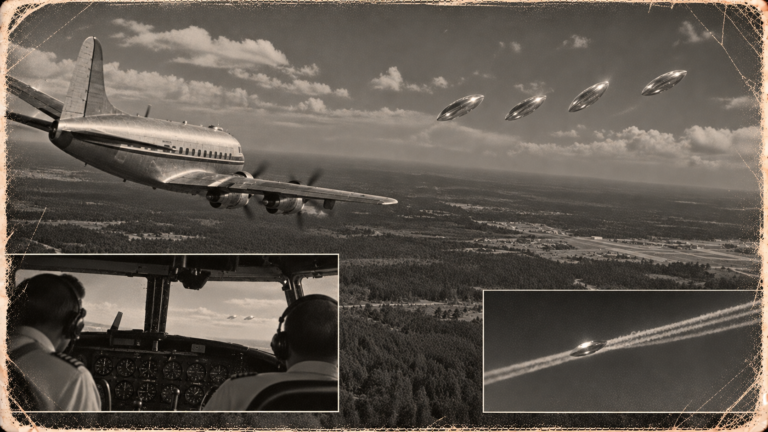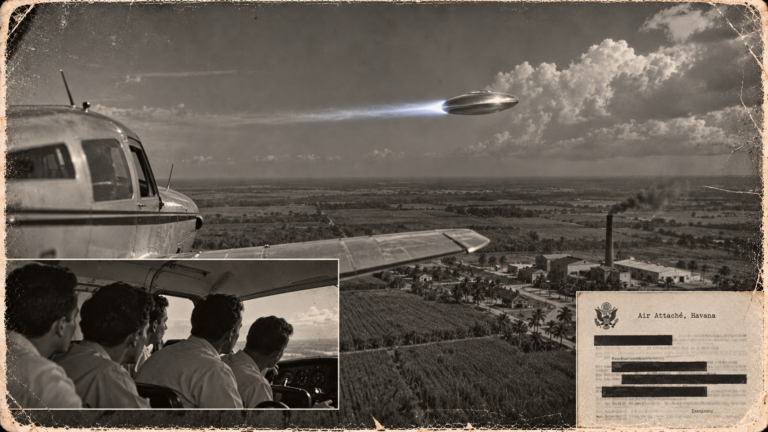
The August 12, 1825 Pacific fireball — witnessed by the entire middle watch of HMS Blonde and recorded by ship's naturalist Andrew Bloxam, who described a sun-sized, red-hot luminous body rising twice from the water before vanishing
THINK ABOUTIT UFO|UAP SIGHTINGS REPORT
1825: Pacific Ocean — Andrew Bloxam’s HMS Blonde Fireball
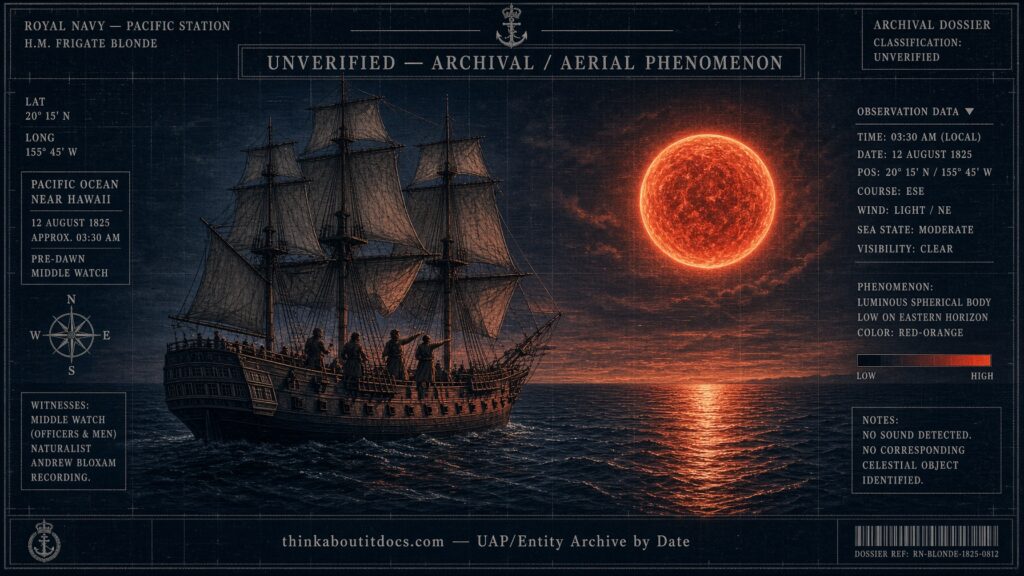
At half past three in the morning on August 12, 1825, the middle watch aboard the Royal Navy frigate HMS Blonde was startled to find everything around them suddenly lit up. Looking east, they watched a large, round, luminous body — the color of a red-hot cannon shot, roughly the apparent size of the sun — rise some seven degrees from the water toward the clouds, fall back out of sight, and then rise and fall a second time. The light it threw was strong enough, in the words of the man who wrote it down, that “a pin might be picked up on deck.” That man was Andrew Bloxam, the ship’s naturalist, and his account survives not as secondhand folklore but as a dated entry in his own published diary.
HMS Blonde was no obscure vessel on an anonymous errand. Commanded by Captain Lord Byron — cousin to the poet — she had been sent by the British government on a solemn diplomatic mission: returning the bodies of Hawaii’s King Kamehameha II and Queen Kamāmalu, both dead of measles in London, to the Sandwich Islands. Bloxam sailed as the expedition’s naturalist, his brother served as ship’s chaplain, and the voyage was significant enough to produce not one but three separate published journals from different men aboard. The fireball watched by the middle watch that August morning is folded into one of them, described with the same careful, dated precision Bloxam brought to every bird and plant he catalogued on the voyage.
Date: August 12, 1825
Sighting Time: Approximately 3:30 AM
Day/Night: Night
Location: At sea, Pacific Ocean, near Hawaii (Sandwich Islands)
Urban or Rural: Not Applicable — open ocean
No. of Entity(‘s): Not Applicable
Entity Type: Not Applicable
Entity Description: Not Applicable
Hynek Classification: NL
Duration: Not precisely recorded — object rose and fell twice in the course of the observation
No. of Object(s): One
Description of the Object(s): A large, round, luminous body that rose from the water toward the clouds to an elevation of roughly 7 degrees, fell back out of sight, then rose and fell a second time, illuminating the surrounding sea and sky brightly enough to read or pick up small objects by its light
Shape of Object(s): Large and round
Size of Object(s): Described as “about the size of the sun” in apparent diameter
Color of Object(s): The color of a red-hot cannon shot
Distance to Object(s): Not recorded — observed rising from the water to the east of the ship
Height & Speed: Rose approximately 7 degrees from the water toward the clouds, fell back out of sight, then repeated the rise-and-fall sequence a second time
Number of Witnesses: Multiple — the ship’s entire middle watch, with the account recorded by naturalist Andrew Bloxam
Special Features/Characteristics: Illumination bright enough that, in Bloxam’s words, “a pin might be picked up on deck”; the object’s twofold rise-and-fall behavior distinguishes it from a single ballistic meteor trajectory
Case Status: Unexplained.
Source: The Diary of Andrew Bloxam, Naturalist of the “Blonde” (Honolulu: Bernice P. Bishop Museum Special Publication, 1925); as reported in UFO Investigator (NICAP) 4, No. 5, March 1968
Summary/Description: At approximately 3:30 AM on August 12, 1825, the middle watch aboard HMS Blonde, at sea in the Pacific near Hawaii, was astonished to find their surroundings suddenly illuminated. Turning east, they saw a large, round, luminous body the color of a red-hot cannon shot, roughly the apparent size of the sun, rise about 7 degrees from the water toward the clouds before falling back out of sight — then rise and fall a second time. The light was bright enough that a pin could reportedly be picked up on deck by it. The event was recorded by the ship’s naturalist, Andrew Bloxam, in his diary of the voyage.
Related Cases: 1825–1834: UFO|UAP & Entity Sightings Archive
Detailed Report
HMS Blonde was dispatched by the British government in 1824 on an unusual diplomatic errand: returning the bodies of Hawaii’s King Kamehameha II (Liholiho) and Queen Kamāmalu, both of whom had died of measles while visiting London, to the Sandwich Islands. The ship was commanded by Captain George Anson Byron, 7th Baron Byron — cousin of the poet — and carried, alongside her naval crew, a small complement of scientific and clerical personnel: ship’s chaplain Richard Rowland Bloxam, Scottish botanist James Macrae (sent by the Royal Horticultural Society), ship’s artist Robert Dampier, and naturalist Andrew Bloxam, Richard’s brother.
The Blonde reached the Hawaiian Islands on May 4, 1825, remained through mid-July conducting the funerary mission and related diplomatic business — including Bloxam’s presence at a June 6 meeting of Hawaiian chiefs where the visitors suggested adopting trial by jury — and departed the islands on July 18, 1825, bound onward across the Pacific. It was roughly three and a half weeks into this onward voyage, in the pre-dawn hours of August 12, 1825, that the fireball was observed.
According to Bloxam’s diary entry, at about half past three in the morning the ship’s middle watch was startled to find everything around them suddenly illuminated. Looking to the east, the watch saw a large, round, luminous body rising from the water toward the clouds to an elevation of roughly seven degrees, then falling back out of sight — before rising and falling a second time. Bloxam records the object’s color as that of a red-hot cannon shot, and its apparent size as comparable to the sun. The light it cast, he wrote, was strong enough that “a pin might be picked up on deck.”
Bloxam’s diary was not published in his lifetime; it appeared in 1925 as a Bishop Museum special publication, nearly a century after the voyage. It stands alongside two other independent accounts of the same expedition — Lord Byron’s own official narrative (compiled by Maria Graham and published in 1826) and James Macrae’s journal (published 1922) — though the fireball sighting does not appear to have been separately corroborated in those other surviving accounts. The case was later picked up by NICAP (the National Investigations Committee on Aerial Phenomena) and reported in its UFO Investigator bulletin in March 1968.
RESEARCHER’S NOTES
The Blonde’s Fireball — Pacific 1825 and the Value of a Trained Observer
- Classification Issues: Filed as NL (Nocturnal Light) — the object never approached the ship, produced no physical trace, and involved no structural or occupant detail beyond size, color, and repeated vertical motion. The twofold rise-and-fall behavior is the case’s most analytically interesting feature and the primary reason it resists an easy meteor or bolide explanation, which would typically show one continuous trajectory rather than two discrete oscillations.
- Source Chain Assessment: This is a first-hand, dated diary entry by a trained natural historian on an official Royal Navy expedition, later published by a respected scientific institution (the Bernice P. Bishop Museum in Honolulu, still an active natural history and cultural research institution today). Bloxam’s broader diary is used as a legitimate historical and ornithological source independent of this sighting, which lends the fireball entry the same baseline credibility as the rest of his observational record.
- Pattern Context: Shipboard fireball and luminous-object accounts are a recurring category across this archive’s 19th-century maritime record, generally considered among the more reliable case types since multiple trained crew members on watch duty are typically present and accustomed to distinguishing known celestial and meteorological phenomena from genuine anomalies. The “entire middle watch” framing here — not a single individual but a shift of Royal Navy sailors — strengthens the witness count even though only Bloxam’s account survives in writing.
- Geographic and Historical Context: The sighting occurred in open Pacific waters roughly three and a half weeks after the Blonde’s July 18 departure from Hawaii, placing it in a well-documented and precisely dated leg of a historically significant voyage — meaning the ship’s approximate position, heading, and personnel roster for this date are all independently reconstructable from the voyage’s other surviving records, even though the fireball itself is not corroborated in them.
A ship’s naturalist, on a solemn diplomatic voyage carrying the bodies of a dead king and queen home across the Pacific, looked east one pre-dawn morning and wrote down something that gave off enough light to find a pin on deck by. Andrew Bloxam had no reason to embellish and every professional habit pointing the other way — he was, by every account, a careful and literal recorder of what he saw. What the middle watch of HMS Blonde witnessed on August 12, 1825 remains exactly what he left it as: an honest entry in a naturalist’s diary, describing something that rose and fell twice out of the Pacific and has never been explained.
“It was the color of a red-hot [cannon] shot and appeared about the size of the sun… It gave so great a light that a pin might be picked up on deck.”