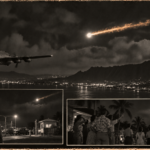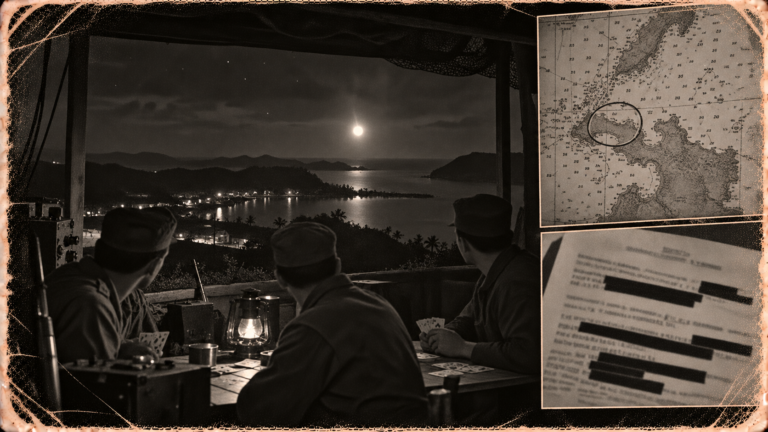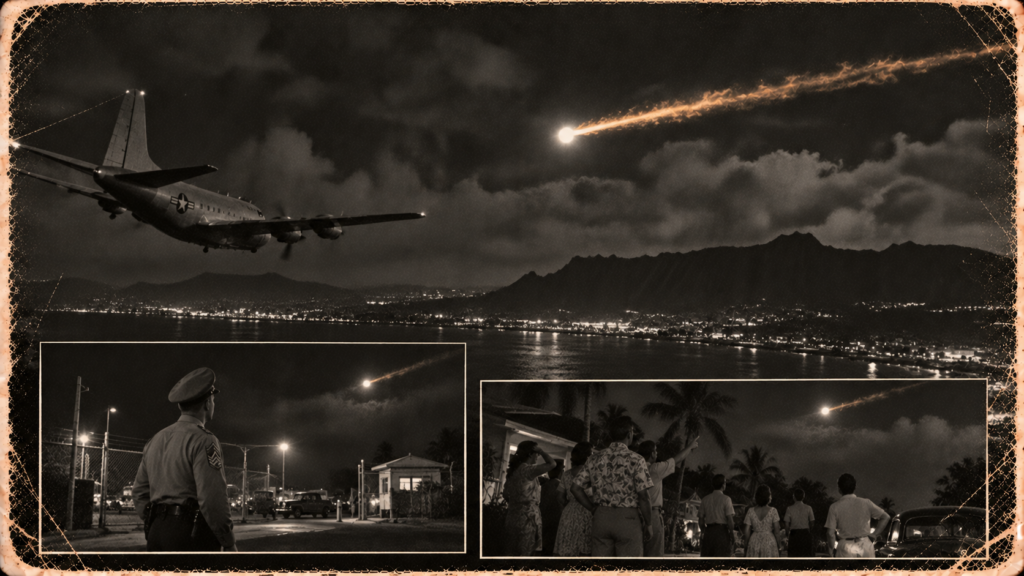
Hickam AFB and Honolulu, Hawaii, December 24, 1950: an orange-tailed white light seen by an Air Police sergeant, residents and a USAF transport crew.
THINK ABOUTIT UFO|UAP SIGHTINGS REPORT
1950: Hickam AFB and Honolulu, Hawaii
An Orange Flame Over Oahu and a Transport Plane at 7,000 Feet
At 10:32 on Christmas Eve, 1950, a technical sergeant of the 1500th Air Police Squadron standing watch at Hickam Air Force Base saw a bright white light race from Barbers Point past the base and into the clouds over the Koolau mountains, trailing an orange flame as long as the light itself. He thought it looked “like a squid going through water.” It held a straight, level course for 30 to 45 seconds and made no sound, and he was on his way to midnight church services.
He was not alone. Honolulu residents from Diamond Head to Koko Head jammed police, newspaper and Coast Guard switchboards, and about three minutes earlier a USAF transport carrying patients from Johnston Island to Hickam had flown through the wake of a similar light that cut across its nose at 7,000 feet. Blue Book kept the reports; the cards we have carry no evaluation. This Hickam AFB, Hawaii UFO sighting stands among the best-witnessed events of December 1950.
Date: December 24, 1950 (0832Z and 0829Z, December 25)
Sighting Time: About 10:29 to 10:33 p.m. Hawaii Standard Time
Day/Night: Night
Location: Hickam AFB and Honolulu, Oahu, Hawaii, and the airway near Hawaii on the Johnston-Hickam leg
Urban or Rural: Urban, with a sighting from the air over the sea
No. of Entity’s: Not Applicable
Entity Type: Not Applicable
Entity Description: Not Applicable
Hynek Classification: Nocturnal Light (NL)
Duration: About 30 to 45 seconds from Hickam; the Honolulu Star-Bulletin witnesses gave 3 to 5 seconds
No. of Object(s): One
Description of the Object(s): A white, circular light like fluorescent lighting with an orange flame-like tail about as long as the lit section; the pilot saw a large bright light that trailed an orange flame and sparks, and described no shape because the light was too bright
Shape/Size/Color of Object(s): Circular; about 18 inches across at arm’s length from Hickam; white with an orange tail
Distance to Object(s): Offshore from Hickam for the sergeant; the transport pilot put it within about 200 yards of his aircraft
Height & Speed: About 6,000 feet and high speed from Hickam, about 8,000 feet in the Pacific Division message; the pilot guessed over 300 mph and said it maneuvered like a fighter; speed greater than a jet in the MATS message
Number of Witnesses: The Air Police sergeant, many Honolulu residents, and the four-man crew of the transport; the Pacific Division message says at least ten others
Special Features/Characteristics: Orange flame and sparks; clouds lit up as it entered them; the transport crew flew through its “prop wash”; no navigation lights and no answer to the transport’s landing lights; no sound heard from Hickam
Case Status: Unexplained in the files reviewed; the record cards show no evaluation; one observer told CINCPAC he thought it a meteorite.
Source: Hq Pacific Division MATS Spot Intelligence Report, December 26, 1950; Hq USAF special inquiry letter of January 17, 1951; Air Intelligence Information Report IR-376-50, Hq MATS, December 27, 1950; Honolulu Star-Bulletin, December 25, 1950, p. 11; Project Blue Book record cards
Summary/Description: On Christmas Eve 1950 an orange-tailed white light crossed Oahu on a straight course, seen from Hickam, from Honolulu and from a USAF transport 7,000 feet over the sea.
Related Cases: Other December fireball reports in the December 1950 archive include three Los Alamos events (December 21, 24 and 28), all evaluated as meteors.
Detailed Report
The first report came from Hickam itself. At about 2232 hours on December 24, a technical sergeant of the 1500th Air Police Squadron, on duty with the Hawaiian Armed Services Police, saw a bright object offshore moving at high speed from the direction of Barbers Point, past the base and toward Lanikai, vanishing into low clouds over the Koolau mountains. The front of the object looked white like fluorescent lighting, circular, about 18 inches across at arm’s length, at roughly 6,000 feet. Behind it streamed an orange flame-like tail about as long as the lit section, narrowing to a point. “Like that of a squid going through water,” he said. He kept the light in view for 30 to 45 seconds; it held its course and height, flew parallel to the ground and made no noise. He had 19 years of service and told the investigator he had not been drinking, as he was on his way to midnight services. His sketch map of the island with the course marked in red pencil was attached to the action copy of the report.
The Honolulu Star-Bulletin reported on December 25 that many Honolulans called police, newspapers and radio stations about a mysterious light about 10:30 p.m. Callers described a streak flashing through the clouds from Diamond Head toward Wilhelmina Rise, a brilliant orange light lasting four or five seconds, or a brilliant orange flame about the size of a four-engine plane traveling parallel to the ground at great speed on what seemed a definite course. A drive-in theater patron saw it come from the Koko Head direction toward town; a Kahala resident saw it go from Diamond Head toward Koko Head, visible about five seconds, not over 5,000 feet. The police called the Coast Guard, which did not know what it was, and a Bishop Museum astronomer who had not seen it could not account for it from the descriptions.
The Pacific Division message of December 26 added that the object “followed a straight, level course at a constant speed greater than that of a jet aircraft,” at about 8,000 feet, with a diameter proportionate to a one-foot object ten feet from the observer and an orange flame extending twice its diameter, and that the clouds over the mountains lit up as it entered them. It was based on two observers, who indicated at least ten others had seen it, and CINCPAC had received similar reports, one from an observer who believed it a meteorite.
The second report came from the air. A USAF transport on the Johnston AFB to Hickam leg, evacuating patients, was cruising at 7,000 feet on a magnetic heading of 053 at about 0829Z when, in the pilot’s words, “a large bright light approached our aircraft from about three o’clock.” It “approached from the right and cut in front of us and climbed straight ahead of us out of sight.” The crew went through its “prop wash”; it trailed an orange flame and sparks, noticeable only as it pulled away and up. He guessed its speed at over 300 mph and said “it maneuvered like a fighter type aircraft.” The light was so bright he thought at first it was a floodlight, and he could not make out a shape although there was a full moon and no clouds. He flashed his landing lights and got no response; it carried no navigation lights. He judged it came within 200 yards, about 1,000 feet above his flight path. His navigator, copilot and engineer also saw it, and on landing he found others who had seen “the identical description.” He added: “This object had no resemblance to a falling star or meteor.” Hq MATS issued the report as IR-376-50 on December 27.
RESEARCHER’S NOTES
Meteor, Rocket or Something Else
- Classification issues: Two witness groups and a newspaper sample describe a single event, but they disagree on duration: 3 to 5 seconds in the newspaper, 30 to 45 seconds at Hickam, 45 to 46 seconds in the Pacific Division message. The longer times are hard to reconcile with a typical fireball and are the main reason the case stays open.
- Source chain assessment: The Hickam report and the transport pilot’s report come from official intelligence channels and were forwarded to Washington as a special inquiry, while the Star-Bulletin account is a press sample of public calls. All three agree on the orange flame, the straight course and the roughly 10:30 p.m. time.
- The meteor possibility: CINCPAC’s own correspondent, who thought it a meteorite from experience, and the Bishop Museum astronomer’s failure to account for it show the local experts were divided. The Air Force cards we have contain no evaluation, so this archive does not call it a meteor.
- The two timings: The Hickam report gives 2232 hours local, or 0832Z; the transport’s message gives 0829Z, about three minutes earlier. At Hawaii’s UTC-10 offset that places both on the evening of December 24, although the cards are dated December 25. The three-minute gap is consistent with one light moving along the route described.
- Close approach: The transport crew’s statement that the light came within about 200 yards, crossed their path and climbed away is the most unusual detail in the case, since a meteor would not turn across an aircraft’s path. It rests on one pilot’s account, though three crewmen are said to have seen it.
- Why it matters: It is a rare case in which a military police sergeant, an aircrew and the general public describe the same light on a holiday night, and the Air Force chose to send it to Washington as a special inquiry.
The Christmas Eve 1950 Hawaii sighting is a well-documented event whose cause is not settled in the files. A meteor remains a reasonable candidate, but the pilot’s account of a close, turning pass keeps the case on the unexplained side of the ledger.
“This object had no resemblance to a falling star or meteor.”
— USAF transport pilot, Air Intelligence Information Report IR-376-50, Hq MATS, December 27, 1950