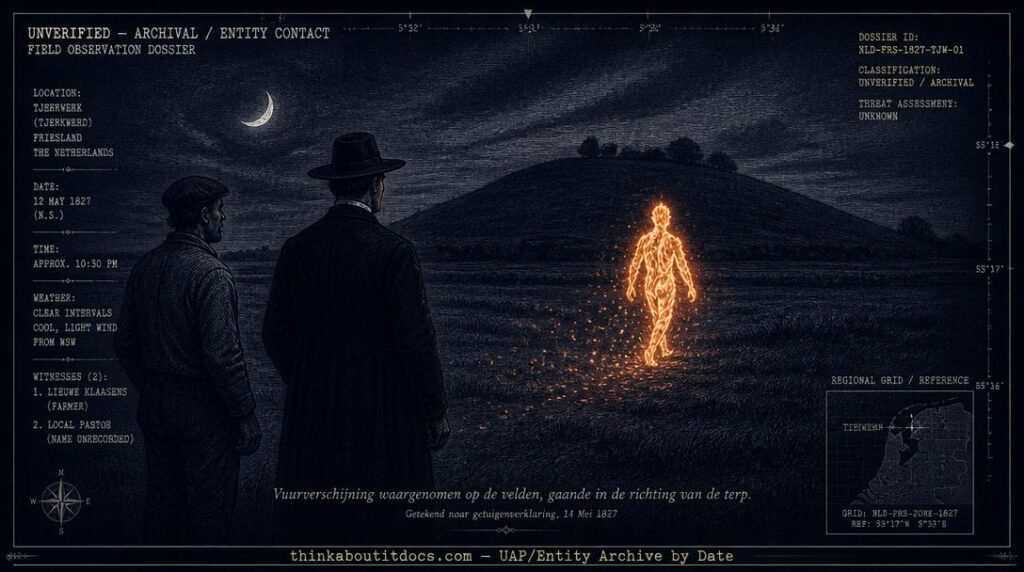
The 1827 Tjerwerk, Friesland encounter — witnesses Lieuwe Klaasens and a local pastor watched a fireball take human shape and walk to a nearby terp, where it rolled back into a ball and vanished.
THINK ABOUTIT ENTITY ENCOUNTER REPORT
1827: Tjerwerk, Friesland — The Fireball That Walked to a Burial Mound
A fireball descended out of the night sky over the Frisian countryside, landed near two witnesses, and did something no ordinary meteor does: it stood up. According to the account preserved in Frisian folkloric records, the burning mass took on human shape, walked with apparent purpose toward a nearby terp — one of the ancient artificial dwelling mounds built across Friesland over a thousand years earlier as flood defense and burial ground — and there, at its destination, rolled itself back into a ball and vanished into the air. The witnesses were not anonymous villagers repeating a half-remembered tale; one was a named local man, Lieuwe Klaasens, and the other a local pastor — a specific pairing of testimony that gave the account enough institutional weight to survive in print.
Terpen are not incidental scenery in this story. They are among the oldest continuously significant landscape features in the northern Netherlands, purpose-built mounds that Frisian communities have used for refuge, settlement, and burial since antiquity. That the fireball-entity walked specifically to one, rather than in any other direction across open farmland, is the detail that has kept this case in the folklore record for two centuries — a fire that seemed to know exactly where it was going.
Date: 1827 (specific date not recorded)
Sighting Time: Night
Day/Night: Night
Location: Tjerwerk (also rendered Tjerkwerd), Friesland, The Netherlands
Urban or Rural: Rural
No. of Entity(‘s): One
Entity Type: Humanoid — formed from a landed fireball
Entity Description: A fireball that descended from the sky, landed, and assumed human shape; walked (“strolled”) toward a nearby terp; upon arrival, rolled itself back into a ball and disappeared into the air
Hynek Classification: Not Applicable — non-craft entity contact, outside the standard Hynek close encounter scale
Duration: Not recorded — encompassed descent, landing, transformation, a walk of unspecified distance to the terp, and a final transformation and disappearance
No. of Object(s): Not Applicable — the “object” (fireball) and the entity are the same phenomenon at different stages
Description of the Object(s): Not Applicable
Shape of Object(s): Not Applicable
Size of Object(s): Not Applicable
Color of Object(s): Not Applicable
Distance to Object(s): Not Applicable
Height & Speed: Descended from the sky, landed nearby the witnesses, then moved on foot at walking pace toward the terp
Number of Witnesses: Two — Lieuwe Klaasens and a local pastor
Special Features/Characteristics: Fireball-to-humanoid transformation on landing; directed, purposeful movement toward a specific ancient landmark (the terp); reverse transformation (humanoid to ball) and disappearance upon arrival
Case Status: Unexplained.
Source: M.D. Teenstra; K. ter Laan, Folkloristisch Woordenboek van Nederland
Summary/Description: In 1827, a man named Lieuwe Klaasens, together with a local pastor, saw a fireball descend from the night sky and land near them in Tjerwerk, Friesland. The fireball took on human shape and walked toward a small terp — an ancient Frisian burial and dwelling mound. Upon reaching it, the humanoid figure rolled itself back into a ball and disappeared into the air. The account is preserved in K. ter Laan’s Folkloristisch Woordenboek van Nederland, drawing on earlier material recorded by M.D. Teenstra.
Related Cases: 1825–1834: UFO|UAP & Entity Sightings Archive
Detailed Report
The case is preserved through Dutch folkloric scholarship rather than a contemporaneous newspaper or scientific journal — it appears in K. ter Laan’s Folkloristisch Woordenboek van Nederland (Folkloric Dictionary of the Netherlands), which drew in part on earlier material gathered by the 19th-century Frisian writer and traveler M.D. Teenstra. This puts the case in a different evidentiary category from scientific-journal cases like the Saarbrücken meteorite or Bloxam’s Pacific fireball: it survives as documented regional folklore, attributed to a specific named witness and a second, professionally identifiable witness (a pastor), rather than as an eyewitness letter or diary entry.
According to the account, Lieuwe Klaasens and a local pastor together observed a fireball descend from the sky and land in the vicinity. Rather than extinguishing or continuing on a ballistic path, as an ordinary meteor or bolide would, the fireball took on the shape of a human figure. This humanoid form then walked — the record specifically uses language suggesting an unhurried pace, a “stroll” — toward a nearby terp, one of the artificial mounds built by Frisian communities over roughly two millennia for flood protection, settlement, and burial. Upon reaching the terp, the figure reversed its transformation, rolling itself back into a compact ball shape before disappearing into the air.
No further details on the witnesses, the exact date within 1827, or any subsequent investigation have surfaced in available sources. The location name “Tjerwerk” as recorded does not correspond exactly to any current Frisian place name; the closest modern match is Tjerkwerd, a small village in the Súdwest-Fryslân municipality of Friesland, and it is plausible the case’s location name is a period spelling variant or transcription of that village, though this has not been independently confirmed.
RESEARCHER’S NOTES
The Frisian Fireball — Netherlands 1827 and the Destination That Wasn’t Random
- Classification Issues: This case is filed as an entity encounter rather than a UFO sighting, consistent with archive policy for cases where the phenomenon is described taking humanoid form with no separate craft involved. The fireball and the entity are the same object at different stages, which makes standard object-description fields (shape, size, color) not applicable in the way they would be for a conventional aerial sighting.
- Source Chain Assessment: The case’s survival through Dutch folkloric scholarship (Teenstra, then ter Laan) rather than a contemporaneous press or scientific account places it closer in evidentiary weight to the archive’s other folklore-preserved cases — a named local witness plus a second, identifiable witness (the pastor) is a stronger pairing than most anonymous folk accounts, but the absence of an exact date or a primary eyewitness document limits how far the case can be independently verified.
- Pattern Context: Fireball-to-humanoid transformation is a recurring motif in this archive’s European folk record — the same basic pattern (a burning or luminous mass assuming human shape) appears independently in cases spanning multiple countries and centuries. What makes the Tjerwerk case distinctive within that pattern is the directed movement toward a specific, named type of ancient landmark rather than a random or unexplained trajectory, suggesting — if the account is taken at face value — some form of apparent intentionality behind the phenomenon’s destination.
- Geographic and Historical Context: Terpen carry deep cultural and historical weight in Friesland — continuously significant since antiquity as sites of habitation, refuge from flooding, and burial. A folk account describing an anomalous entity moving specifically to one, rather than to a church, a farmhouse, or open ground, situates the case within a long regional tradition of terpen as liminal or spiritually significant places, independent of whatever the underlying phenomenon actually was.
Two men in the Frisian countryside watched something fall from the sky, stand up, and walk with apparent purpose to one of the oldest kinds of landmark their region has to offer, before folding itself away and vanishing. The record gives no explanation and very little corroborating detail — only a name, a companion witness, and a destination too specific to read as coincidence. It remains one of this archive’s clearest examples of a fireball behaving like something that knew exactly where it needed to go.
“The fireball took the shape of a human; it then strolled towards a small ‘terp’… There, the fiery human rolled itself up to a ball and disappeared in the air.”