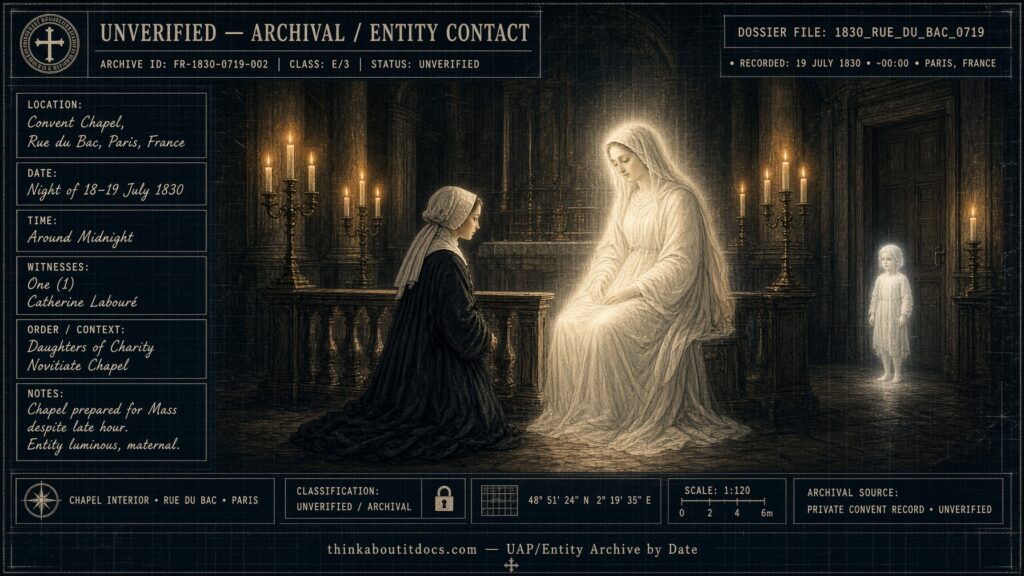
The July 18, 1830 Rue du Bac encounter — novice Catherine Labouré, guided by a luminous child, knelt before a radiant female figure who foretold the fall of the French throne nine days before it happened.
THINK ABOUTIT ENTITY ENCOUNTER REPORT
1830: Paris, France — Catherine Labouré’s Rue du Bac Nocturnal Contact
Just before midnight on July 18, 1830, a 24-year-old novice in a Paris convent was woken by the voice of a child who should not have been there — a boy of four or five, luminous, who called her by name and told her to come to the chapel because “the Blessed Virgin is waiting for you.” Catherine Labouré followed the child down darkened hallways to a chapel door that swung open at his touch, into a room blazing with light as though prepared for a midnight Mass. Thirty minutes later, at the stroke of midnight, she heard what she described as the rustle of a silk dress — and looked up to see a luminous woman seated in the spiritual director’s chair, who spoke to her of coming catastrophe: sorrow for France, an overturned throne, the whole world plunged into misery.
Nine days later, on July 27, 1830, revolution broke out in the streets of Paris. King Charles X’s throne — the very one the figure in the chapel had reportedly named — was overturned within the week. Catherine’s spiritual director, who had heard her account with open skepticism, found that skepticism considerably harder to maintain once the prediction played out in the newspapers.
Date: Night of July 18–19, 1830
Sighting Time: Approximately 11:30 PM to after midnight
Day/Night: Night
Location: Convent chapel, Rue du Bac, Paris, France
Urban or Rural: Urban
No. of Entity(‘s): Two — a child guide and a luminous adult female figure
Entity Type: Humanoid — a luminous child (identified by the witness as her guardian angel) and a luminous adult woman
Entity Description: A child of about four or five, luminous, who woke and guided the witness to the chapel; a beautiful young woman surrounded by a blaze of white light, seated in a chair, wearing a robe described in later accounts as dawn-colored with a white veil
Hynek Classification: Not Applicable — non-craft entity contact, outside the standard Hynek close encounter scale
Duration: Roughly 30 minutes from the initial waking to the main encounter, with the encounter itself of unspecified length
No. of Object(s): Not Applicable
Description of the Object(s): Not Applicable
Shape of Object(s): Not Applicable
Size of Object(s): Not Applicable
Color of Object(s): Not Applicable
Distance to Object(s): Not Applicable
Height & Speed: Not Applicable — the witness approached and knelt beside the seated figure; no aerial movement described
Number of Witnesses: One direct witness (Catherine Labouré); reported afterward to her spiritual director, Father Jean-Marie Aladel
Special Features/Characteristics: Chapel described as suddenly lit as if for midnight Mass; door reportedly opened without being touched or unlocked; specific, dated predictive content that appeared to be confirmed by events nine days later; the witness experienced two further apparitions from the same figure in the following months (November 27 and December 1830)
Case Status: Unexplained.
Source: Catherine Labouré’s own testimony as recorded by the Daughters of Charity and the Association of the Miraculous Medal; canonical inquiry records of Archbishop Hyacinthe-Louis de Quélen, Archdiocese of Paris (1836)
Summary/Description: On the night of July 18, 1830 — eve of the feast of St. Vincent de Paul — 24-year-old novice Catherine Labouré was woken around 11:30 PM by a luminous child who called her by name and led her to the convent chapel, which she found ablaze with light. About thirty minutes later, at midnight, she heard the rustle of a silk dress and saw a luminous young woman seated in the spiritual director’s chair. Catherine knelt and placed her hands in the figure’s lap. The figure told her the times were evil, that sorrow would befall France, that the throne would be overturned, and that the world would be plunged into misery — then gave her a specific mission. Nine days later, revolution broke out in Paris and the French throne was overturned within the week. Catherine experienced two further apparitions from the same figure that year, on November 27 and in December, the first of which included a design later struck as the “Miraculous Medal.”
Related Cases: 1825–1834: UFO|UAP & Entity Sightings Archive
Detailed Report
Catherine Labouré entered the novitiate of the Daughters of Charity at the Rue du Bac motherhouse in Paris on April 21, 1830, at age 24. According to her own later testimony, on the night of July 18 — the eve of the feast day of St. Vincent de Paul, founder of the order, to whom Catherine held a particular devotion — she prayed earnestly for the grace to see the Virgin Mary before falling asleep, convinced she would be granted the vision that very night.
She was woken by a bright light and the voice of a child, who called, “Sister Labouré, come to the chapel; the Blessed Virgin awaits you.” Catherine hesitated, uncertain of the hour, and the child reassured her: it was half past eleven, everyone else was asleep, and she was expected. She dressed and followed the child through hallways where the lights were already burning. At the chapel door, locked as usual, the child’s touch alone caused it to swing open. Inside, Catherine found the chapel blazing with candlelight as though prepared for a midnight Mass.
She knelt at the communion rail. At midnight, she heard what she described as the rustling of a silk dress, and saw a young woman of medium height, indescribably beautiful, descend and take a seat in the chapel’s spiritual director’s chair. The child announced, “Here is the Blessed Virgin.” Catherine went to the figure and knelt with her hands resting in the figure’s lap. During the conversation that followed, the figure told Catherine that the times were very evil, that sorrows would befall France, that the throne would be overturned, and that the whole world would be plunged into every kind of misery — before giving Catherine a specific mission she was to carry out.
Catherine reported the encounter to her spiritual director, Father Jean-Marie Aladel, who received the account with open skepticism. That skepticism was tested nine days later: on July 27, 1830, the July Revolution broke out in Paris, and within days King Charles X had abdicated and fled — the throne, as reportedly foretold, overturned. Catherine experienced a second apparition from the same figure on November 27, 1830, during evening meditation, in which the figure was said to appear standing on a globe with rays of light streaming from her hands and to reveal the design of a medal — a large “M” surmounted by a cross, two flaming hearts, and twelve encircling stars — that she asked to be struck and distributed. A third and final apparition followed in December 1830. Once the medal was produced and distributed, it rapidly acquired the popular name “the Miraculous Medal,” and a formal canonical inquiry opened by Archbishop Hyacinthe-Louis de Quélen of Paris concluded in 1836 that Catherine’s character was sound and the apparitions worthy of belief.
RESEARCHER’S NOTES
The Rue du Bac Contact — Paris 1830 and the Predictive Detail That Landed
- Classification Issues: Filed as an entity encounter with no craft component, consistent with archive treatment of visionary/contact cases such as Joseph Smith’s 1820 and 1823 visitations elsewhere in this record. The case is catalogued here as a documented anomalous contact event with specific predictive content — not as a matter of religious doctrine, which is outside this archive’s scope. The child-guide and adult-figure entities are recorded as separate rows above since the witness described them as distinct beings interacting with one another.
- Source Chain Assessment: This case has an unusually thorough institutional paper trail for an early-19th-century contact account: a single named, identifiable witness who lived a further 46 years in the same religious order without seeking personal recognition for the events (her role was not publicly revealed until near the end of her life); a formal ecclesiastical canonical inquiry conducted within six years of the events; and a shrine and continuously operating devotional record extending to the present day. Few cases in this decade’s archive have been subject to anything resembling a formal institutional investigation.
- Pattern Context: The specific, dated predictive content — an “overturned throne” reportedly named nine days before the actual overthrow of Charles X — is the detail that most invites analytical attention independent of religious interpretation. Precognitive or predictive elements delivered during contact events recur elsewhere in this archive (compare the 1816 Gallardon, France entity encounter, in which a stranger’s secret message to King Louis XVIII preceded his abdication the following morning), suggesting a recurring motif of contact-adjacent political prediction in the French record specifically across this period.
- Geographic and Historical Context: Paris in July 1830 was a city on the edge of political rupture — Charles X’s increasingly unpopular ordinances were already straining public patience when Catherine reported her vision, meaning the “overturned throne” prediction arrived during a period when political upheaval was a live possibility rather than a bolt from the blue. That context does not resolve the case, but it belongs in any assessment of how predictable the prediction actually was at the time it was made.
A 24-year-old novice, alone in a chapel lit as if for midnight Mass, knelt before a luminous figure who told her a throne would fall — and nine days later, it did. Catherine Labouré carried the rest of that night’s mission quietly for over four decades, telling no one beyond her confessor who she was until she was near death. Whatever happened in that Paris chapel on July 18, 1830, it left behind a medal worn by millions, a formal Church inquiry, and a predictive detail that arrived nine days ahead of the event it named.
“The times are very evil. Sorrows will befall France; the throne will be overturned. The whole world will be plunged into every kind of misery.”