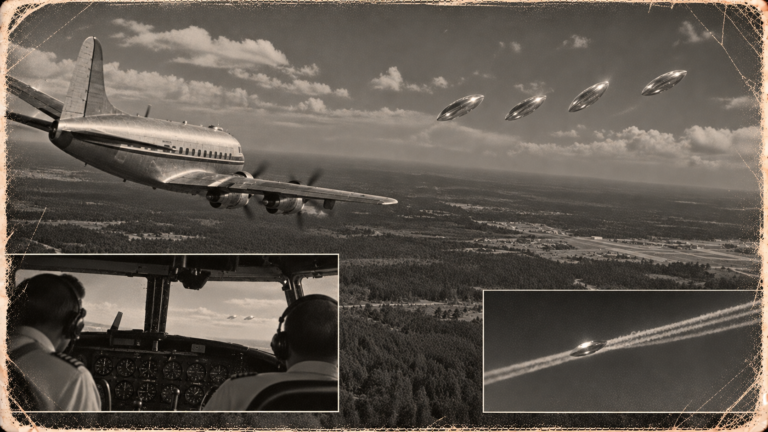
The September 1, 1808 Moscow Kremlin sighting — a long, straight luminous plate with a flaring oval flame at its leading edge, documented in the personal papers of Senator Peter Poludensky and authenticated by the Russian State History Museum.
THINK ABOUTIT UFO|UAP SIGHTINGS REPORT
September 1, 1808: Moscow, Russia — The Kremlin Luminous Plate
Most 19th-century aerial anomaly reports survive as fragments — a line in a newspaper, a paragraph in a scientific journal, a folk memory written down decades after the fact. The September 1, 1808 Moscow Kremlin case is different. It survives as a formal written account, complete with precise timing, measured dimensions, and an attached sketch, preserved for nearly two centuries in the personal archive of a sitting Russian senator before a manuscript researcher rediscovered it in the Russian State History Museum. It is, by the documentary standard of its era, about as good a record as the early 19th century could produce — and it describes a long, straight, glowing plate hanging motionless in the sky directly over one of the most recognizable landmarks in the country.
The account comes from the personal papers of Senator Peter Poludensky, found in the manuscript department of the Russian State History Museum by researcher Alexander Afanasyev. Poludensky’s household witnessed, on the evening of September 1, 1808, an object described with unusual technical precision for the period — its arc of ascent measured in degrees, its dimensions given in arshins, its behavior recorded almost second by second. Afanasyev, examining the paper stock and handwriting style of the original document, concluded it was not a later fabrication. What remains is one of the earliest formal government-adjacent UAP records in Russian history.
Date: September 1, 1808
Day/Night: Night
Location: Sullivan, Hancock County, Maine, USA
Urban or Rural: Rural
No. of Entity(‘s): One
Entity Type: Humanoid — luminous female apparition
Entity Description: A globe of red-tinged light approximately two feet in diameter that transformed first into a child-sized female figure, then into a full-grown adult woman in a dress, with rectilinear rays of light emanating from the head and reaching to the ground
Hynek Classification: Not Applicable — non-craft entity contact, outside the standard Hynek close encounter scale
Duration: Not recorded — sequence described as occurring across several minutes (initial sighting, approach, and transformation)
No. of Object(s): Not Applicable
Description of the Object(s): Not Applicable
Shape of Object(s): Not Applicable
Size of Object(s): Not Applicable
Color of Object(s): Not Applicable
Distance to Object(s): Not Applicable
Height & Speed: Entity closed from approximately 12 ft to 11 ft distance from the witness at high speed before transforming
Number of Witnesses: One direct witness to this specific encounter (Rev. Abraham Cummings); part of a wider case with 31 sworn affidavits from separate incidents
Special Features/Characteristics: Progressive size-and-form transformation; rectilinear rays of light from the head reaching to the ground; entity closed distance under its own apparent volition
Case Status: Unexplained.
Source: Rev. Abraham Cummings, Immortality Proved by the Testimony of Sense (1826); Chris Aubeck, Return to Magonia; Marcus LiBrizzi & Dennis Boyd, The Nelly Butler Hauntings: A Documentary History (2010)
Summary/Description: The Reverend Abraham Cummings, having traveled to Sullivan, Maine to debunk widely circulated reports of a ghost haunting the Blaisdell family, was informed that two persons had seen what appeared to be a specter in a nearby field. Going to check ten minutes later, he first mistook a white mass on the ground for a rock. Three minutes on, he saw it had risen into the air as a red-tinged luminous globe roughly two feet across. It approached him at high speed to within eleven feet, took the form of a child-sized female figure, then expanded to adult height with rays of light streaming from its head to the ground. Others in the area independently reported a similar luminous female figure accompanied by a small glowing cloud.
Related Cases: 1800–1809: UFO|UAP & Alien Sightings Archive
Detailed Report
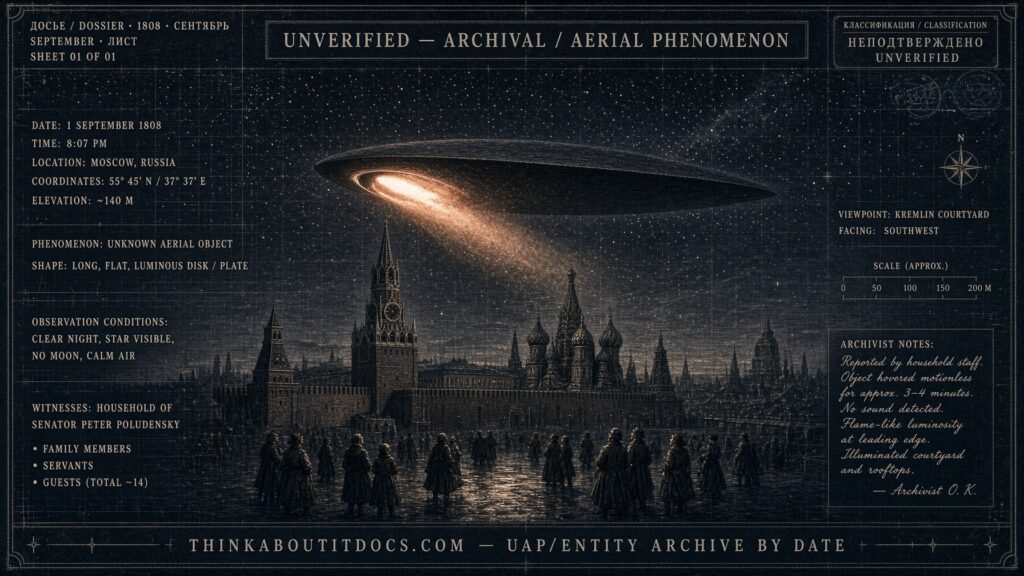
According to the document recovered by Alexander Afanasyev from the personal archive of Senator Peter Poludensky, held in the manuscript department of the Russian State History Museum, the sighting began at 8:07 PM on September 1, 1808. The night sky was described as clear and “sown with stars.” Witnesses were first drawn to the phenomenon by a loud cracking sound. Looking up, they saw an object rising in an arc over the horizon, climbing from roughly 55 degrees to nearly 90 degrees of elevation in what the account describes as an instant.
The object then came to a stop among the clouds, positioned as if directly over the Kremlin, and resolved into a distinct shape: a long, straight plate approximately nine arshin (6.35 meters) in length and half an arshin (0.35 meters) thick. On its forward edge, oriented to the southwest, an oval flame flared into view — roughly two arshin (1.4 meters) long and one and a half arshin (about one meter) thick, described as burning with a radiance comparable to phosphor.
The flame reportedly floated in a circular pattern without visible sparks or open combustion, yet lit the surrounding area as brightly as daylight. After a period, the flame extinguished and the light faded, but the plate itself remained visible, moving smoothly and perpendicularly upward. It climbed until it reached star altitude and remained visible for approximately two more minutes before becoming invisible — not through any visible departure or dimming, but, in the account’s own words, “due to the extraordinary height” it had achieved.
A sketch was included with the original document, depicting the object’s shape. Afanasyev’s assessment, based on the physical characteristics of the paper and the period-consistent handwriting, ruled out the likelihood of the account being a later hoax or fabrication inserted into the senator’s papers.
RESEARCHER’S NOTES
The Kremlin Plate — Moscow 1808 and the Weight of a Documented Record
- Classification Issues: This case is filed here as DD on the Hynek scale — a structured, detailed object rather than a simple nocturnal light — given the precise dimensions, sustained hover phase, and distinct flame-emission event described. No radar corroboration exists to support an RV classification, and no occupants or craft interaction were reported, so it does not rise to a close-encounter tier.
- Source Chain Assessment: The chain of custody here is unusually clean for a case this old: private senatorial papers, held in family archive, later transferred to the manuscript department of a state historical museum, examined and authenticated by a named researcher (Afanasyev) on the basis of period-consistent paper and handwriting. That is a materially stronger provenance than the great majority of contemporaneous 1800s reports, which typically survive only as newspaper reprints or secondhand folklore.
- Physical Evidence and Evidentiary Weight: The precision of the account — angular elevation given in degrees, object dimensions given in a period-standard unit of measure (the arshin, roughly 0.71 meters), and a described maneuver sequence — reads less like folk testimony and more like a structured observational log, consistent with the profile of an educated, literate household attached to the Tsarist court system. No period astronomical explanation (bolide, aurora, ball lightning) neatly accounts for the described structural detail — the flat elongated plate shape, the fixed hover directly over a specific landmark, and light-source behavior localized to one edge of the object rather than the object as a whole.
- Geographic and Historical Context: The 1808 Moscow case predates the more widely circulated 19th-century Russian aerial reports by decades and sits in an unusual position: it is neither a peasant folk account nor a formal state document in the modern sense, but the private record of a government official, later authenticated by a state historical institution. It occurred four years before Napoleon’s invasion of Russia and the burning of Moscow — worth noting as period context, though the account itself makes no connection to the coming conflict.
The September 1, 1808 Moscow Kremlin case remains one of the best-documented pre-industrial aerial anomaly reports in the Russian archive — precise, dated, measured, sketched, and preserved through an unusually clean chain of custody from private senatorial papers to state museum authentication. Whatever hovered over the Kremlin that September evening, it did so long enough, and was described carefully enough, to leave behind one of the 19th century’s most exacting eyewitness records.
“Having passed this distance in an instant, it stopped among the clouds as if over the Kremlin and looked like a long straight plate… lighting everything around as broad daylight.”